
The Ethereum Name Service (ENS) community is facing renewed governance debate after ENS co-founder Nick Johnson voted against renewing the protocol’s Security Council, using his significant delegated voting power to block the proposal.
Johnson has rejected claims that he manipulated the vote, arguing his decision was based on governance concerns rather than an attempt to control the outcome. The incident has reignited discussions around voting concentration, decentralization, and the future governance structure of one of Ethereum’s most important infrastructure projects.
Security Council Renewal Fails to Gain Approval
The proposal sought to renew ENS DAO’s eight-member Security Council for another two years before its current mandate expires in July 2026.
The council serves as an emergency safeguard, with authority to block malicious governance proposals under exceptional circumstances through a multisignature approval process.
Governance took place in two stages:
- An initial off-chain Snapshot vote
- A final on-chain executable vote
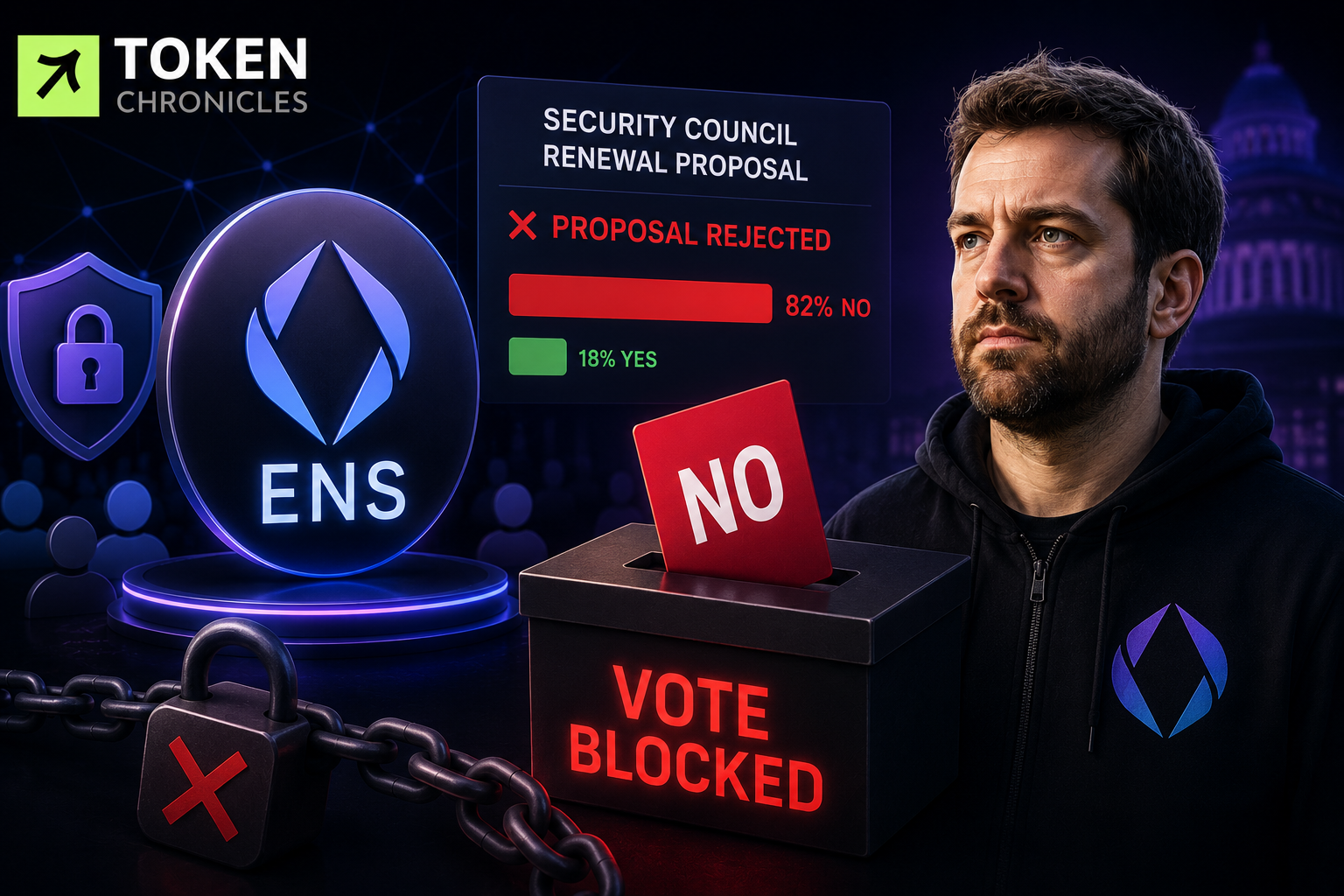
While the Snapshot proposal passed, the on-chain vote has struggled to reach approval, with roughly 82% of participating votes opposing the proposal. Johnson’s delegated voting power represents nearly 80% of votes cast in the current proposal, making his opposition decisive.
Johnson Explains His Decision
Johnson said he deliberately abstained during the Snapshot phase while expressing support for renewing the Security Council in principle.
However, he opposed the executable proposal because he believed his concerns had not been addressed.
According to Johnson, several current council members appeared willing to use their emergency veto powers to block proposals based on personal disagreements rather than genuine security threats.
He argued that the Security Council should function strictly as a constitutional safeguard against protocol compromise or governance attacks—not as a political body capable of influencing ordinary governance decisions.
Johnson has instead expressed support for an alternative Security Council proposal introduced this week that would revise both the council’s mandate and its operating rules.
Community Raises Governance Concerns
The vote has triggered widespread discussion across the Ethereum community.
Several contributors argued that the outcome demonstrates how concentrated voting power can undermine decentralized governance when a single delegate controls enough tokens to determine the result.
Some long-time ENS contributors described the situation as damaging for the protocol’s governance model, while others questioned whether any decentralized organization should allow one participant to exercise such significant influence.
Supporters of Johnson, however, argue that delegated governance naturally allows token holders to entrust voting authority to experienced contributors and that his actions were consistent with his publicly stated concerns.
Alternative Proposal Gains Attention
Alongside the contested renewal vote, ENS Labs has introduced a separate proposal to restructure the Security Council.
The revised framework would:
- Replace the current council with a newly appointed eight-member group.
- Increase the approval threshold for emergency interventions from 4-of-8 members to 5-of-8.
- Clarify that the council’s role is limited to protecting the protocol from security threats rather than influencing governance decisions.
Johnson has publicly indicated that he supports this revised governance framework.
Broader Governance Reform Underway
The controversy comes during a broader period of governance reform within the ENS ecosystem.
Earlier this month, ENS Labs proposed shifting several operational responsibilities—including treasury management, grants administration, and endowment oversight—from the DAO to the ENS Foundation.
Supporters argue the change would improve operational efficiency, while critics believe it could further centralize decision-making within the foundation’s leadership.
The debate follows another major strategic decision earlier this year, when ENS Labs abandoned plans to launch its own Layer-2 blockchain and instead chose to deploy the upcoming ENSv2 upgrade directly on Ethereum’s mainnet.
Why It Matters
The latest governance dispute highlights one of the biggest challenges facing decentralized autonomous organizations: balancing efficient decision-making with decentralization. While delegated voting allows experienced participants to represent token holders, concentrated voting power can raise concerns over governance influence and community representation.
How ENS resolves its Security Council dispute and broader governance reforms could shape not only the protocol’s future but also serve as an important case study for governance across the wider Ethereum ecosystem.