

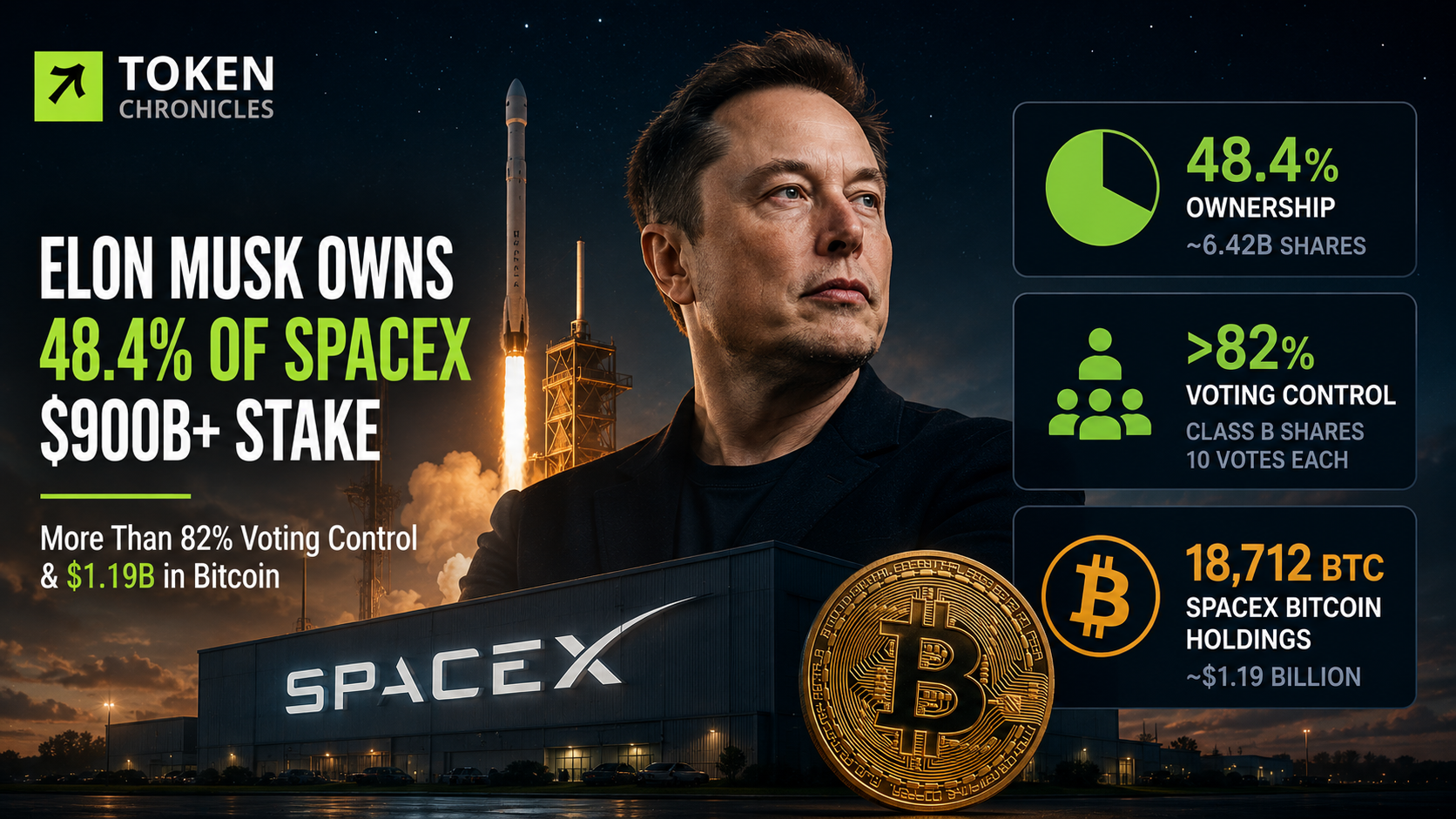
Elon Musk holds approximately 48.4% of SpaceX, representing roughly 6.42 billion shares valued at more than $900 billion, according to a recent SEC filing.
But Musk’s influence over the company extends far beyond his economic ownership.
Because SpaceX uses a dual-class share structure, Musk controls more than 82% of the company’s voting power. That gives him overwhelming influence over corporate decisions despite owning less than half of the company’s equity.
The distinction between economic ownership and voting control has become increasingly important as SpaceX’s valuation approaches $2 trillion and the company continues to hold a substantial Bitcoin treasury.
Musk’s SpaceX stake includes multiple share classes
Musk reported sole voting and dispositive power over 6,418,547,515 SpaceX shares as of June 30.
His reported position consists of several different holdings.
Trusts for which Musk serves as trustee hold approximately 849.5 million Class A shares and 3.92 billion Class B shares. Musk also directly owns around 1.30 billion restricted Class B shares.
In addition, options covering approximately 350 million Class B shares contribute to the reported total.
The headline 48.4% ownership figure, however, does not necessarily represent the portion of SpaceX that Musk has fully vested today.
Some of Musk’s equity remains subject to demanding performance and vesting conditions tied to milestones that include extremely high company valuations, orbital data centers and the establishment of a Mars settlement with a population of one million people.
As a result, his ultimate economic ownership could differ from the headline figure depending on which awards ultimately vest.
Dual-class shares give Musk overwhelming voting control
The most important element of Musk’s SpaceX position is the company’s dual-class share structure.
Class A shares carry one vote per share, while Class B shares carry 10 votes each.
That structure allows Musk to maintain control over SpaceX’s corporate decisions without owning a majority of the company’s economic equity.
The arrangement effectively separates two concepts that investors often associate with one another: ownership and control.
Musk owns less than 50% of SpaceX but commands more than 82% of its voting power.
There is also an important conversion mechanism.
When Class B shares held by an insider are transferred to an outside investor, those shares convert into Class A stock. That means the enhanced 10-vote power can disappear when the shares leave the insider-controlled structure.
For public shareholders, this creates a significant limitation. They can acquire an economic interest in SpaceX without gaining anything close to proportional influence over major corporate decisions.
SpaceX’s Bitcoin is also effectively under Musk’s control
The governance structure has implications beyond SpaceX’s stock.
The company reportedly holds 18,712 BTC, a Bitcoin position worth roughly $1.19 billion at the price referenced in the supplied report.
SpaceX has held the Bitcoin since 2021 and has not reported selling the position.
Because Musk controls more than 82% of SpaceX’s voting power, he retains enormous influence over decisions involving the company’s balance sheet, including how its Bitcoin treasury is managed.
That does not mean Musk personally owns SpaceX’s Bitcoin.
The BTC belongs to SpaceX, while public shareholders own equity in the company.
However, shareholders have limited ability to directly influence what SpaceX does with its digital-asset holdings because of the company’s concentrated voting structure.
The distinction becomes particularly important when Bitcoin prices move sharply and the value of SpaceX’s treasury changes alongside the company’s broader valuation.
Institutional investors have questioned the governance structure
The concentration of voting power has attracted attention from institutional investors.
The Council of Institutional Investors, which represents pension funds and asset managers, previously called for a single-class share structure.
Its argument reflects a broader concern among governance-focused investors: shareholders should generally have voting rights that correspond more closely to their economic ownership.
SpaceX nevertheless proceeded with its public-market structure while maintaining the dual-class arrangement.
For investors, this means purchasing SpaceX shares provides exposure to the company’s growth but does not provide proportional influence over its strategic direction.
SpaceX’s valuation has surged despite volatility
SpaceX’s growing valuation has made Musk’s stake one of the world’s most valuable individual corporate holdings.
The company raised approximately $85.7 billion through its June IPO, reaching a market capitalization of roughly $2 trillion on its first day of trading.
The stock subsequently experienced significant volatility, falling nearly 33% during July.
August brought a sharp recovery, with shares rising approximately 30% during the month on the back of stronger revenue growth and the expiration of an initial lockup period.
The company’s reported revenue growth has further strengthened investor interest, although the stock remains subject to significant swings given SpaceX’s enormous valuation and exposure to ambitious long-term projects.
Norway adds institutional exposure to SpaceX
Institutional interest has also emerged.
Norway’s sovereign wealth fund recently disclosed a substantial position in SpaceX, reportedly worth approximately $1.2 billion.
The investment illustrates how large institutional investors are gaining exposure to SpaceX through public equity even as the company maintains an unusually concentrated governance structure.
Other investors have also shown interest in SpaceX’s artificial intelligence operations, including its Grok-related business.
At the same time, some market observers have warned that the rapid rise in SpaceX’s valuation could create broader risks for equity and crypto markets if the company’s shares experience a significant reversal.
Lockup expirations could increase the public float
Additional lockup expirations are expected in the coming months.
As restrictions expire, more Class A shares could become available for trading, potentially increasing the company’s public float and liquidity.
However, increased share availability does not necessarily translate into greater shareholder influence over SpaceX.
Musk’s enhanced Class B voting rights remain structurally separate from the growing number of publicly traded Class A shares.
In other words, the ownership base can become more widely distributed without materially changing who controls the company.
What Musk’s SpaceX ownership means for investors
SpaceX presents an unusual combination of enormous economic value, concentrated voting power and significant exposure to emerging technologies.
Musk owns approximately 48.4% of the company, but his Class B shares give him more than 82% of the voting power.
That control extends to decisions involving SpaceX’s capital allocation, strategic direction and Bitcoin holdings.
For investors, the key issue is therefore not simply how much of SpaceX Musk owns.
It is how much control he retains over the assets and decisions that determine the value of the shares investors own.
SpaceX’s Bitcoin treasury adds another layer to that equation. Investors gain indirect exposure to the company’s BTC holdings, but they cannot independently decide whether those assets should be held, sold or expanded.
As SpaceX continues to mature as a public company, future lockup expirations may increase the number of shares available to investors, but they are unlikely to materially dilute Musk’s voting dominance under the current structure.
The result is a company where economic ownership is becoming increasingly public, while corporate control remains firmly concentrated in Musk’s hands.