
The decentralized finance (DeFi) industry is undergoing a significant security transformation as developers, auditors, and risk-management teams respond to a growing wave of sophisticated exploits targeting blockchain infrastructure. Following several high-profile cross-chain vulnerabilities, protocol operators are accelerating efforts to build more resilient systems capable of identifying and neutralizing threats before they escalate into major losses.
Rather than relying solely on traditional audits and reactive security measures, the industry is increasingly embracing proactive defense frameworks designed to protect user funds, maintain protocol stability, and strengthen confidence across the broader DeFi ecosystem.
Security Moves to the Top of the DeFi Agenda
Over the past several years, decentralized finance has evolved into a multi-billion-dollar ecosystem supporting lending, trading, staking, derivatives, and cross-chain asset transfers. However, as the industry has grown, so has the sophistication of attackers.
Recent cross-chain bridge exploits have highlighted one of the sector’s most vulnerable areas: the movement of assets between different blockchain networks. These incidents have exposed weaknesses in smart contracts, validation systems, and bridge architectures, prompting developers to rethink how security should be approached in a multi-chain world.
As a result, security is no longer viewed as a feature added after deployment—it is increasingly becoming a foundational design principle.
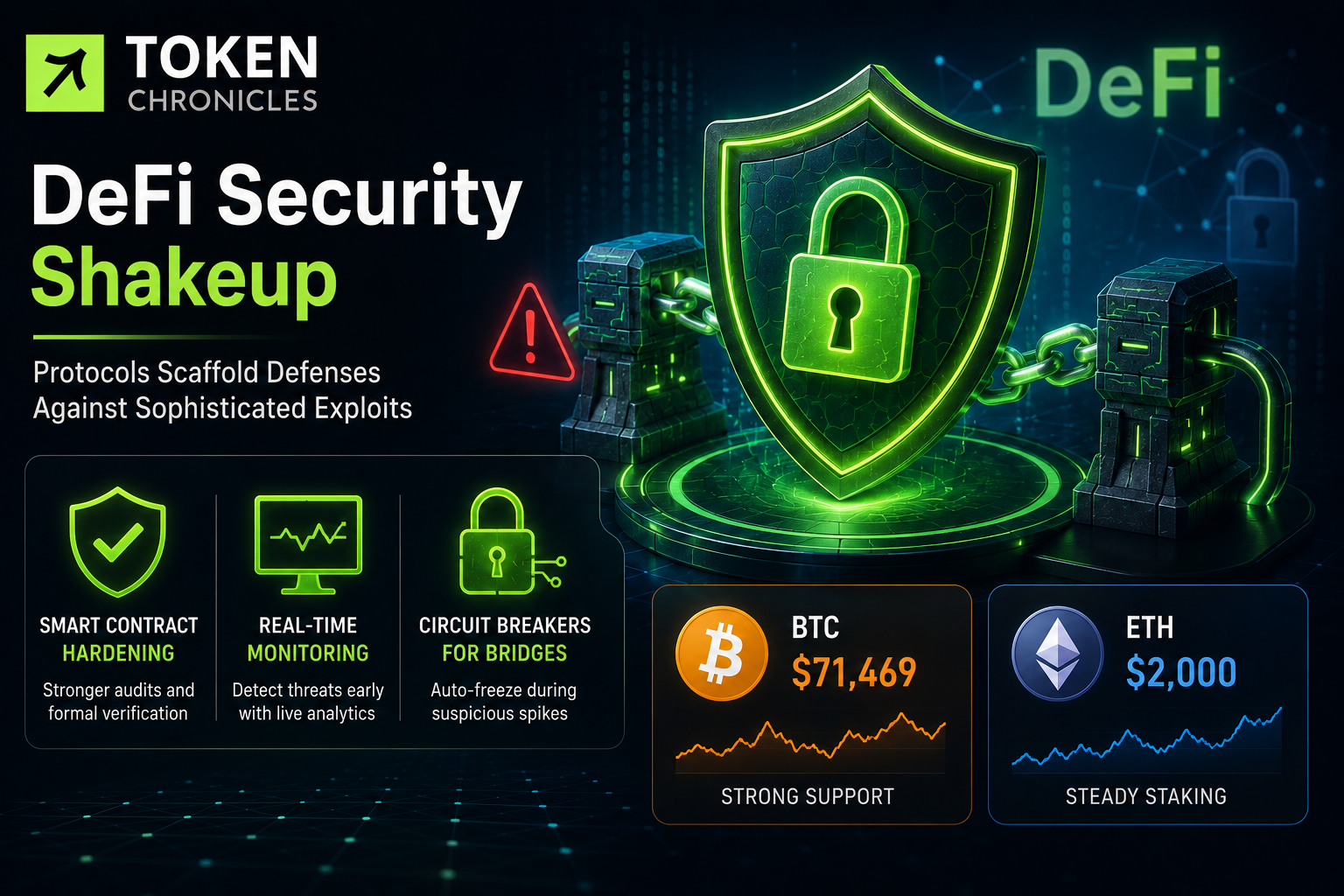
Smart Contract Hardening Becomes the New Standard
One of the most important shifts underway is the move toward stronger smart contract verification.
Traditionally, protocols have relied on periodic code audits performed before launch. While valuable, these audits provide only a snapshot of security at a specific moment in time.
Industry experts are now advocating for more advanced approaches, including:
- Formal verification frameworks
- Continuous code validation
- Automated threat detection systems
- Dynamic monitoring environments
- AI-assisted vulnerability scanning
Formal verification uses mathematical proofs to confirm that smart contracts behave exactly as intended under all possible conditions. Unlike conventional audits, this approach aims to eliminate entire classes of vulnerabilities before protocols go live.
Many developers now see formal verification as a critical component of next-generation DeFi infrastructure.
Real-Time Monitoring Takes Center Stage
Another major trend is the deployment of real-time monitoring systems capable of identifying suspicious activity as it occurs.
Instead of waiting for exploits to happen, protocols are increasingly implementing:
- Automated anomaly detection
- Transaction pattern analysis
- Wallet behavior monitoring
- Cross-chain flow tracking
- Liquidity movement alerts
These systems are designed to provide immediate warnings when unusual activity appears on-chain, allowing teams to respond before significant damage occurs.
The objective is simple: shorten the gap between detection and response.
Circuit Breakers Protect Cross-Chain Liquidity
Cross-chain bridges remain one of the most attractive targets for attackers due to the large amounts of capital they often secure.
To address this risk, developers are introducing “circuit breaker” mechanisms inspired by traditional financial markets.
These protective systems can automatically pause or restrict activity when predefined risk thresholds are exceeded.
Examples include:
- Sudden spikes in withdrawal activity
- Abnormal transaction volumes
- Unusual validator behavior
- Rapid liquidity drains
By temporarily freezing bridge operations during suspicious events, protocols can prevent attackers from draining remaining funds while investigations take place.
This approach creates valuable response time that was often missing during previous exploit events.
Protecting Total Value Locked (TVL)
One of the primary goals of these security enhancements is preserving Total Value Locked (TVL), the capital deposited across DeFi protocols.
Historically, large exploits have triggered:
- Immediate liquidity withdrawals
- User panic
- Sharp token price declines
- Reduced protocol participation
By strengthening defensive infrastructure, developers hope to prevent isolated security incidents from cascading into broader ecosystem disruptions.
A more secure environment could ultimately encourage greater institutional participation and long-term capital commitment.
Market Remains Resilient Despite Security Concerns
Interestingly, while security discussions dominate industry conversations, major digital assets have remained relatively stable.
As of June 2, 2026:
Bitcoin (BTC)
Bitcoin continues to serve as the anchor of the digital asset market, trading near $71,469. Despite broader concerns surrounding DeFi vulnerabilities, Bitcoin has maintained strong support levels and remains a key indicator of overall market confidence.
Ethereum (ETH)
Ethereum is consolidating around the $2,000 level, supported by steady on-chain activity and long-term staking participation. Network data suggests that committed holders continue to view Ethereum as a foundational asset despite short-term uncertainty across certain DeFi sectors.
The stability of both BTC and ETH indicates that investors largely view recent security challenges as protocol-specific issues rather than systemic threats to the broader blockchain industry.
The Future of DeFi Security
The current wave of security upgrades represents more than a temporary response to recent exploits—it signals a broader maturation of decentralized finance.
The industry is moving away from a model where security is primarily reactive and toward one where prevention, monitoring, and automated risk management operate continuously in the background.
As protocols adopt formal verification, real-time surveillance systems, circuit breakers, and advanced risk controls, DeFi infrastructure may become significantly more resilient than earlier generations of blockchain applications.
While no system can completely eliminate risk, the next phase of decentralized finance appears increasingly focused on minimizing vulnerabilities before attackers can exploit them.
In many ways, the future success of DeFi may depend less on innovation alone and more on the industry’s ability to build security frameworks capable of protecting billions of dollars in digital assets at global scale.