

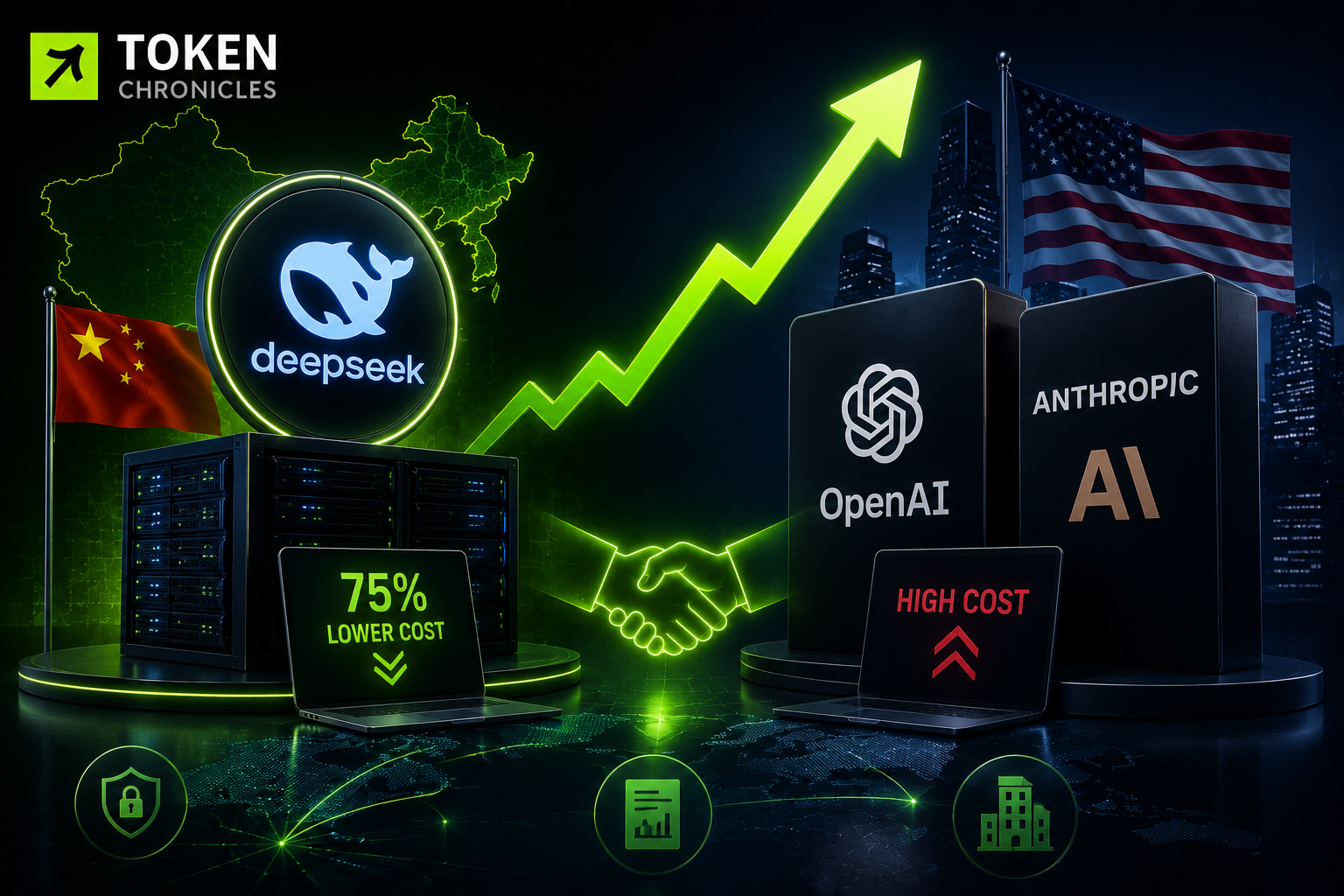
A growing number of U.S. companies are beginning to look beyond Silicon Valley for their artificial intelligence needs, and one Chinese startup is emerging as an unexpected winner.
DeepSeek, an AI company based in Hangzhou, China, has rapidly gained traction among American businesses by offering high-performance AI models at a fraction of the cost charged by industry leaders such as OpenAI and Anthropic. The shift highlights a growing tension in the AI market: while leading U.S. firms continue to raise capital at record valuations, many businesses are increasingly focused on one thing—cost efficiency.
DeepSeek Tops Enterprise Adoption Rankings
According to data from Ramp, a New York-based corporate spending platform that tracks software purchases across more than 50,000 U.S. businesses, DeepSeek ranked as the top trending software vendor in June.
The ranking measures how many companies begin paying a vendor for the first time, making it a strong indicator of emerging adoption trends.
While OpenAI and Anthropic continue to dominate overall enterprise AI spending—accounting for approximately 32.3% and 34.4% respectively—the rapid rise of DeepSeek suggests that businesses are becoming more willing to explore alternative providers when the economics make sense.
AI Costs Are Becoming a Major Enterprise Concern
For many organizations, AI adoption is no longer limited by technology—it is limited by budget.
As companies expand their use of generative AI across customer support, software development, research, analytics, and workflow automation, token costs and API expenses are growing into substantial operating expenditures.
Critics argue that some leading AI providers have business models that naturally encourage higher spending. Since revenue is often tied directly to token consumption, providers benefit when customers use larger models more frequently, even when less expensive alternatives may be sufficient for certain workloads.
The issue has become significant enough that major technology companies are publicly discussing the financial burden of AI deployment. Uber’s Chief Technology Officer recently revealed that the company had already exhausted its planned AI budget for 2026, highlighting how rapidly costs can escalate at enterprise scale.
DeepSeek’s Pricing Strategy Changes the Conversation
DeepSeek’s recent pricing decisions have dramatically increased its appeal.
The company recently reduced the price of its V4 Pro model by approximately 75%, making it one of the most affordable high-performance AI systems available to enterprise customers.
Following the price reduction, industry benchmarking platform Artificial Analysis ranked DeepSeek among the strongest models globally when measuring intelligence delivered per dollar spent.
Performance evaluations have also been encouraging. On legal and professional reasoning benchmarks, DeepSeek reportedly performed just below OpenAI’s GPT-5.5, placing it firmly within the range required for enterprise-grade workloads.
For businesses evaluating return on investment, the gap between performance and pricing has become increasingly difficult to ignore.
Data Sovereignty Concerns Are Growing
However, DeepSeek’s rapid adoption is creating a new debate around data security and national interests.
Although DeepSeek’s models are open-source and can theoretically be self-hosted by organizations, many companies are instead accessing the platform directly through DeepSeek’s infrastructure.
This means business data, prompts, documents, and operational information may be transmitted through servers located in China.
According to Ramp economist Ara Kharazian, this trend demonstrates how strongly companies are prioritizing cost savings.
In many cases, businesses appear willing to accept increased geopolitical and data governance risks in exchange for substantially lower AI expenses.
This raises concerns for regulators, cybersecurity experts, and policymakers who have increasingly warned about the movement of sensitive corporate information across international AI platforms.
Massive Valuations Could Limit Price Competition
The challenge for U.S. AI leaders may become even more pronounced as investor expectations continue to rise.
Anthropic recently filed for an initial public offering reportedly targeting a valuation approaching $965 billion, while OpenAI completed a funding round earlier this year valuing the company at approximately $852 billion.
Such enormous valuations create pressure to maintain aggressive revenue growth and profitability targets.
As a result, significant price reductions may be difficult for these firms to implement without affecting investor expectations and future earnings projections.
DeepSeek, by contrast, is operating from a different position. As a newer entrant focused on market expansion, it appears willing to compete aggressively on pricing in order to gain enterprise market share.
The Enterprise AI Market Is Entering a New Phase
While DeepSeek still represents only a small fraction of total enterprise AI spending compared to OpenAI and Anthropic, its recent momentum highlights a broader shift occurring across the industry.
The first phase of the AI boom was driven primarily by capability—companies wanted access to the most advanced models available.
The next phase may be driven by economics.
As AI becomes embedded into everyday business operations, organizations are increasingly evaluating providers based on cost efficiency, scalability, and measurable business outcomes rather than brand recognition alone.
For many executives, the question is no longer which AI model is the most powerful. Instead, it is which model delivers the best value at scale.
If DeepSeek continues improving performance while maintaining its pricing advantage, it could become one of the most disruptive forces in the global AI market—forcing established leaders to rethink both their pricing strategies and competitive positioning.
The rise of DeepSeek underscores a growing reality: in enterprise AI, performance matters, but cost increasingly determines adoption.