

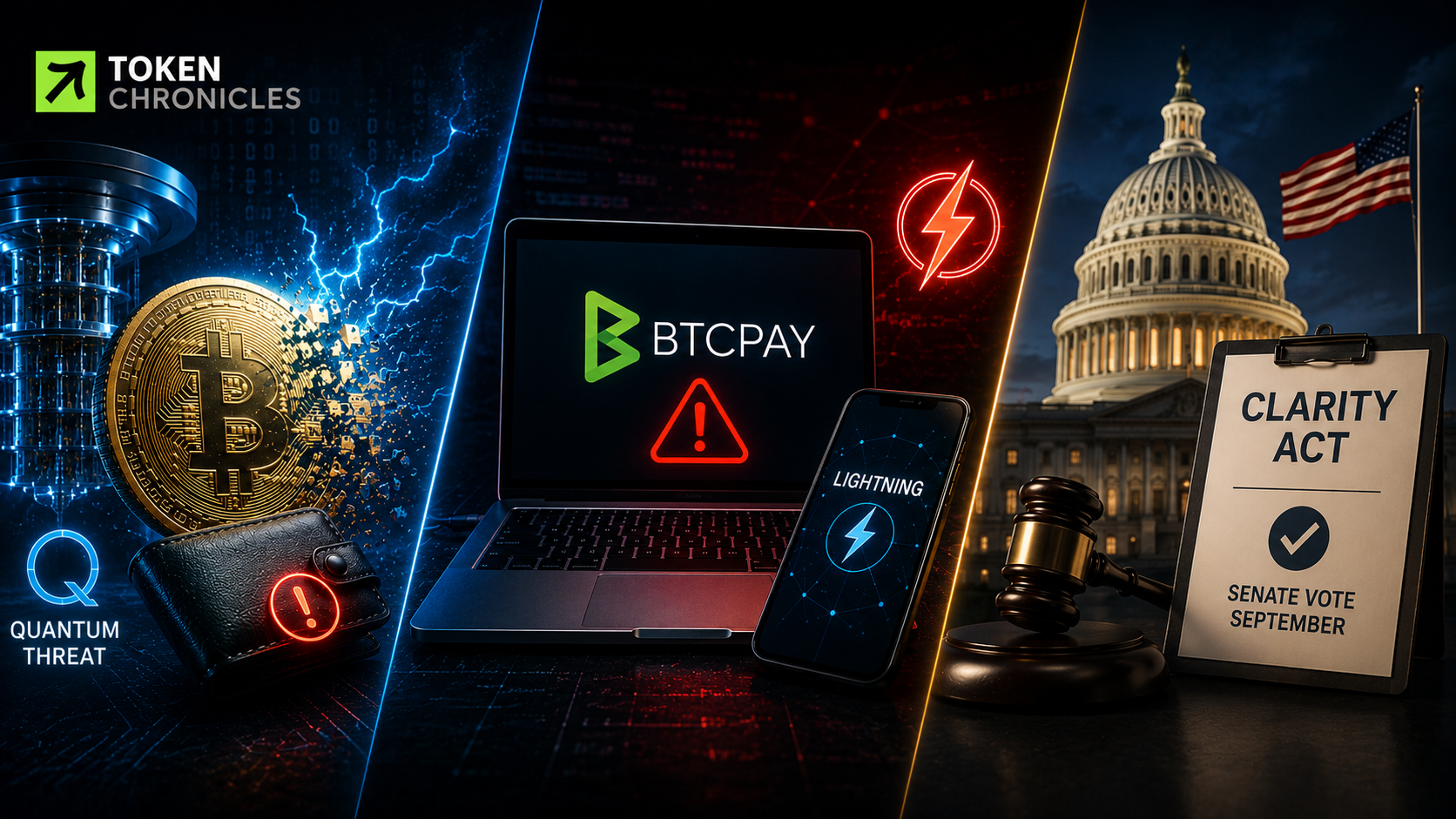
Crypto markets faced a day of heightened security and regulatory concerns as quantum computing emerged as a potential future threat to blockchain wallets, BTCPay Server restricted remote Lightning access following a critical exploit, and the U.S. Senate revived momentum around the CLARITY Act with a key procedural vote scheduled for September.
Here are the biggest developments shaping Bitcoin, blockchain, DeFi, Web3 and crypto regulation today.
Quantum Attack Could Look Like an Ordinary Wallet Breach
The first major quantum-powered attack on cryptocurrency may not look like a sophisticated breakthrough at all.
Christopher Smith, CEO and co-founder of blockchain startup Quantus Network, warned that an attacker using a sufficiently powerful quantum computer could potentially derive private keys from publicly exposed blockchain data and move funds without compromising a user’s device, wallet provider or exchange infrastructure.
That could make a future quantum attack extremely difficult to identify.
Instead of leaving obvious evidence of an intrusion, the event could initially appear to be a series of unrelated wallet thefts.
The underlying concern is the potential ability of quantum computers to break the public-key cryptography used by major blockchain networks. Advances in quantum algorithms have already led researchers to reconsider how much computational power could eventually be required to attack existing cryptographic systems.
The hypothetical moment when quantum computers become capable of doing so is often referred to as “Q-day.”
For the crypto industry, the challenge is not simply preparing for the technology. It is also developing ways to detect attacks that may leave little conventional forensic evidence.
BTCPay Restricts Lightning Access After Critical Exploit
Security concerns also intensified around Bitcoin’s Lightning Network after BTCPay Server temporarily restricted public remote access to LND nodes following a critical vulnerability.
Attackers reportedly exploited the vulnerability to obtain macaroon credentials, which can provide control over Lightning Network nodes and potentially allow funds to be moved.
The restriction affects external wallets such as Zeus when connecting to BTCPay Server through a BTCPay domain or Tor onion address on Docker deployments.
BTCPay said Lightning payments can continue operating and that remote access will be restored once the team determines that the connection method is safe.
The project has released BTCPay Server version 2.4.2, which includes LND version 0.21.1 and automatically regenerates macaroon credentials for standard installations.
Node operators have also been advised to review their systems for unauthorized payments, unexpected channel closures, unfamiliar peers and discrepancies between their recorded and actual on-chain or Lightning balances.
Operators using independent reverse proxies, Tor services, forwarded ports or other external access mechanisms may need to rotate their credentials separately.
The incident adds to a growing list of security problems affecting Bitcoin-related infrastructure, including the recent Coldcard hardware-wallet exploit. Importantly, these incidents target applications, wallets and infrastructure built around Bitcoin rather than the Bitcoin protocol itself.
Senate Revives CLARITY Act With September Procedural Vote
U.S. crypto regulation also returned to the spotlight after Senate Majority Leader John Thune filed a cloture motion to advance the CLARITY Act, setting up a key procedural vote when lawmakers return from their August recess.
The vote is expected in September and represents an important step for legislation designed to establish a clearer regulatory framework for digital assets in the United States.
However, the procedural vote is not a vote to pass the CLARITY Act itself.
Cloture requires 60 votes, meaning Republicans will need support from Democratic senators to clear the procedural hurdle and move the legislation closer to formal Senate consideration.
The development restores momentum around one of the most significant pieces of U.S. crypto legislation after negotiations stalled before the August recess.
The CLARITY Act seeks to establish a federal market structure for digital assets while clarifying the respective regulatory responsibilities of the Securities and Exchange Commission (SEC) and the Commodity Futures Trading Commission (CFTC).
Ethics and Stablecoin Rules Remain Major Obstacles
Despite the renewed momentum, negotiations over the legislation remain complicated.
Lawmakers continue to debate proposed ethics provisions and rules concerning stablecoin rewards.
Democratic senators have also raised concerns about President Donald Trump’s cryptocurrency-related financial interests. Discussions have reportedly included a bipartisan ethics proposal that could require divestment from certain crypto-related businesses.
Until these issues are resolved, the path from the September procedural vote to final passage remains uncertain.
The Bigger Picture
Today’s crypto developments highlight three different challenges facing the industry.
Quantum computing represents a long-term threat to cryptographic security. BTCPay’s vulnerability demonstrates the immediate risks facing crypto infrastructure. And the CLARITY Act shows that regulatory uncertainty remains one of the industry’s biggest structural issues.
For investors and users, the message is clear: crypto’s next phase will depend not only on market prices and adoption, but also on how effectively the industry addresses security, technological resilience and regulatory clarity.