
The crypto industry is navigating a pivotal week as Europe prepares to enforce its landmark Markets in Crypto-Assets (MiCA) framework, US lawmakers move closer to banning a central bank digital currency (CBDC), and crypto-backed political action committees ramp up spending ahead of key elections.
BitGo Targets European Market as MiCA Deadline Approaches
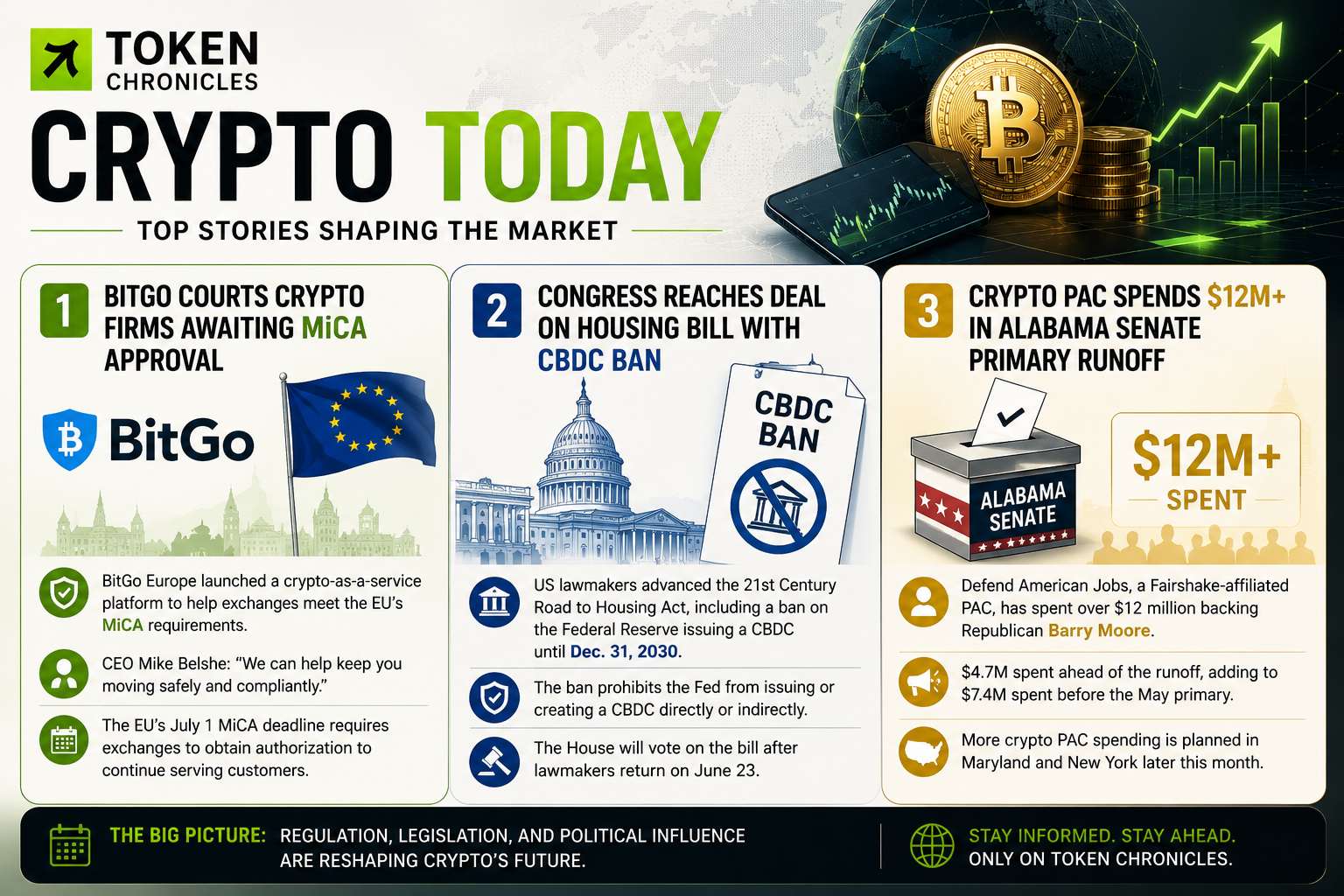
As the European Union’s July 1 MiCA deadline draws closer, crypto firms are racing to secure regulatory approval to continue operating across the bloc.
Amid this uncertainty, digital asset custodian BitGo has launched a new crypto-as-a-service platform in Europe, designed to help exchanges and financial institutions comply with MiCA requirements.
BitGo CEO Mike Belshe said companies facing licensing delays should not have to pause operations or disrupt services for customers.
“Regulated infrastructure can help companies continue operating safely and compliantly while they navigate the licensing process,” Belshe said.
The launch comes as speculation grows over the regulatory future of several major exchanges in Europe. Reports this week suggested that Greek regulators may reject Binance’s MiCA application, creating uncertainty around the exchange’s long-term EU strategy.
If approved, MiCA will establish a unified regulatory framework across all 27 EU member states, fundamentally reshaping how crypto companies operate in Europe.
US Congress Moves Forward With CBDC Ban
Meanwhile, lawmakers in Washington have reached an agreement on a broader housing bill that includes a significant provision for the crypto industry: a temporary ban on a US central bank digital currency.
The updated 21st Century Road to Housing Act would prohibit the Federal Reserve from issuing or creating a CBDC until December 31, 2030.
The bill states that the Fed may not:
- Issue a central bank digital currency directly
- Create any digital asset substantially similar to a CBDC
- Introduce such a system indirectly through intermediaries
The measure reflects growing concerns among lawmakers about privacy, government surveillance, and financial sovereignty.
The issue has already received strong support from President Donald Trump, who signed an executive order in January 2025 prohibiting federal agencies from pursuing CBDC-related initiatives.
The House is expected to vote on the legislation after lawmakers return from recess on June 23.
Crypto PAC Spending Shapes Alabama Senate Race
Crypto’s influence in US politics continues to expand.
Defend American Jobs, a political action committee affiliated with the crypto-focused Fairshake network, has spent more than $12 million backing Republican candidate Barry Moore in Alabama’s Senate primary runoff.
According to filings with the Federal Election Commission:
- $7.4 million was spent before the May primary.
- An additional $4.7 million was spent ahead of the runoff election.
- Total spending now exceeds $12 million.
Moore, who has also received the endorsement of President Donald Trump, is competing against Republican candidate Jared Hudson to replace Senator Tommy Tuberville, who is pursuing a gubernatorial bid.
The Alabama race is becoming another important test of crypto’s growing political influence.
Crypto’s Political Influence Continues to Expand
Fairshake and its affiliated PACs have already become some of the largest political spenders in the digital asset industry.
Beyond Alabama, the organization is also investing heavily in congressional races across the country, including:
- Maryland: Supporting Democrat Adrian Boafo with roughly $5 million in media spending.
- New York: Backing Representative Ritchie Torres with approximately $500,000 in campaign advertising.
As crypto regulation increasingly becomes a central political issue, industry-backed PACs are expected to play an even larger role in shaping policy debates and election outcomes.
The Bigger Picture
This week’s developments highlight how quickly the crypto industry is maturing across multiple fronts:
- Europe is implementing a unified regulatory framework under MiCA.
- The United States is debating the future of digital money through CBDC legislation.
- Crypto companies are becoming major political players through coordinated campaign spending.
Together, these shifts signal that digital assets are no longer operating on the fringes of finance and politics—they are becoming an increasingly important part of both.