

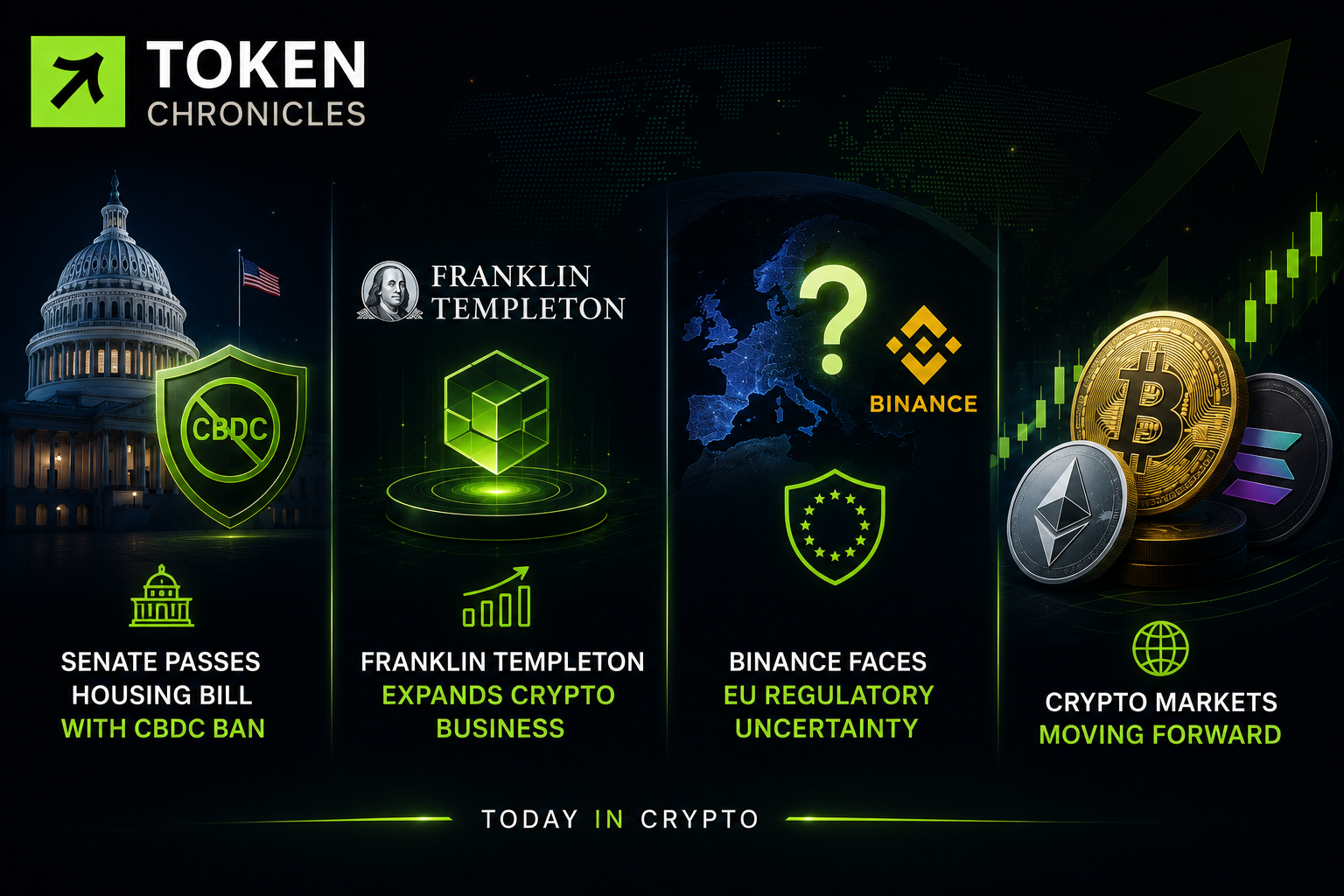
The crypto industry saw several important developments today, ranging from regulatory changes in the United States to institutional expansion into digital assets and ongoing uncertainty around Binance’s European future.
US Senate Advances CBDC Ban Until 2030
The US Senate has overwhelmingly approved a bipartisan housing affordability bill that includes a provision preventing the Federal Reserve from issuing a Central Bank Digital Currency (CBDC) until 2030.
The legislation prohibits the Fed from directly or indirectly creating a CBDC or any similar digital asset without explicit approval from Congress. However, the restriction does not apply to privately issued stablecoins.
The bill now heads to the House of Representatives, where it is widely expected to receive approval before being sent to the President for final signing.
Franklin Templeton Launches Dedicated Crypto Division
Global investment giant Franklin Templeton has officially expanded its digital asset business after completing the acquisition of crypto asset manager 250 Digital.
The company has launched a new business unit, Franklin Crypto, which will focus on digital asset investment strategies, blockchain-based financial products, and tokenized assets.
The move strengthens Franklin Templeton’s growing presence in the crypto sector. Over the past year, the firm has expanded its tokenized real-world asset portfolio significantly and has actively explored blockchain-based ETFs, tokenized money market funds, and crypto investment products.
Binance Faces Growing Regulatory Pressure in Europe
Meanwhile, questions continue to surround Binance’s position in the European market as the deadline for the EU’s Markets in Crypto-Assets (MiCA) framework approaches.
According to CryptoQuant, euro-denominated trading currently represents only about 1% of Binance’s total spot trading volume, suggesting the exchange’s business remains heavily diversified across global markets.
However, reports indicate that Greek regulators may reject Binance’s MiCA license application ahead of the July 1 transition deadline. If confirmed, the decision could complicate Binance’s ability to offer services across the European Union under the new regulatory framework.
Despite these challenges, analysts believe Binance’s broad international user base may help limit the overall impact of any regional regulatory setbacks.
As crypto regulation evolves and institutional participation continues to grow, these developments are likely to remain key themes shaping the industry in the months ahead.