

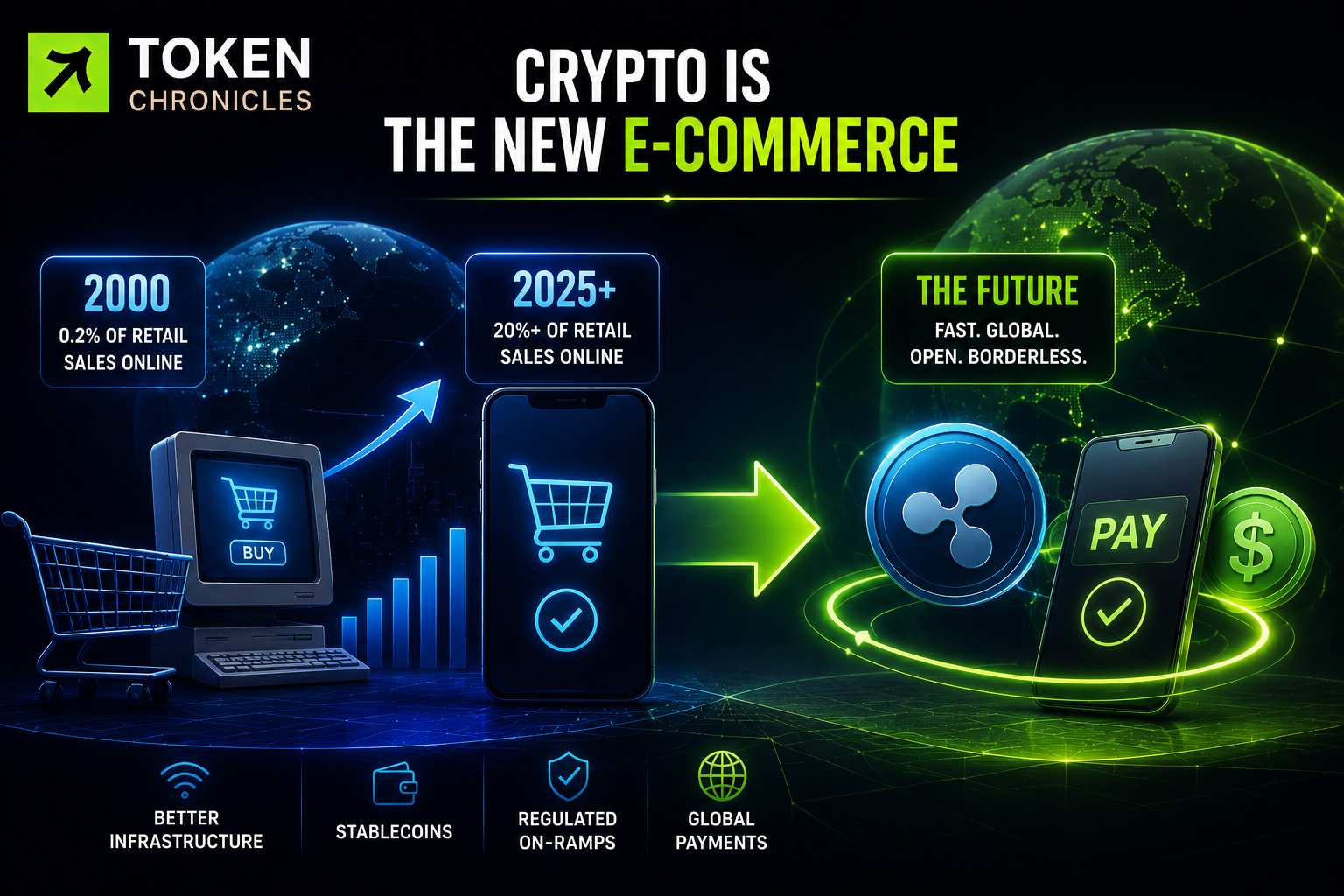
The global payments industry may be approaching a major transformation, and according to Ripple executive Reece Merrick, cryptocurrency could be at the center of it.
Merrick believes crypto payments today resemble the early days of online shopping—a technology that was once viewed with skepticism but eventually reshaped the way billions of people buy and sell goods worldwide.
From Internet Shopping to Internet Money
At the start of the 2000s, purchasing products online was far from common. Consumers hesitated to enter their credit card details on websites, and concerns about security dominated public opinion.
At that time, online shopping accounted for only a tiny fraction of global retail activity. Few expected it to become one of the world’s largest industries.
Over the next two decades, however, several innovations changed everything:
- Secure digital payment gateways
- Faster internet infrastructure
- Mobile applications and smartphones
- Improved consumer trust
- Global digital marketplaces
Today, online commerce represents a substantial share of global retail spending and has become an essential part of everyday life.
Crypto Payments May Be Entering a Similar Growth Phase
According to Merrick, cryptocurrency payments are currently in the same foundational stage that e-commerce once experienced.
While adoption remains relatively limited compared to traditional payment systems, the underlying infrastructure is rapidly maturing.
The industry is now building:
- High-speed Layer-1 blockchains
- Stablecoins designed for everyday transactions
- Regulated fiat on-ramps and off-ramps
- Cross-border settlement networks
- Enterprise-grade payment infrastructure
These developments, Merrick argues, could serve as the equivalent of broadband internet and smartphones for the crypto economy.
Infrastructure Comes Before Mass Adoption
Rather than focusing solely on price movements, many companies are now investing in the payment rails that could support large-scale crypto transactions.
Stablecoins, in particular, have emerged as one of the fastest-growing sectors within digital assets. Their ability to provide near-instant settlement, lower transaction costs, and global accessibility is attracting interest from businesses, payment providers, and financial institutions alike.
Several major firms are already exploring blockchain-based payment systems as alternatives to slower and more expensive traditional networks.
The Shift May Already Be Underway
The comparison with e-commerce highlights a broader trend: transformational technologies often spend years developing quietly before entering mainstream use.
Just as online shopping evolved from a niche activity into a global industry, crypto payments may be progressing through a similar cycle—moving from experimentation toward real-world utility.
If infrastructure continues to improve and regulatory clarity expands, digital assets could increasingly become part of everyday financial activity rather than remaining a specialized segment of the technology industry.
Looking Ahead
While challenges around regulation, scalability, and user adoption remain, proponents believe the foundation for mainstream crypto payments is being laid today.
For Ripple and other blockchain companies, the question is no longer whether digital payments will evolve, but how quickly cryptocurrency becomes part of that evolution.
As global finance continues to digitize, crypto payments may follow the same path that transformed e-commerce from an ambitious idea into a worldwide standard.


