


Crypto markets remain on edge as investors weigh two major macro developments: the Federal Reserve’s latest policy stance under new Chair Kevin Warsh and the uncertain outlook surrounding a proposed U.S.-Iran peace agreement.
While Bitcoin has managed to stabilize above key support levels, institutional demand remains weak and broader market sentiment is cautious, leaving traders questioning the strength of any near-term recovery.
Markets React to Mixed Signals on Iran
Wall Street traded lower after President Donald Trump suggested that the memorandum of understanding with Iran was not yet finalized, despite earlier optimism surrounding the agreement.
The proposed deal is expected to be formally signed on Friday and could begin a 60-day negotiation period aimed at restoring stability in the region and reopening trade routes through the Strait of Hormuz, one of the world’s most important oil corridors.
However, Trump’s comments injected fresh uncertainty into markets.
While he stated that the agreement could lower oil prices and benefit global markets, he also warned that military action remained an option if Iran failed to comply with the deal.
That mixed messaging has left investors hesitant.
Oil Falls, But Inflation Risks Remain
Brent crude oil prices dropped to their lowest level in more than three months as traders priced in a possible easing of geopolitical tensions.
However, market participants remain unconvinced that lower energy prices will be enough to reduce inflation meaningfully in the short term.
US Treasury yields remained elevated around 4.16%, reflecting investor skepticism that the Federal Reserve will begin cutting interest rates anytime soon.
Higher bond yields generally create headwinds for risk assets, including cryptocurrencies, as investors shift toward safer, income-generating investments.
Kevin Warsh’s First FOMC Meeting Draws Attention
Wednesday also marked the first Federal Open Market Committee (FOMC) meeting led by Federal Reserve Chair Kevin Warsh.
As widely expected, the Fed kept interest rates unchanged.
But investors are less focused on the decision itself and more interested in Warsh’s long-term policy approach.
Markets are now trying to determine:
- How aggressively the Fed will fight inflation.
- Whether rate cuts remain possible later in 2026.
- How Warsh balances economic growth with price stability.
- Whether monetary policy will become more accommodative.
The answers to these questions will likely shape the trajectory of both traditional and digital asset markets over the coming months.
Bitcoin Faces Institutional Demand Challenges
Despite the improving geopolitical backdrop, Bitcoin has struggled to regain strong momentum.
The cryptocurrency has repeatedly failed to sustain a move above $80,000 since mid-May, reflecting weak institutional participation.
Several indicators point to this slowdown:
Key Market Metrics
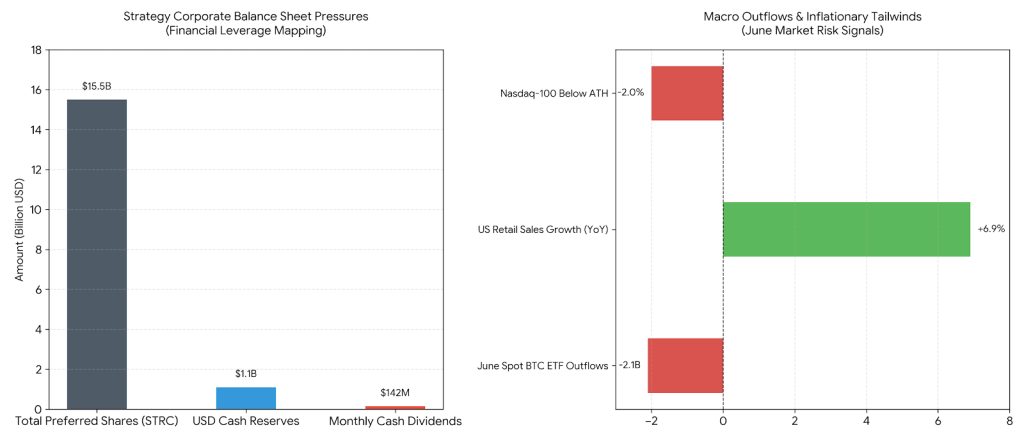
- Spot Bitcoin ETFs have recorded $2.1 billion in net outflows during June.
- Coinbase Bitcoin prices continue to trade at a discount relative to international USDT markets.
- Institutional buying pressure remains subdued.
- Market liquidity has not returned to levels seen earlier in the year.
This suggests that large investors remain cautious despite recent price stability.
Strategy’s STRC Weakness Raises Concerns
Another source of concern comes from Strategy’s preferred stock, STRC, which has recently shown signs of weakness.
The security offers investors an 11.5% annual yield, but maintaining those payouts may become increasingly difficult.
Current estimates suggest:
- Monthly dividend obligations exceed $142 million.
- Strategy currently holds around $1.1 billion in cash reserves.
- Total preferred shares outstanding have grown to approximately $15.5 billion.
Because new STRC shares can only be issued at a fixed price of $100, investors worry that the company may eventually rely on additional share dilution to meet its obligations.
While there is currently no indication that Strategy would need to sell its Bitcoin holdings, the decline in STRC’s market confidence has contributed to broader caution across crypto markets.
Can Bitcoin Reclaim $80,000?
The path to a sustained Bitcoin rally remains uncertain.
Several factors need to align:
- Successful implementation of the U.S.-Iran agreement
- Lower inflation readings
- Improved ETF inflows
- Stronger institutional demand
- A more accommodative Federal Reserve outlook
Until then, Bitcoin may continue trading within a volatile range as investors wait for clearer macroeconomic signals.
A Market Waiting for Conviction
For now, crypto markets are balancing optimism with caution.
The possibility of easing geopolitical tensions and stable monetary policy offers reasons for hope.
At the same time, weak institutional flows, ETF outflows, and uncertainty surrounding the Iran agreement continue to weigh on sentiment.
The coming weeks may determine whether the current market stabilization evolves into a renewed bull cycle—or remains another temporary pause in a still-fragile recovery.