

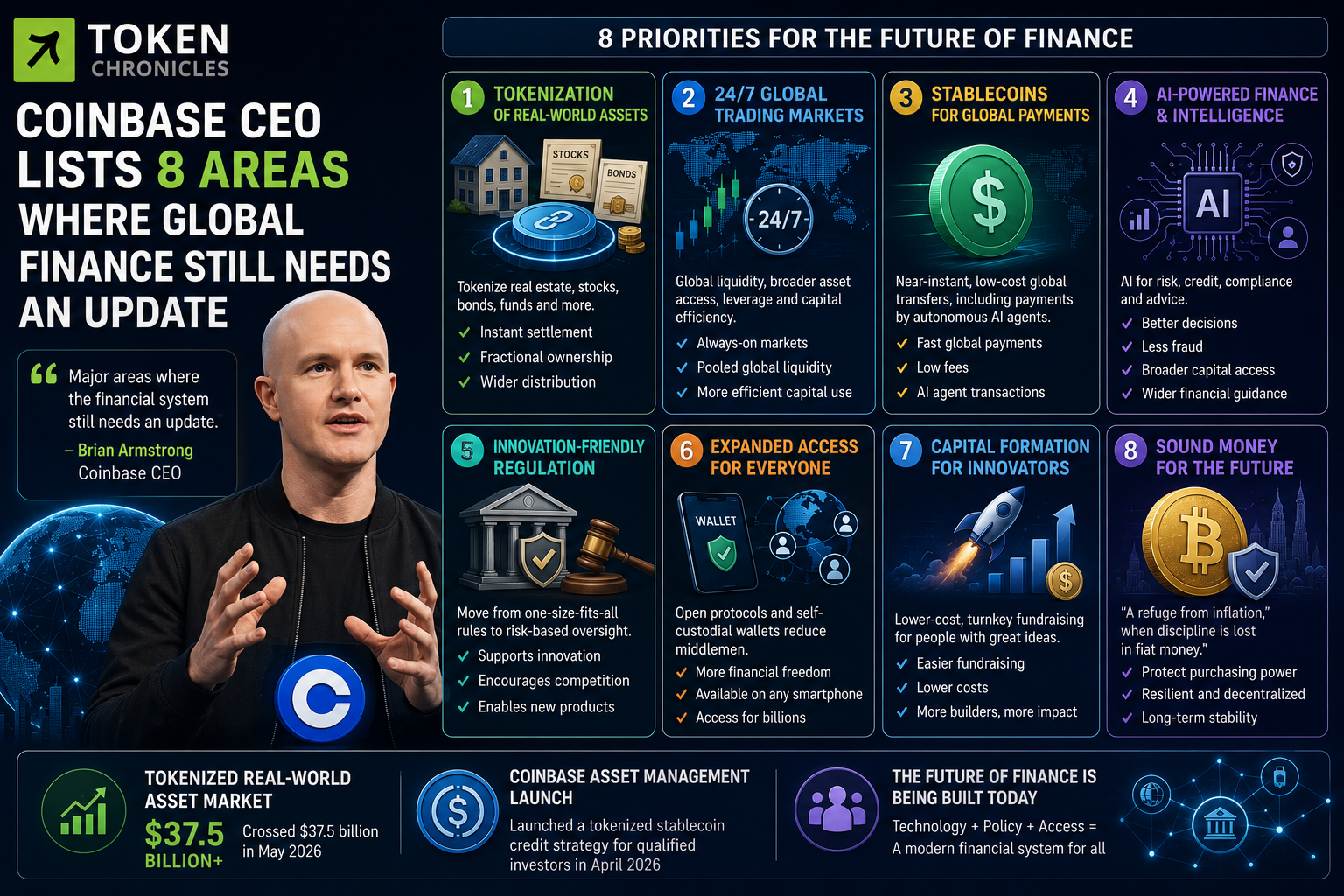
Coinbase CEO Brian Armstrong has outlined eight major areas where he believes the global financial system still requires significant upgrades, placing blockchain technology, tokenization, stablecoins, artificial intelligence, and financial accessibility at the center of the next phase of financial innovation.
In a post shared on X on May 24, Armstrong described these areas as key gaps that remain unresolved within modern finance despite rapid technological progress over the past decade.
Armstrong summarized the list as:
“Major areas where the financial system still needs an update.”
Tokenization And Global Markets Lead The List
The first area Armstrong emphasized was the tokenization of real-world assets (RWAs), including:
- Real estate
- Stocks
- Bonds
- Investment funds
According to Armstrong, placing these assets on blockchain networks could unlock several major improvements for global markets, including:
- Instant settlement
- Fractional ownership
- Broader investor access
- More efficient asset distribution
The second priority focused on creating truly global 24/7 financial markets.
Armstrong argued that blockchain-based infrastructure could enable continuous trading with:
- Shared global liquidity
- Wider asset accessibility
- Improved leverage efficiency
- Greater capital efficiency
Together, these ideas point toward a future financial system built around faster settlement speeds, borderless participation, and more open access to investment opportunities.
Stablecoins And AI Become Core Infrastructure
The third major area identified by Armstrong was stablecoins.
He described stablecoins as one of the most important upgrades for global payments because they allow near-instant, low-cost money transfers across borders.
Armstrong also highlighted the growing role of autonomous AI agents, suggesting stablecoins could become the primary payment layer for machine-driven economic activity.
The fourth area focused on artificial intelligence itself.
Armstrong believes AI can significantly improve:
- Risk management
- Credit assessment
- Fraud prevention
- Compliance systems
- Financial advice
He argued that AI-powered financial infrastructure could help reduce inefficiencies while expanding access to financial services and capital for a broader global population.
Regulation And Financial Access Remain Critical
The fifth area Armstrong addressed was regulation.
He called for more innovation-friendly regulatory frameworks that move away from rigid one-size-fits-all policies and instead adopt risk-based approaches that support competition and emerging financial technologies.
According to Armstrong, better regulation could encourage innovation while still protecting consumers and maintaining market stability.
The sixth priority focused on expanding financial access through:
- Open blockchain protocols
- Self-custodial wallets
- Decentralized financial infrastructure
Armstrong argued that these technologies could reduce reliance on intermediaries and make financial services available to anyone with access to a smartphone and internet connection.
Capital Formation And Sound Money
The seventh area Armstrong identified was capital formation.
He emphasized the need for lower-cost and more accessible fundraising systems that allow entrepreneurs and creators with strong ideas to raise capital more efficiently.
The final priority on Armstrong’s list was sound money.
He described it as:
“A refuge from inflation, when discipline is lost in fiat money.”
This reflects the broader crypto industry belief that decentralized financial systems and digital assets can provide alternatives to inflation-prone monetary systems controlled by governments and central banks.
Tokenization And Stablecoins Continue Expanding
Armstrong’s comments arrive as tokenization and stablecoins continue gaining momentum across both crypto markets and traditional finance.
The tokenized real-world asset market reportedly surpassed $37.5 billion in May 2026 as institutional interest in blockchain-based financial products continues growing.
Meanwhile, Coinbase Asset Management recently launched a tokenized stablecoin credit strategy aimed at qualified investors, further signaling how blockchain-based finance is increasingly moving into mainstream institutional markets.
As governments, banks, and technology companies continue exploring digital financial infrastructure, Armstrong’s list reflects the broader industry view that modern finance remains in the early stages of a much larger technological transformation.