

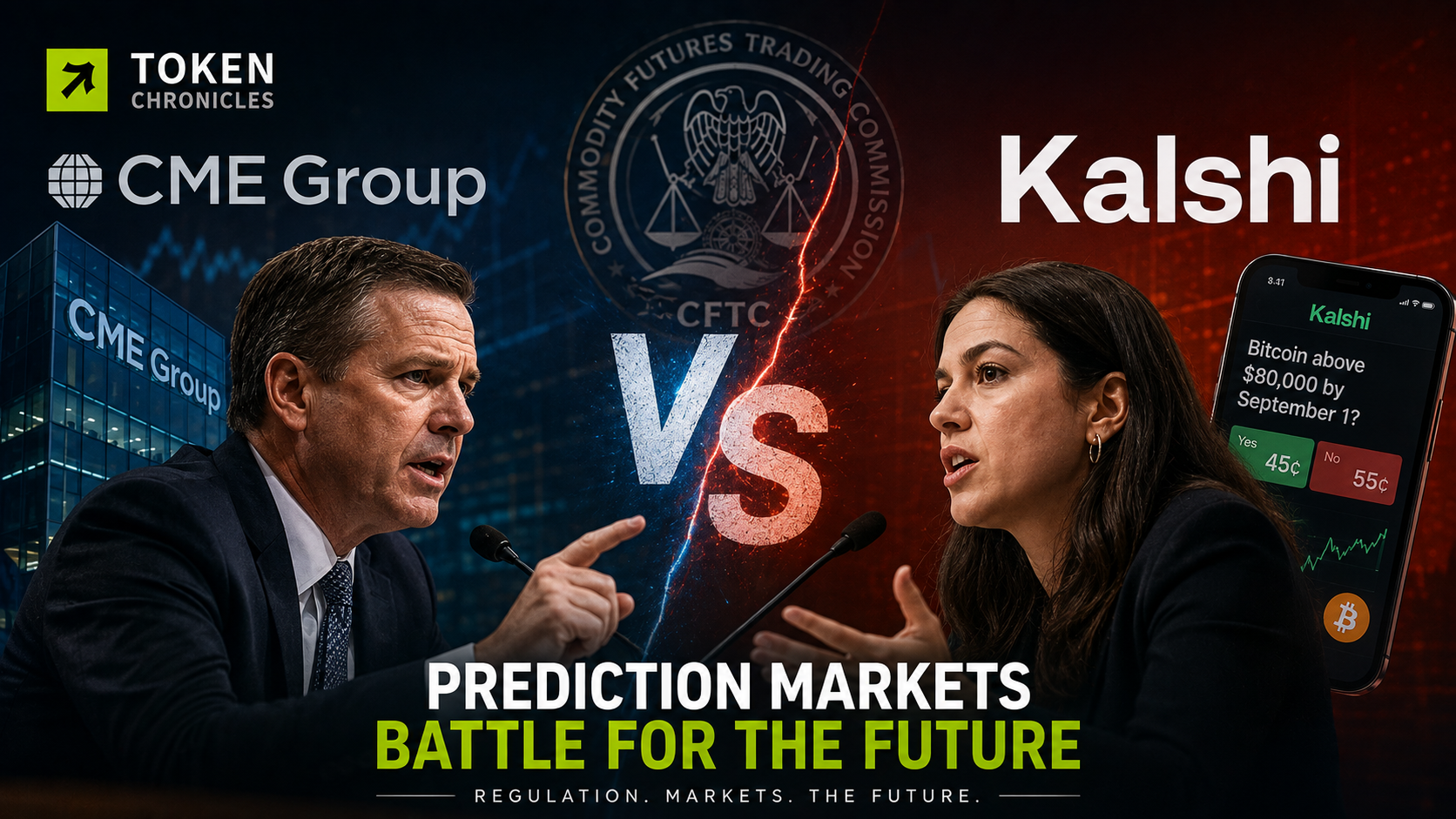
A heated exchange between CME Group Chairman Terry Duffy and Kalshi co-founder Luana Lopes Lara at a recent CFTC roundtable exposed a much larger fight over the future of prediction markets in the United States.
What began as a discussion about how event contracts should be regulated quickly turned into a clash between one of the world’s largest derivatives exchanges and a new generation of prediction-market platforms. Beneath the personal sparring lies a bigger question: Are prediction markets legitimate financial markets, or are some of them simply gambling products operating under a different regulatory framework?
The answer could reshape the U.S. derivatives industry, determine how states and federal regulators divide authority, and influence whether prediction markets become a mainstream financial product.
A CFTC hearing turns confrontational
The CFTC organized the roundtable to examine the regulatory treatment of event contracts. These contracts generally pay a fixed amount depending on whether a specific event occurs.
For example, a contract predicting whether Bitcoin will exceed a particular price by a certain date might trade at 45 cents. If the outcome occurs, the holder receives $1; otherwise, the contract expires worthless.
CME Chairman Terry Duffy questioned whether newer prediction-market platforms should face the same regulatory standards as established derivatives exchanges.
He also criticized contracts tied to events such as competitive sports and entertainment, using a hot-dog eating contest as an example of what he viewed as questionable market activity.
Kalshi co-founder Luana Lopes Lara pushed back after Duffy directly referenced the company. She challenged CME’s record on market integrity and questioned whether size and regulatory infrastructure should determine which companies are considered credible market operators.
The exchange became increasingly pointed, with Duffy highlighting CME’s large regulatory organization and Lara responding that smaller technology-driven companies could potentially operate more efficiently.
DraftKings CEO Jason Robins eventually called for a more constructive discussion, warning that attacking competing business models would not advance the regulatory debate.
The argument, however, highlighted a much deeper disagreement over how prediction markets should be classified.
Federal derivatives regulation vs. state gambling laws
Prediction markets occupy an unusual position within the U.S. regulatory system.
The CFTC considers qualifying event contracts to fall under the federal derivatives framework. Platforms operating within that system can potentially offer contracts covering economic, financial, political and other outcomes, subject to applicable rules.
Several states take a different view. They argue that certain event contracts are effectively gambling products and should therefore fall under state gambling laws.
That creates a fundamental jurisdictional dispute.
A contract tied to an oil price or interest-rate decision can look like a conventional financial derivative. A contract tied to a sporting event or entertainment outcome can look much more like a wager.
The unresolved question is where regulators should draw the line.
The CFTC has increasingly asserted federal authority while also examining restrictions on contracts involving areas such as warfare, assassination and certain sports events where manipulation or public-policy concerns may be particularly significant.
That creates an unusual balancing act for the agency: preserve federal oversight of prediction markets while determining which types of contracts should not be permitted.
Kalshi’s legal battles raise the stakes
The regulatory dispute has already moved into the courts.
New York has challenged Kalshi’s operations, arguing that its event contracts constitute unlicensed gambling. The state has also sought significant financial penalties and restrictions on the platform.
Washington has separately taken action against certain Kalshi contracts involving sports, elections and other events.
At the same time, the CFTC has defended its authority over federally regulated event contracts.
The result is an increasingly complicated situation in which federal regulators and individual states can take opposing positions on essentially the same products.
If the courts ultimately side with the states, prediction-market operators could face a fragmented licensing regime across the country. If federal authority prevails, states could have significantly less ability to regulate these markets through traditional gambling laws.
Congress could resolve the conflict through legislation, but prediction-market jurisdiction has not yet emerged as a clear legislative priority.
Why CME sees prediction markets as a competitive threat
CME’s concerns extend beyond the regulatory debate.
The exchange has built its business around institutional-grade futures and derivatives markets. Prediction platforms are targeting a different audience: ordinary consumers who want simple access to event-based contracts through mobile applications.
That difference in user experience could become strategically important.
Accessing a traditional futures contract can require a brokerage account, margin arrangements and familiarity with derivatives markets. Prediction platforms are designed to make event-based trading considerably simpler.
This creates the possibility that prediction markets could capture a growing share of retail demand for event-driven exposure.
CME has also been developing products linked to areas such as weather, economic indicators and other real-world events. As prediction markets expand into similar categories, the two business models could increasingly overlap.
For established exchanges, the concern is therefore not necessarily that platforms such as Kalshi will replace CME overnight. The larger issue is whether prediction markets capture the next generation of retail trading activity before traditional exchanges can establish a comparable offering.
The consumer protection question
One of the most important issues in the debate is also one of the least discussed: how users actually perform in these markets.
Research cited in the debate suggests that a large proportion of prediction-market participants lose money, with some users also relying on borrowed funds.
Those figures raise questions that go beyond jurisdiction.
If prediction markets primarily function as speculative entertainment for retail users, regulators may have stronger grounds for treating them similarly to gambling products.
If they instead provide useful price discovery, risk management and information aggregation, the argument for treating them as financial markets becomes stronger.
The distinction matters because financial-market regulation and gambling regulation are built around very different objectives.
The CFTC framework emphasizes market integrity, transparency, price discovery and systemic risk. Gambling regulation generally places much greater emphasis on consumer protection, responsible participation and restrictions on wagering.
Prediction markets sit directly between these two philosophies.
The economics behind the confrontation
The competitive stakes become clearer when considering the scale of the traditional derivatives industry.
CME generates billions of dollars in annual revenue from trading activity across interest rates, equities, energy, agriculture, metals and foreign exchange.
Prediction markets remain considerably smaller.
But their growth rate is what makes them strategically interesting.
Platforms such as Kalshi and Polymarket have demonstrated that consumers are willing to trade contracts based on elections, economic events, cryptocurrency prices, sports and other real-world outcomes.
If that market continues expanding rapidly, prediction platforms could become an alternative venue for event-driven speculation that traditionally would have flowed through exchanges, sportsbooks or other financial intermediaries.
For CME, the regulatory playing field therefore matters almost as much as the products themselves.
Traditional exchanges operate with substantial compliance, surveillance and infrastructure costs. If newer platforms can provide comparable exposure under a lighter regulatory framework, incumbents may argue that competition is occurring on unequal terms.
Kalshi’s counterargument is essentially that modern technology allows smaller companies to provide market infrastructure more efficiently.
Prediction markets are becoming an international issue
The U.S. debate is unfolding alongside different approaches overseas.
Regulators in other financial centers are considering whether event contracts should be treated primarily as derivatives, gambling products or a separate category altogether.
That matters because prediction markets can operate across borders with relative ease.
If U.S. regulation becomes significantly more restrictive than rules in other jurisdictions, trading activity could migrate elsewhere. The same dynamic has occurred across other areas of digital finance when regulatory requirements differed substantially between countries.
For established global exchanges such as CME, international diversification provides some protection. For U.S.-focused startups, however, losing access to the domestic market could be far more damaging.
Crypto adds another layer of complexity
The prediction-market debate also intersects with the crypto industry.
Blockchain-based platforms have helped accelerate the growth of prediction markets by allowing contracts and settlement systems to operate on digital infrastructure.
Polymarket, for example, has become one of the most prominent blockchain-based prediction platforms, while other platforms are experimenting with crypto deposits, onchain settlement and decentralized market infrastructure.
That raises another regulatory question: Does putting a prediction market on blockchain change which regulator should oversee it?
If the underlying contract is considered a derivative, federal derivatives rules could potentially apply regardless of the technology.
If it is considered gambling, state-level restrictions could still become relevant.
The unresolved classification problem therefore extends beyond traditional prediction platforms and could become another major regulatory issue for crypto-native financial applications.
The overlooked insurance analogy
There is another way to understand prediction markets: as a form of event-based risk transfer.
Consider a farmer concerned about drought, a logistics company worried about a port strike or an energy company exposed to hurricane risk.
A contract tied to the occurrence of one of these events could help the participant offset potential losses.
That starts to resemble insurance.
Insurance, however, is heavily regulated at the state level in the United States. Products require oversight, companies must maintain financial reserves and regulators focus heavily on consumer protection and solvency.
This analogy creates an uncomfortable problem for both sides.
Calling prediction markets “event insurance” could strengthen the argument that they should be subject to state regulation. But imposing traditional insurance requirements could also make rapid product development extremely difficult.
For that reason, neither prediction-market operators nor traditional exchanges have much incentive to push the insurance comparison too far.
What comes next?
The CME-Kalshi confrontation is likely to be remembered less for the personal exchanges and more for what it revealed about the future of event-based financial markets.
Several developments will be particularly important:
- Court decisions: Rulings in cases involving Kalshi could clarify whether states can regulate event contracts as gambling.
- CFTC rulemaking: Restrictions on politically sensitive, sports-related or manipulation-prone contracts will show how broadly the federal regulator intends to police the sector.
- Consumer-loss data: More reliable evidence about user outcomes could significantly influence the consumer-protection debate.
- CME’s own products: If CME expands aggressively into event contracts, the dispute could evolve into direct competition between traditional derivatives and prediction-market platforms.
- Congressional action: Any federal legislation addressing event-contract jurisdiction could eliminate much of the current regulatory uncertainty.
- Crypto regulation: The eventual treatment of blockchain-based prediction markets could determine whether the industry develops primarily on regulated exchanges or decentralized networks.
Conclusion
The confrontation between Terry Duffy and Luana Lopes Lara was more than a disagreement between two executives.
It represented a collision between old financial infrastructure and a new model of market access.
CME’s position is built around institutional credibility, deep liquidity, extensive compliance systems and decades of regulatory experience. Kalshi represents a different philosophy: simpler products, technology-driven infrastructure and direct access for retail users.
The central question is not whether prediction markets will exist. They already do.
The real question is what they will become.
If regulators classify them primarily as derivatives, prediction markets could evolve into a legitimate new segment of the financial system. If states succeed in treating large portions of the sector as gambling, the industry could face a fragmented regulatory landscape that fundamentally changes its economics.
Either way, the fight between CME and Kalshi is only the beginning. The eventual outcome could determine who controls the rapidly growing market for trading on the events that shape the real world.