

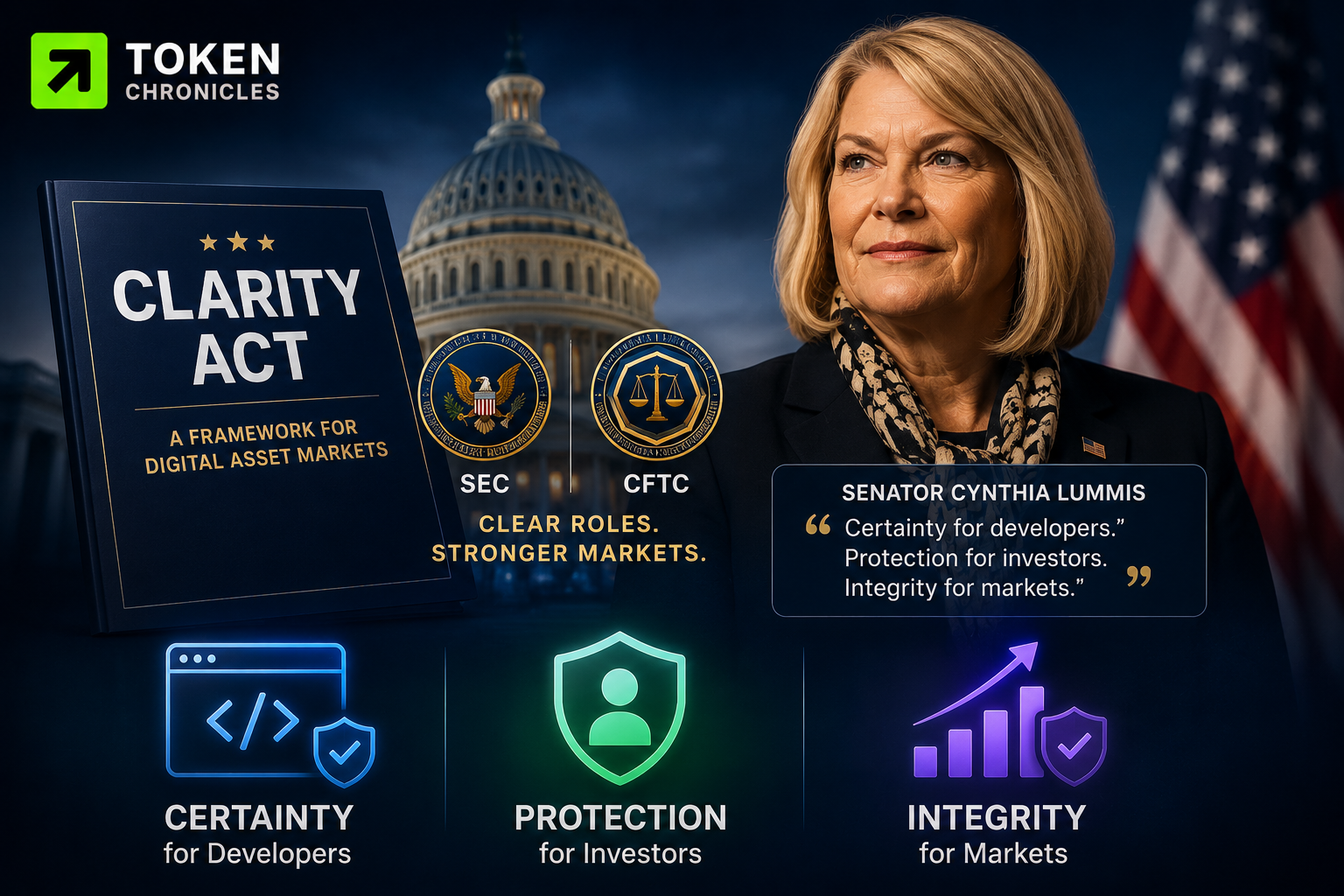
U.S. Senator Cynthia Lummis is making the case for the CLARITY Act, arguing that the proposed legislation could deliver three major benefits to the digital asset industry: regulatory certainty for developers, stronger protections for investors, and greater integrity across crypto markets.
The legislation is part of a broader congressional effort to establish a comprehensive U.S. regulatory framework for digital assets. A central goal is to clarify the respective roles of the Securities and Exchange Commission (SEC) and the Commodity Futures Trading Commission (CFTC), an issue that has created years of uncertainty for crypto companies and investors.
However, the legislation has not yet become law, meaning its final provisions and regulatory impact remain subject to congressional negotiations and potential amendments.
Lummis highlights three core benefits
Lummis summarized her argument for the legislation around three priorities: certainty for developers, protection for investors, and integrity for markets.
For crypto developers and businesses, clearer legislation could provide more predictable rules for determining how digital assets and related activities are regulated. Supporters argue this could reduce reliance on enforcement actions and court battles to establish regulatory boundaries.
For investors, the legislation aims to introduce stronger consumer safeguards, particularly around the custody and treatment of customer assets.
For markets, clearer oversight responsibilities could establish more consistent standards for exchanges and other digital asset intermediaries while giving regulators additional authority to supervise crypto activity.
SEC and CFTC Jurisdiction is central to the debate
One of the most important elements of crypto market structure legislation is determining which federal regulator oversees different parts of the digital asset market.
For years, the SEC and CFTC have operated under different statutory mandates, contributing to disputes over whether particular crypto assets or transactions fall under securities or commodities laws.
Supporters of the CLARITY Act argue that Congress needs to establish clearer legal boundaries rather than leaving major regulatory questions to enforcement actions, agency interpretations and litigation.
The framework could also expand the CFTC’s authority over certain digital asset spot markets, depending on the final legislation approved by Congress.
Such changes could significantly reshape how crypto exchanges, brokers and other intermediaries operate in the United States.
Consumer protection takes center stage
Lummis has also emphasized customer asset protection, pointing to the collapses of FTX, Celsius and Voyager as examples of weaknesses exposed during the 2022 crypto crisis.
Millions of customers faced lengthy bankruptcy proceedings after losing access to assets held on failed platforms.
A major policy question emerging from those collapses is how customer crypto assets should be treated when a digital asset company enters bankruptcy.
Supporters of stronger market structure rules want clearer protections separating customer property from corporate assets, reducing uncertainty over ownership during insolvency proceedings.
Such protections could help ensure that customer assets receive clearer legal treatment if another major crypto intermediary fails.
However, new legislation would primarily establish rules for future market activity and would not automatically resolve existing bankruptcy disputes unless Congress explicitly included retroactive provisions.
Developer protections could be another major Component
Another important issue involves legal protections for software developers who build decentralized blockchain infrastructure.
The crypto industry has repeatedly argued that developers who create non-custodial software should not automatically face the same regulatory obligations as financial intermediaries that directly control customer assets or execute transactions on their behalf.
Lummis has argued that congressional legislation could provide clearer protections for developers while still allowing law enforcement agencies to pursue illicit financial activity.
The distinction between writing software and operating a financial intermediary has become an increasingly important issue in U.S. crypto policy.
Law enforcement and illicit finance remain key priorities
Supporters also argue that comprehensive market structure legislation could improve cooperation between crypto platforms and law enforcement.
Clearer regulatory requirements could establish more standardized mechanisms for exchanges and investigators to respond to suspicious transactions, sanctions violations and other illicit financial activity.
The challenge for lawmakers is balancing those enforcement powers with privacy protections, technological innovation and the decentralized nature of blockchain networks.
Lummis has argued that stronger regulation and stronger innovation do not have to be opposing objectives.
CLARITY builds on the U.S. Stablecoin framework
Lummis has positioned broader crypto market structure legislation as the next major step following federal stablecoin regulation.
The GENIUS Act, signed into law in July 2025, established a federal framework for payment stablecoins. Supporters now want Congress to extend regulatory clarity to the broader digital asset market.
While stablecoin legislation addresses a specific category of dollar-linked digital assets, market structure legislation tackles a much wider set of questions involving crypto trading, regulatory jurisdiction, intermediaries, consumer assets and decentralized technology.
The stakes are therefore considerably broader.
The Bill still faces a political test
Despite strong support from parts of the crypto industry, the CLARITY Act’s path through Congress remains uncertain.
Lawmakers continue to debate issues including consumer protections, developer rights, market manipulation safeguards, illicit finance controls, regulatory jurisdiction and political conflicts of interest.
Any final framework will likely require bipartisan support to navigate the Senate.
For Lummis and other supporters, the objective is to move the United States away from years of regulatory uncertainty toward a statutory framework that can simultaneously support innovation and strengthen oversight.
Whether the final legislation delivers on its three stated goals of developer certainty, investor protection and market integrity will ultimately depend on the language Congress agrees to and how that framework is implemented by federal regulators.