
Key Highlights
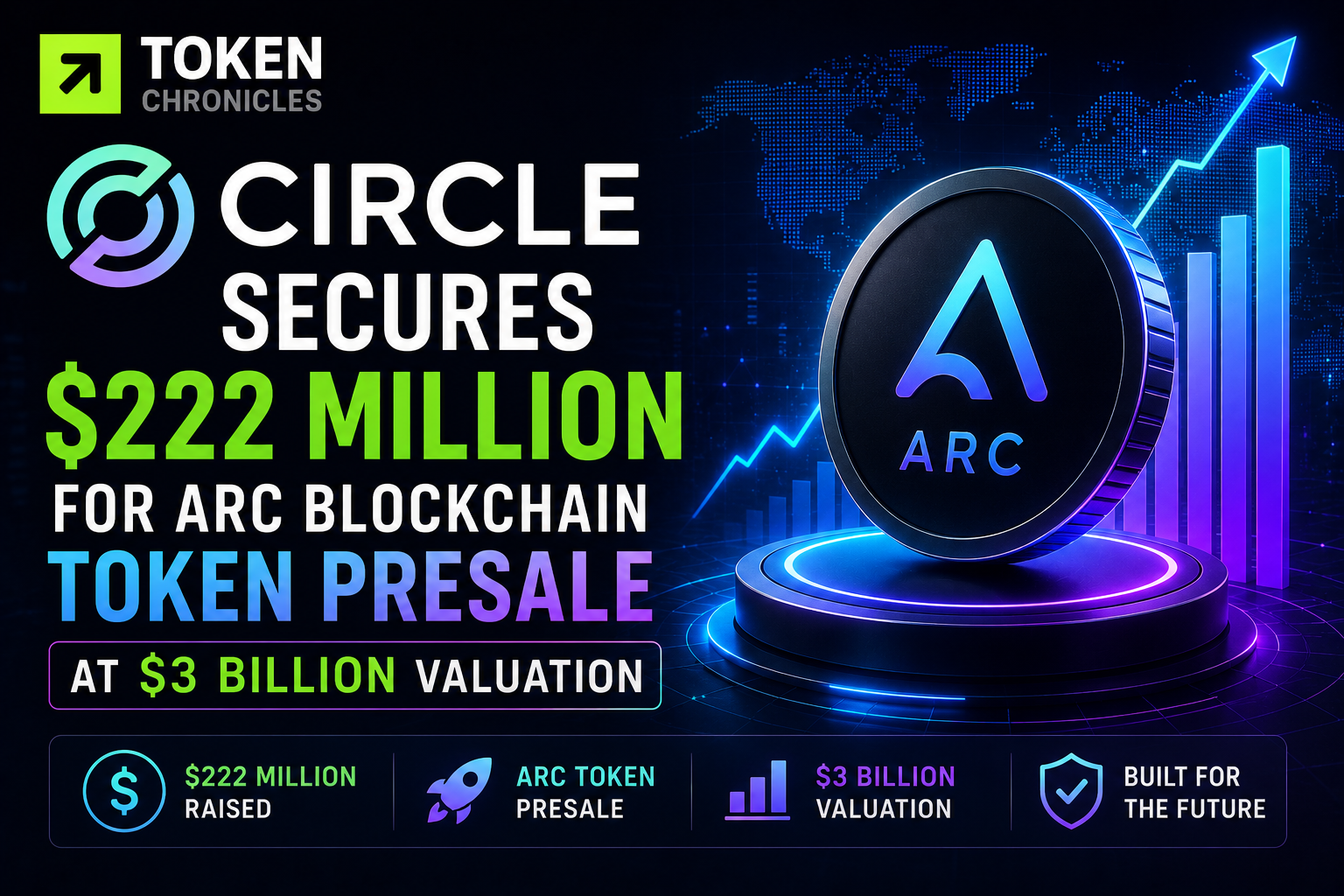
- Circle raised $222 million through the presale of Arc, the native token powering its upcoming blockchain network.
- The funding round values the Arc ecosystem at a fully diluted valuation of $3 billion.
- Major investors included Andreessen Horowitz, BlackRock, Apollo Funds, and Intercontinental Exchange.
- Circle CEO Jeremy Allaire said the company is expanding beyond stablecoins into blockchain infrastructure, applications, and AI-driven financial systems.
Circle Internet Group has raised $222 million in an early token sale tied to Arc, its newly announced public blockchain network, marking a major step in the company’s evolution beyond the USDC stablecoin business.
The fundraising round places Arc at a fully diluted valuation of approximately $3 billion and represents one of the most significant institutional blockchain infrastructure investments of the year.
Andreessen Horowitz’s crypto division, a16z crypto, led the round with a $75 million investment. Other participants included major financial and investment firms such as BlackRock, Apollo Funds, Intercontinental Exchange, SBI Group, Janus Henderson Investors, Standard Chartered Ventures, General Catalyst, ARK Invest, Haun Ventures, and crypto exchange operator Bullish.
Circle Expands Beyond Stablecoins
In an interview with CNBC, Circle CEO Jeremy Allaire described blockchain infrastructure as becoming as foundational as cloud computing platforms and mobile operating systems.
According to Allaire, Circle aims to transform into a broader internet infrastructure company by building a decentralized operating system supported by multiple institutional stakeholders.
“We’re entering the operating system business,” Allaire explained, adding that Circle intends to create a distributed network where major companies help operate, govern, and expand the ecosystem through the Arc token model.
The company also plans to move deeper into application development alongside blockchain infrastructure services.
Arc Targets Institutional Finance
Arc is being positioned as a public blockchain specifically designed for institutional-grade financial activity. While USDC remains central to Circle’s ecosystem, Allaire emphasized that Arc is intended to support a much broader digital economy beyond stablecoin payments.
He explained that blockchain networks will increasingly manage financial contracts, governance systems, and automated economic relationships that currently rely on traditional institutions and manual processes.
Circle will control roughly 25% of Arc’s initial 10 billion token supply, allowing the company to participate in network validation, staking, and transaction fee generation. Around 60% of tokens are reserved for developers, users, and ecosystem contributors, while the remaining 15% will be held in long-term reserves.
AI and Blockchain Convergence
Circle also unveiled new developer tools designed to support AI-powered financial agents capable of handling transactions, accessing online services, and making payments using USDC.
Allaire said the future economy will increasingly be operated by software and autonomous AI systems rather than humans performing routine contractual and operational tasks.
“We’re entering an era where software machines power large parts of the economy,” he said, describing AI agents as the next major layer of digital economic infrastructure.
Strategic Shift as Competition Intensifies
Circle’s Arc initiative reflects a broader transition taking place across the crypto industry. Companies that originally built businesses around speculative cryptocurrency cycles are now seeking more stable, diversified, and infrastructure-focused revenue models.
Although USDC has become one of the most widely used regulated stablecoins for institutions, Circle still relies heavily on external networks such as Ethereum and Solana for settlement and on distribution partners like Coinbase.
If Arc succeeds, Circle could gain greater control over the infrastructure supporting USDC and reduce dependence on third-party blockchains.
The launch also comes as stablecoin competition intensifies. New U.S. regulations, including the GENIUS Act and the proposed CLARITY Act, have strengthened legal support for stablecoins, but they have also increased expectations that banks and fintech companies may eventually issue their own dollar-backed digital assets.
A New Era for Tokenized Fundraising
Circle’s Arc presale is notable because it marks the first time a publicly traded company has conducted a large-scale token presale tied to a blockchain ecosystem.
Token sales, often compared to IPOs, allow projects to raise capital while simultaneously building early user communities and distributing transferable digital assets.
While initial coin offerings (ICOs) became controversial during the 2017 crypto boom due to scams and poorly regulated fundraising, the regulatory landscape has changed significantly in recent years.
Under the current pro-crypto regulatory climate in the United States, regulators are increasingly exploring frameworks for compliant tokenized securities and blockchain-based capital formation, potentially paving the way for a more mature version of ICO-style fundraising.
Allaire believes tokenization will eventually extend far beyond crypto startups.
“Over time, every company will become tokenized,” he said, predicting that digital tokens will increasingly serve as both ownership instruments and engagement tools between businesses and their customers.