

Blockchain analytics firm Chainalysis says the crypto industry has significantly strengthened its compliance standards in recent years, although important anti-money laundering (AML) gaps still remain across the market.
According to a new report preview released on May 27, many crypto companies entering the market in 2026 are launching with compliance systems that are far stricter than those commonly used just five years ago.
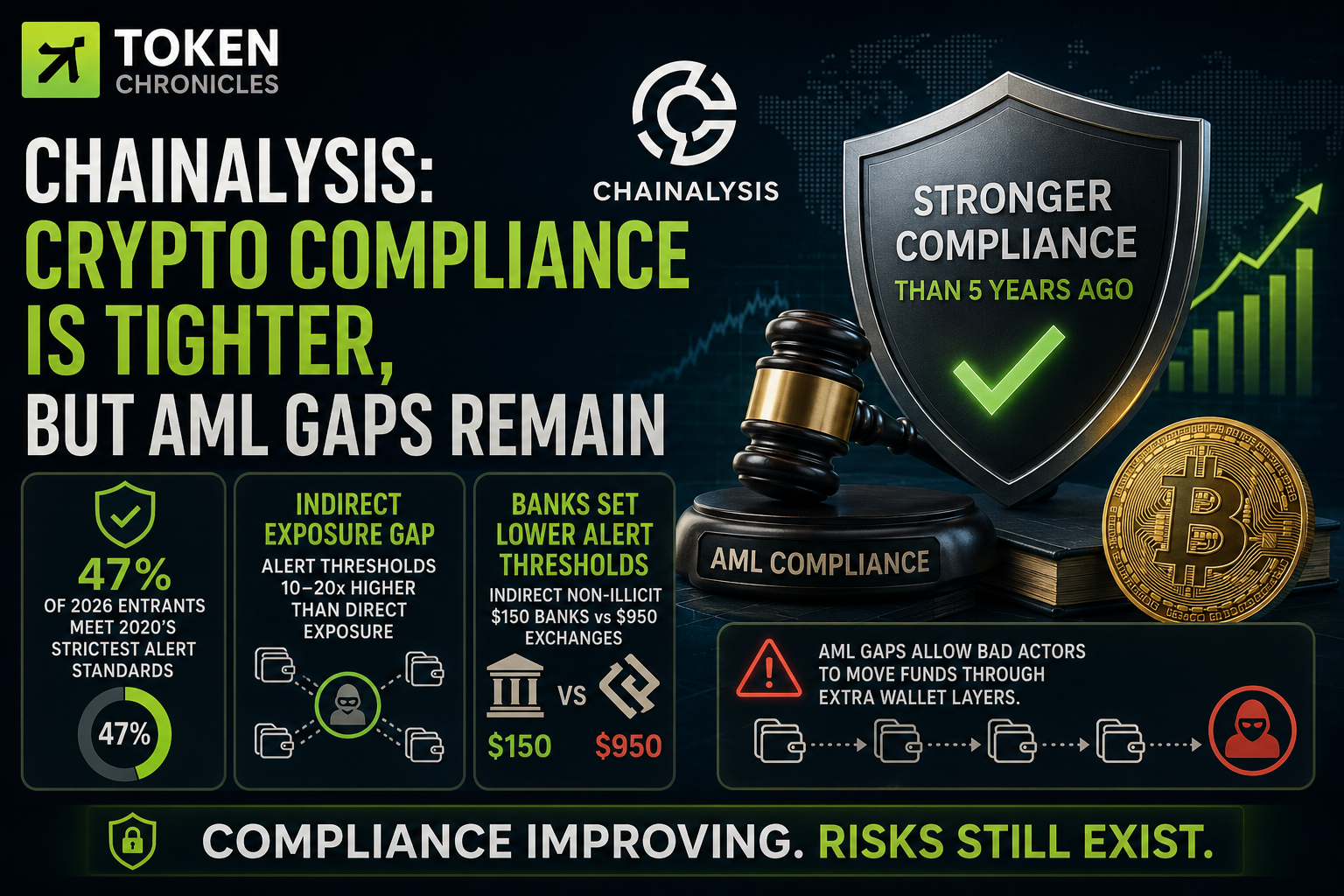
Chainalysis found that nearly 47% of organizations onboarded in 2026 now operate with alerting standards that would have ranked among the strictest 10% of the industry back in 2020.
The report evaluated:
- Alert sensitivity
- Risk trigger thresholds
- Monitoring severity
- Minimum transaction values for suspicious activity detection
The company said this reflects how rapidly compliance expectations have evolved across the crypto sector.
“Standard compliance configurations today would have been considered industry-leading just five years ago,” Chainalysis stated.
Indirect Exposure Still Creates Major AML Risks
Despite these improvements, Chainalysis warned that indirect exposure monitoring remains one of the industry’s biggest weak points.
The report distinguishes between:
- Direct exposure: funds sent directly from known illicit sources
- Indirect exposure: funds routed through intermediary wallets before reaching exchanges or platforms
While direct monitoring has become more standardized globally, indirect monitoring thresholds often remain much weaker.
According to Chainalysis, alert thresholds for indirect exposure tied to:
- Ransomware
- Scam operations
- Darknet markets
- Fraud networks
- Sanctioned jurisdictions
can sometimes be set 10 to 20 times higher than thresholds for direct exposure.
This creates opportunities for bad actors to move funds through multiple wallet layers before detection systems are triggered.
Traditional Banks Still Use Stricter Monitoring
The report also found that traditional financial institutions generally maintain tighter AML monitoring settings than crypto exchanges.
For non-illicit indirect exposure:
- Crypto exchanges set average alert minimums near $950
- Traditional banks average around $150
Even for explicitly illicit flows, banks continue applying stricter thresholds:
- Crypto exchanges often trigger alerts starting at around $100
- Banks typically begin monitoring from roughly $55
Chainalysis noted that these differences are becoming increasingly important as banks continue expanding into:
- Stablecoins
- Tokenized assets
- Crypto custody services
- Blockchain-based payments
Regulatory Pressure Increasing Across Crypto Industry
The findings arrive as compliance scrutiny continues growing throughout the digital asset sector.
Earlier this year, prediction market platform Polymarket partnered with Chainalysis to strengthen monitoring against insider trading and market manipulation after its trading volume surpassed $7 billion per month.
At the same time, regulators and blockchain investigators have increased pressure on:
- Cross-chain bridges
- Stablecoin issuers
- Major exchanges like Binance
- DeFi protocols
- Crypto payment systems
Chainalysis also reported that North Korean-linked hacking groups stole more than $2 billion worth of crypto assets in 2025 alone, intensifying demands for stronger AML systems and transaction monitoring across the industry.
Industry Moving Toward Stricter Compliance Standards
Overall, the report suggests the crypto industry is gradually maturing from a lightly monitored market into one with increasingly sophisticated compliance infrastructure.
However, Chainalysis warns that improving direct transaction monitoring alone is no longer enough.
As bad actors adopt more advanced laundering techniques involving intermediary wallets, bridges, and cross-chain transfers, exchanges and financial institutions may need far stronger indirect exposure monitoring systems to fully close existing AML gaps.