
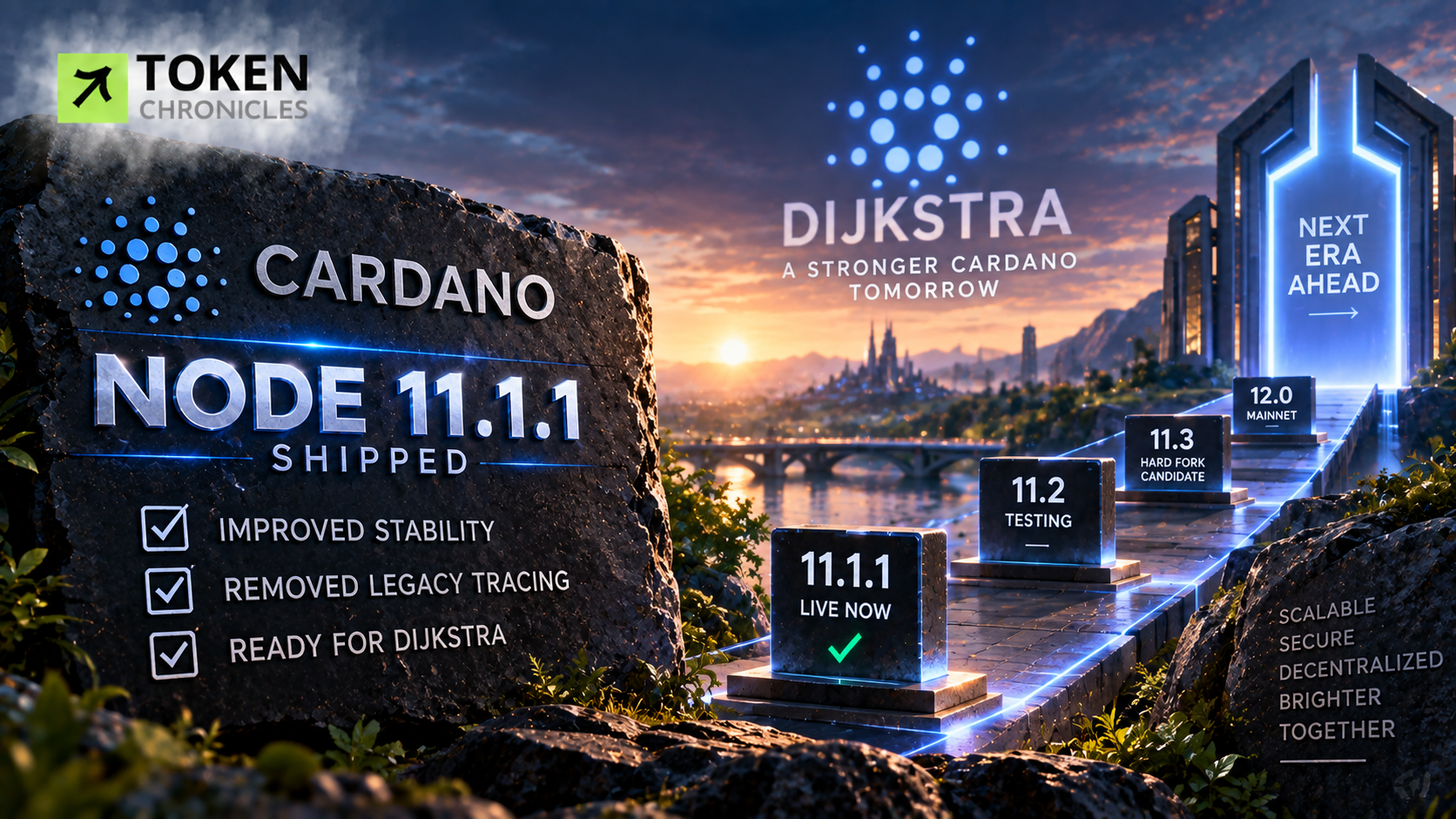
Cardano has released node version 11.1.1, marking the first major milestone in a four-step software rollout designed to prepare the network for its upcoming Dijkstra era.
The maintenance release arrives as Cardano’s development organization, Intersect, publishes a more detailed roadmap for the hard fork. The plan calls for progressively more advanced node versions, followed by public testing and eventually a protocol version 12 release for mainnet activation.
While the current schedule points toward a possible Dijkstra activation between December 5, 2026, and January 4, 2027, Intersect describes that timeframe as a moderate-confidence estimate, rather than a fixed launch date. A later window from February 24 to March 26, 2027 provides additional time if development, testing or governance requirements delay the transition.
Key Takeaways
- Cardano node 11.1.1 has been released as the first milestone toward Dijkstra.
- Node 11.2 is expected to make most Dijkstra features available for testing.
- DijkstraNet will provide a public environment for testing Plutus V4, Nested Transactions and CIP-50.
- Node 11.3 is planned as the Dijkstra hard-fork candidate and is expected to include Linear Leios.
- Mainnet activation remains dependent on technical readiness and on-chain governance approval.
- Peras is planned separately for the second quarter of 2027.
Node 11.1.1 Starts the Dijkstra Release Sequence
Node 11.1.1 was published through Intersect’s official container registry during the weekend ending September 6.
The release is primarily a maintenance and infrastructure update rather than the Dijkstra upgrade itself. It removes Cardano’s legacy tracing infrastructure and addresses known Genesis-related operational issues.
Developers also identified elevated memory consumption during testing of the previous 11.1.0 release, making the latest version an important stabilization step before Cardano moves toward the more substantial Dijkstra releases.
The package is available for multiple processor architectures, including AMD64 and ARM64, allowing stake pool operators and developers using different hardware configurations to adopt the release.
The next milestone is node 11.2, which is expected to arrive roughly a month after Intersect’s September 5 update.
Unlike 11.1.1, node 11.2 will introduce most of the Dijkstra feature set for testing. However, it will initially exclude Leios consensus components, which are being handled separately as part of the network’s consensus and block-production development.
DijkstraNet Will Open Public Testing
Following the release of node 11.2, Intersect plans to launch DijkstraNet, a public testing network dedicated to the upcoming protocol changes.
The testnet is expected to allow developers, stake pool operators and infrastructure providers to examine major Dijkstra functionality before the features are considered ready for Cardano’s mainnet.
Among the features expected to receive testing are:
- Plutus V4
- Nested Transactions
- CIP-50 parameters
- New script functionality
- Address-related changes
- Block-body serialization updates
- Changes to reward withdrawals
Nested Transactions Could Expand Cardano’s Application Design
One of the notable additions is Nested Transactions, which would allow a Cardano transaction to contain other transactions while maintaining separate validation conditions.
The architecture could make it easier to construct more sophisticated applications involving coordinated actions, multi-party workflows and complex transaction sequences.
Meanwhile, Plutus V4 represents the next stage of Cardano’s smart-contract environment. Its rollout will require testing across wallets, decentralized applications, indexers and other infrastructure to ensure that the ecosystem correctly handles the new ledger rules.
CIP-50 will also introduce changes involving pledge leverage and staking rewards, meaning stake pool operators will need to evaluate how the updated parameters could affect their economics.
DijkstraNet and MusashiNet Will Serve Different Purposes
Cardano is not relying on a single testing environment for the broader upgrade.
DijkstraNet will focus primarily on the ledger and transaction-related elements of Dijkstra, while MusashiNet is already being used for testing Leios, consensus and block production.
Running these efforts in parallel allows different parts of the upgrade to advance independently before eventually being combined into the software version selected for the mainnet hard fork.
This separation is particularly important because the Dijkstra upgrade involves more than new application functionality. Cardano must also validate how the proposed consensus architecture performs under real network conditions.
Node 11.3 Will Bring Dijkstra and Linear Leios Together
The next major milestone is Cardano node 11.3, which Intersect expects within roughly one to two months of its September 5 update.
Unlike node 11.2, version 11.3 is expected to contain the complete Dijkstra feature set, including Linear Leios. It is also intended to become the candidate release used to rehearse the transition from Cardano’s current Conway era into Dijkstra.
Linear Leios represents Cardano’s planned first-stage implementation of the broader Ouroboros Leios architecture.
The approach introduces parallel transaction-processing structures around the existing Praos consensus design, with the objective of increasing network throughput without abandoning the underlying security model.
However, higher throughput alone will not determine whether the technology is ready.
Testing will also need to examine:
- Block propagation
- Network bandwidth
- Resource consumption
- Synchronization
- Recovery behavior
- Performance during adverse network conditions
The final protocol version will be node 12.0, which will represent the definitive protocol version 12 release. Intersect has not yet assigned a specific publication date.
Dijkstra’s Launch Date Is Still Not Guaranteed
Intersect currently places the potential Dijkstra activation between December 5, 2026, and January 4, 2027, but explicitly categorizes that period as a moderate-confidence window.
A second window, running from February 24 through March 26, 2027, provides additional room for testing and preparation if the earlier target cannot be achieved.
Neither period represents a guaranteed hard-fork date.
Before Dijkstra can reach mainnet, Cardano must complete software development, public testing, ecosystem preparation and the required governance process.
Cardano Governance Must Approve the Upgrade
A software release alone cannot activate Dijkstra.
Cardano’s on-chain governance system must approve the constitutional and hard-fork actions required to move the network to protocol version 12.
Some of the new Dijkstra parameters also need to be incorporated into the constitutional guardrails before governance participants can modify them.
The approval process involves multiple groups, including delegated representatives, stake pool operators and the Constitutional Committee.
Cardano already demonstrated this governance mechanism during the van Rossem hard fork, which moved the network to protocol version 11 after completing the required on-chain approval process.
Dijkstra is expected to be considerably broader, however, because it changes the ledger era while introducing more extensive transaction, smart-contract and consensus capabilities.
That means exchanges, wallets, blockchain explorers, decentralized applications and other ecosystem infrastructure will all need to prepare for the transition.
Node Diversity Becomes Another Part of the Preparation
Cardano is also working on Amaru, an alternative node implementation written in Rust.
Amaru can already validate and synchronize with the chain tip, while mainnet block production is currently targeted for November 2026.
The development of an alternative client could reduce the network’s reliance on a single Haskell-based implementation and provide additional resilience.
At the same time, it creates another testing requirement: different node implementations must interpret Cardano’s protocol rules consistently.
Intersect is encouraging developers and stake pool operators to participate in both MusashiNet and DijkstraNet testing. The organization has also scheduled node-diversity workshops in Singapore on October 6 and London on November 13–14.
Peras Remains a Separate 2027 Upgrade
Dijkstra itself is being developed in two broad phases.
Phase 1 focuses on the era transition, Nested Transactions and Linear Leios, with mainnet readiness targeted around the end of 2026, subject to testing and governance.
Phase 2 will introduce Ouroboros Peras through a separate intra-era hard fork, currently targeted for the second quarter of 2027.
Peras is designed to use stake-based voting on recent chain tips to accelerate settlement and provide stronger confirmation sooner than conventional chain-depth mechanisms.
Although Phase 1 will install some of the codecs and protocol parameters required for Peras, the finality mechanism itself will not be activated until the later upgrade.
Peras will therefore require its own testing, readiness assessment and governance approval.
What Comes Next for Cardano
The release of node 11.1.1 represents an important but relatively early step in Cardano’s Dijkstra journey.
The immediate milestones are the adoption of node 11.1.1, the release of node 11.2, the public launch of DijkstraNet and the preparation of the constitutional amendments needed for governance.
Node 11.3 will then become a critical checkpoint, as it is expected to bring together the broader Dijkstra feature set and Linear Leios for more comprehensive testing.
Only after those technical milestones are completed and Cardano’s governance process provides the required approvalcan the network proceed with the Dijkstra hard fork.
For now, the roadmap points toward a potentially significant Cardano upgrade at the end of 2026 or early 2027, but the schedule remains conditional rather than guaranteed.