


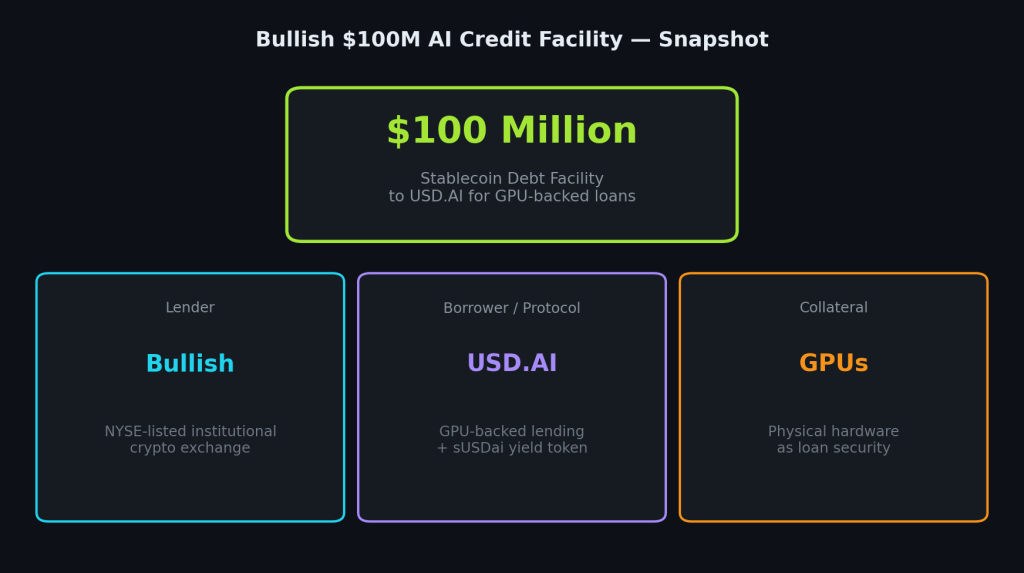
Institutional crypto exchange Bullish has extended a $100 million stablecoin debt facility to USD.AI to support loans backed by graphics processing units (GPUs), bringing together two rapidly growing trends: AI infrastructure financing and tokenized real-world assets. Bullish also plans to list USD.AI’s yield-bearing sUSDai token on its trading platform.
- Bullish has provided USD.AI with a $100 million stablecoin credit facility for GPU-backed financing.
- The deal connects institutional crypto markets with the growing demand for AI infrastructure capital.
- Bullish plans to list sUSDai, USD.AI’s yield-bearing digital asset.
- Falling GPU values and rapid hardware obsolescence could pose significant risks to the lending model.
Bullish Backs the Growing AI Credit Market
Artificial intelligence is creating enormous demand for computing infrastructure, but building and expanding that infrastructure requires substantial amounts of capital. Bullish is now betting that GPU-backed lending could become an important part of that financing ecosystem.
The NYSE-listed institutional digital asset platform announced that it had extended a $100 million stablecoin debt facility to USD.AI. The capital will be used to finance loans to companies involved in AI and related infrastructure.
The model is relatively straightforward: AI businesses can use valuable GPUs as collateral to obtain financing, allowing them to raise capital without relying entirely on traditional forms of corporate debt.
Bullish sees the opportunity as part of a much larger private-credit market emerging around AI infrastructure. The company has argued that the capital requirements of AI computing have created a financing sector capable of rivaling or exceeding some established categories of private borrowing.
This reflects a broader shift in the financial landscape as investors look for ways to gain exposure to the enormous amounts of capital required to build data centers, acquire computing equipment, and expand AI capacity.
Real-World Assets Move Further Onchain
The agreement also represents a significant bet on the tokenization of real-world assets (RWAs).
Bullish, established in Hong Kong in 2020 by Block.one co-founder and CEO Brendan Blumer, has increasingly positioned tokenization as an important bridge between traditional financial assets and blockchain-based markets.
Thomas Cowan, Bullish’s Head of Tokenization, said the company believes credible real-world assets should increasingly be connected to digital financial infrastructure.
According to Cowan, USD.AI’s onchain transparency provided Bullish with the information required to conduct institutional-style due diligence before extending the facility.
The strategy effectively combines traditional physical collateral with blockchain-based financing. GPUs remain physical assets, but the lending and financial claims associated with them can be represented and managed through onchain infrastructure.
Bullish also announced plans to list sUSDai, USD.AI’s yield-bearing crypto asset, on its trading platform. The listing could provide institutional and sophisticated investors with another avenue for gaining exposure to the emerging GPU-financing market.
Bullish Shares Continue to Gain
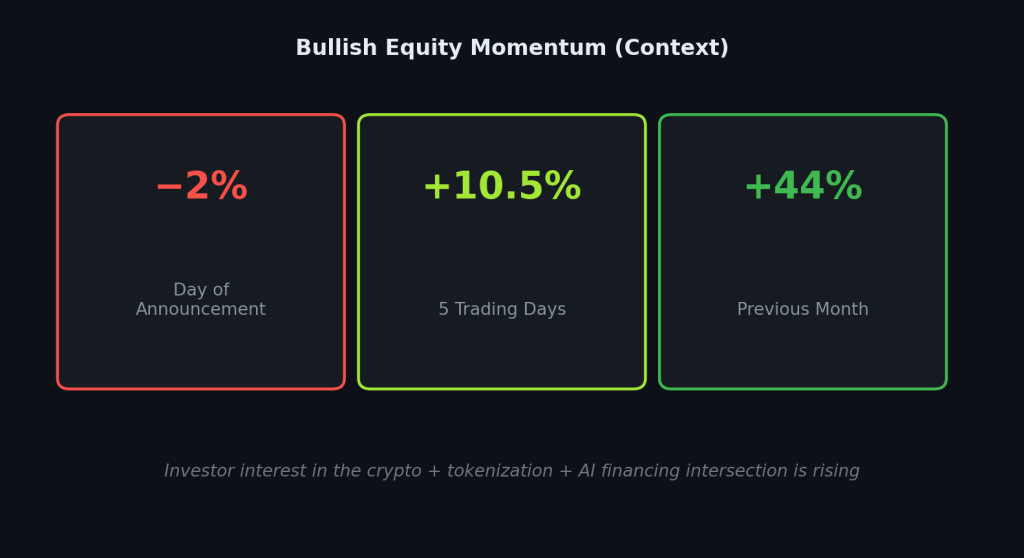
The deal comes as Bullish’s stock has experienced significant momentum.
Although the company’s shares were down roughly 2% on the day following the announcement, the stock had gained about 10.5% over five trading days and more than 44% over the previous month.
The market performance highlights growing investor interest in companies operating at the intersection of digital assets, tokenization, and institutional financial infrastructure.
However, the long-term success of GPU-backed lending will depend on whether the underlying collateral retains enough value throughout the life of the loans.
GPU Collateral Faces a Major Stress Test
The biggest challenge for the model is the same factor driving demand for GPUs in the first place: rapid technological change.
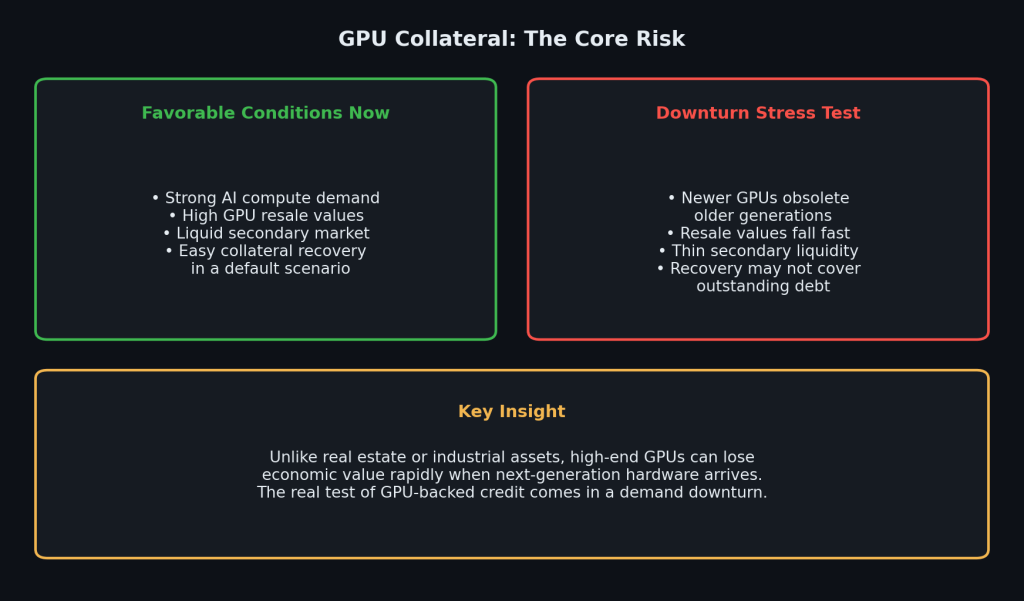
High-end GPUs can be extremely valuable when computing demand is strong, but their resale value can decline rapidly when newer and more powerful hardware becomes available. Unlike traditional real estate or certain industrial assets, computing hardware can become economically obsolete within a relatively short period.
That creates a potentially important risk for lenders.
If an AI company defaults on a GPU-backed loan, the lender may need to liquidate the hardware. But if GPU prices have fallen significantly—or if newer generations have made the collateral less attractive—the proceeds from the sale may not be sufficient to cover the outstanding debt.
This makes the performance of GPU-backed credit particularly sensitive to AI demand, hardware prices, technological obsolescence, and secondary-market liquidity.
For now, strong demand for AI computing has created favorable conditions for the model. The real test, however, will come when the AI financing cycle faces a downturn and lenders are forced to determine how much those GPUs are actually worth.
A New Frontier for Tokenized Credit
Bullish’s $100 million commitment illustrates how AI infrastructure, private credit, stablecoins, and tokenized real-world assets are increasingly converging.
If GPU-backed lending can maintain strong underwriting standards and withstand fluctuations in hardware prices, it could become a new source of capital for the rapidly expanding AI economy.
But the model remains relatively young. Its ultimate credibility will depend not on the value of GPUs during an AI boom, but on how effectively lenders manage collateral and defaults when market conditions become less favorable.
The next major test for tokenized AI credit may therefore come not from another funding announcement, but from the first serious downturn in GPU values.