

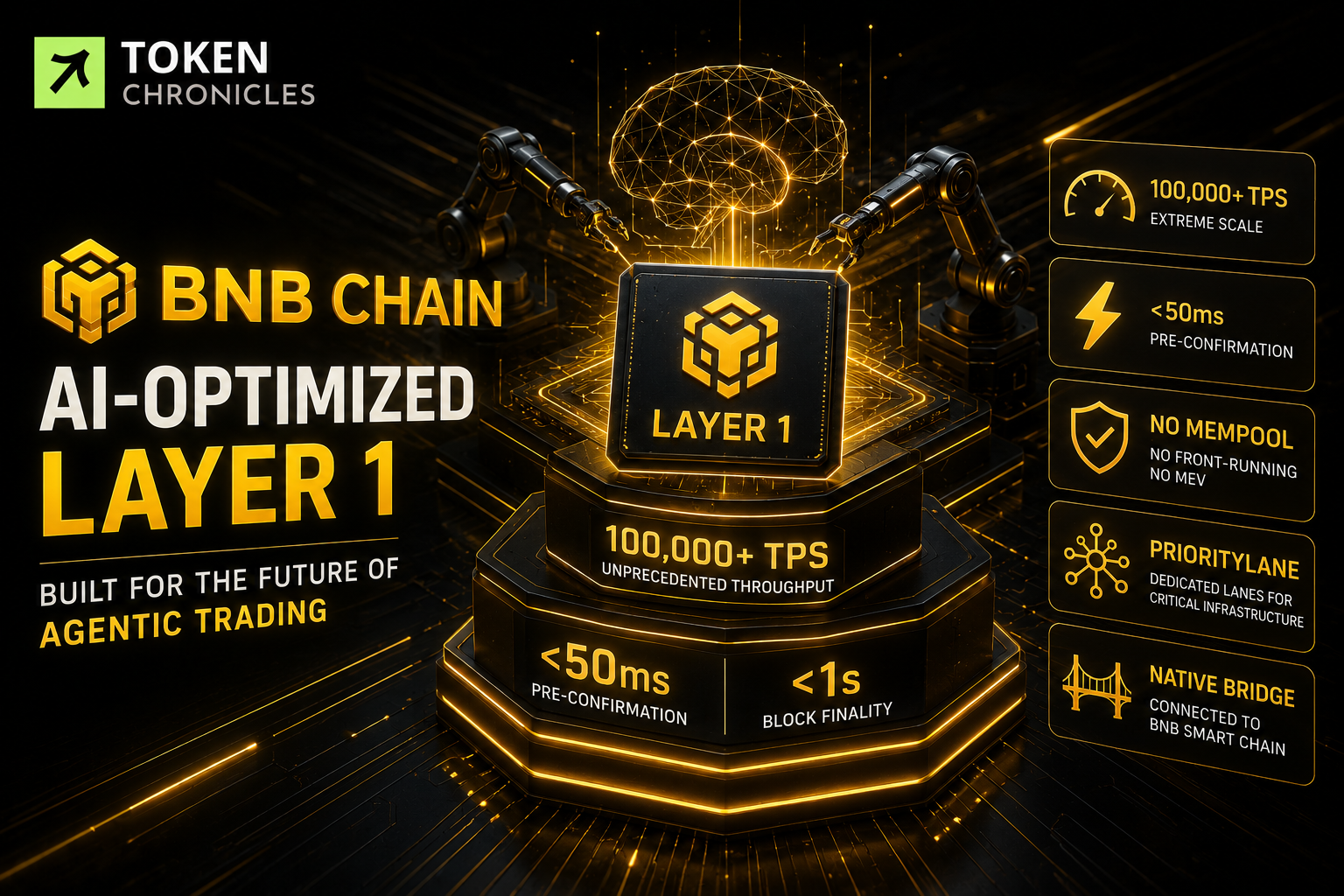
BNB Chain has announced plans to build a next-generation Layer 1 blockchain designed specifically for the emerging era of AI-powered autonomous trading. The new network, revealed as part of BNB Chain’s H2 2026 technical roadmap, will operate alongside the existing BNB Smart Chain ecosystem and is engineered to deliver centralized exchange-level performance while preserving blockchain decentralization and self-custody.
The project aims to achieve over 100,000 transactions per second (TPS), transaction pre-confirmations in under 50 milliseconds, and block finality in less than one second. A public testnet is expected by the end of 2026, with a full mainnet launch planned for early 2027.
Purpose-Built for AI Agentic Trading
Unlike traditional blockchains built primarily for human users, the new Layer 1 is being designed to support AI agents capable of executing trades, managing liquidity, arbitraging markets, and interacting with decentralized applications autonomously.
As AI-powered financial systems become increasingly sophisticated, existing blockchain infrastructure often struggles with network congestion, transaction latency, and execution bottlenecks.
BNB Chain’s new architecture seeks to solve these challenges by creating a blockchain optimized for machine-speed financial activity rather than conventional user interactions.
Performance Comparable to Centralized Exchanges
The upcoming blockchain introduces several major infrastructure upgrades aimed at dramatically increasing performance.
Key targets include:
- 100,000+ Transactions Per Second (TPS)
- Less than 50 milliseconds transaction pre-confirmation
- Sub-one-second transaction finality
- Conflict-free parallel transaction execution
- Advanced LtHash-based storage architecture
If achieved, these performance levels would position the network among the fastest public blockchains in operation, enabling high-frequency onchain trading without sacrificing decentralization.
Eliminating Front-Running and MEV
One of the most significant innovations proposed for the network is the removal of the traditional public mempool, where pending blockchain transactions are typically visible before execution.
Public mempools have long enabled Maximal Extractable Value (MEV) strategies such as:
- Front-running
- Sandwich attacks
- Transaction reordering
- Arbitrage exploitation
To address this issue, BNB Chain plans to introduce a proprietary transaction routing system called TxStream.
Instead of broadcasting transactions publicly, TxStream will send orders directly to the designated block producer, preventing malicious actors from observing and exploiting pending trades before they are confirmed.
This approach aims to create a fairer and more secure trading environment for both retail users and autonomous AI trading systems.
Dedicated Infrastructure for Critical Services
The new blockchain will also feature a specialized execution framework known as PriorityLane.
PriorityLane creates dedicated transaction lanes for critical network operations, ensuring they continue operating efficiently even during periods of heavy blockchain activity.
These protected execution channels will support:
- Price oracle updates
- Liquidation engines
- Cross-chain bridge operations
- Core network infrastructure
- High-priority smart contract execution
By isolating essential services from general transaction traffic, the network aims to maintain stability during periods of peak demand.
Expanding the BNB Chain Ecosystem
The AI-focused Layer 1 will become the fourth blockchain within the broader BNB Chain ecosystem.
Rather than replacing the existing BNB Smart Chain (BSC), the new network will work alongside it while remaining connected through a native low-latency asset bridge.
BNB Smart Chain will continue serving as the ecosystem’s primary settlement and security layer, while the new blockchain focuses on ultra-fast execution for AI-driven financial applications.
This modular approach allows BNB Chain to scale without disrupting its existing infrastructure.
Preparing for the Future of Autonomous Finance
The announcement reflects a broader shift occurring across the blockchain industry as artificial intelligence becomes increasingly integrated into decentralized finance.
Future financial markets may see autonomous AI agents executing trades, managing portfolios, optimizing liquidity, and interacting with smart contracts around the clock without human intervention.
Supporting this new generation of applications requires blockchain infrastructure capable of processing massive transaction volumes with extremely low latency.
BNB Chain’s latest initiative positions the ecosystem to compete in this emerging segment of AI-native financial infrastructure.
Why It Matters
BNB Chain’s proposed AI-optimized Layer 1 represents one of the most ambitious blockchain performance upgrades announced to date. By targeting 100,000+ TPS, sub-50ms confirmations, and eliminating traditional mempool vulnerabilities, the network aims to provide the speed, fairness, and scalability required for autonomous AI-driven finance.
As AI agents increasingly participate in trading, liquidity management, and decentralized applications, specialized high-performance blockchains like this could become the foundation for the next generation of Web3 infrastructure, where machines not just humans interact with financial markets in real time.