

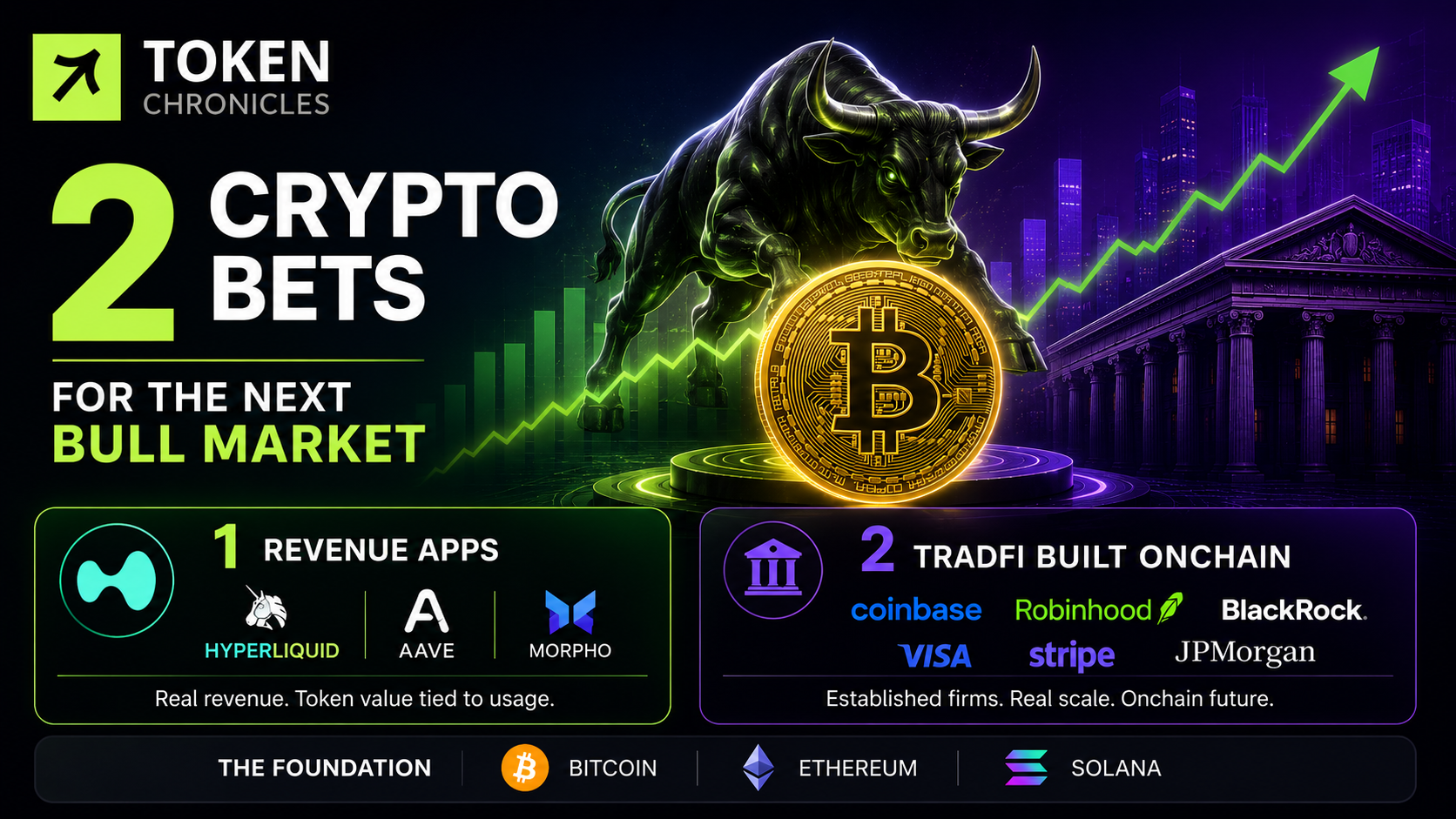
Bitwise Chief Investment Officer Matt Hougan has identified two areas of the crypto market he believes could be particularly well positioned for the next major bull cycle: revenue-generating crypto applications and established financial companies building real businesses on blockchain infrastructure.
Hougan’s thesis centers on the growing convergence between traditional finance and onchain markets. He expects stablecoins, asset tokenization, 24/7 financial markets and blockchain-based trading infrastructure to become increasingly important drivers of the industry’s next phase.
At the same time, Hougan remains bullish on Bitcoin, Ethereum and Solana, viewing the three major crypto assets as foundational exposure to broader industry growth.
Revenue generating crypto applications could lead the Next cycle
Hougan’s first major investment theme focuses on crypto protocols that generate meaningful revenue and create a direct connection between platform growth and token economics.
Rather than relying primarily on speculation, these projects operate more like digital businesses, attracting users, generating fees and potentially returning economic value to their token ecosystems.
Hougan highlighted Hyperliquid and its HYPE token as a leading example of this emerging model.
Hyperliquid operates its own Layer 1 blockchain alongside a major decentralized perpetual futures trading platform. Its rapid growth has demonstrated how an onchain application can generate significant economic activity while integrating its token directly into the platform’s financial model.
According to Hougan, Hyperliquid is on pace to generate close to $800 million in annual revenue, with much of the platform’s economic activity supporting HYPE token buybacks.
That structure creates a clearer relationship between platform usage and token demand than many earlier-generation crypto projects.
Hougan argued that HYPE’s strong performance despite broader weakness in parts of the crypto market reflects investor interest in projects backed by measurable adoption and revenue.
He believes future crypto protocols could increasingly adopt similar models, potentially creating a new generation of tokens valued more like productive digital assets.
Uniswap, Aave and Morpho could follow the revenue based model
Hyperliquid is not the only protocol Hougan is watching.
He also pointed to established decentralized finance platforms including Uniswap, Aave and Morpho, which are exploring or developing mechanisms that more closely connect protocol activity with token economics.
This could represent an important shift in how investors evaluate crypto assets.
During previous bull markets, many tokens appreciated largely because of narrative momentum, liquidity and speculative demand, even when the underlying protocols generated limited economic value for tokenholders.
The next cycle could place greater emphasis on fundamentals such as revenue, transaction volume, user growth, fees, token buybacks and sustainable economic models.
If that happens, protocols capable of converting genuine usage into measurable token value could attract significantly more investor attention.
Traditional financial companies building onchain form the second opportunity
Hougan’s second investment theme sits on the opposite side of the financial ecosystem: established companies integrating blockchain technology into real products.
Rather than focusing on experimental blockchain pilots, Hougan favors businesses deploying crypto infrastructure at meaningful scale.
He highlighted Robinhood as one of the clearest examples.
The company has expanded aggressively into digital assets and blockchain infrastructure, including developing its own blockchain ecosystem as part of a broader strategy involving tokenized assets and onchain financial services.
Hougan argues that operating real blockchain products across large markets provides companies with far more valuable experience than limited proof-of-concept programs.
Although early blockchain activity may still be dominated by speculative assets such as memecoins, he expects more traditional financial products, including tokenized stocks and other real-world assets, to gain adoption over time.
Coinbase, BlackRock and Figure also fit the thesis
Hougan also identified companies including Coinbase, Figure and BlackRock as businesses with meaningful exposure to the convergence of traditional and blockchain-based finance.
Each approaches the opportunity differently.
Coinbase is expanding beyond centralized crypto trading into custody, payments, stablecoins and blockchain infrastructure.
BlackRock has moved deeper into digital assets through crypto investment products and tokenized financial instruments.
Figure has focused heavily on blockchain-based financial infrastructure and tokenization.
Hougan is also watching major traditional finance and payments companies including Visa, Stripe and JPMorgan, which have been developing stablecoin, tokenization and blockchain settlement initiatives.
The broader thesis is that the biggest winners may not necessarily be companies that abandon traditional finance for crypto.
Instead, they could be businesses capable of combining the scale, distribution and regulatory infrastructure of traditional finance with the programmability, global accessibility and 24/7 operation of blockchain networks.
Stablecoins and Tokenization could reshape the next Bull Market
Underlying both investment themes is the same structural trend: financial activity is gradually moving onchain.
Stablecoins have already demonstrated significant demand for blockchain-based representations of traditional currencies.
Tokenization could extend the same concept to equities, bonds, Treasury securities, private credit, funds and other financial assets.
Meanwhile, decentralized exchanges and blockchain networks make it possible for markets to operate continuously rather than being restricted to traditional trading hours.
Hougan believes these developments could increasingly blur the distinction between “crypto” and “traditional finance.”
If that convergence accelerates, the next crypto bull market could look significantly different from previous cycles.
Instead of being driven primarily by speculative token launches, the strongest opportunities may emerge from crypto applications producing measurable revenue and established financial companies moving substantial economic activity onto blockchain rails.
Bitcoin, Ethereum and Solana remain central to Hougan’s broader outlook, but his two higher-conviction themes suggest investors may increasingly look beyond simple token price narratives.
The next phase of crypto growth could ultimately reward projects and companies that can demonstrate something more fundamental: real users, real revenue and financial activity operating at scale onchain.