

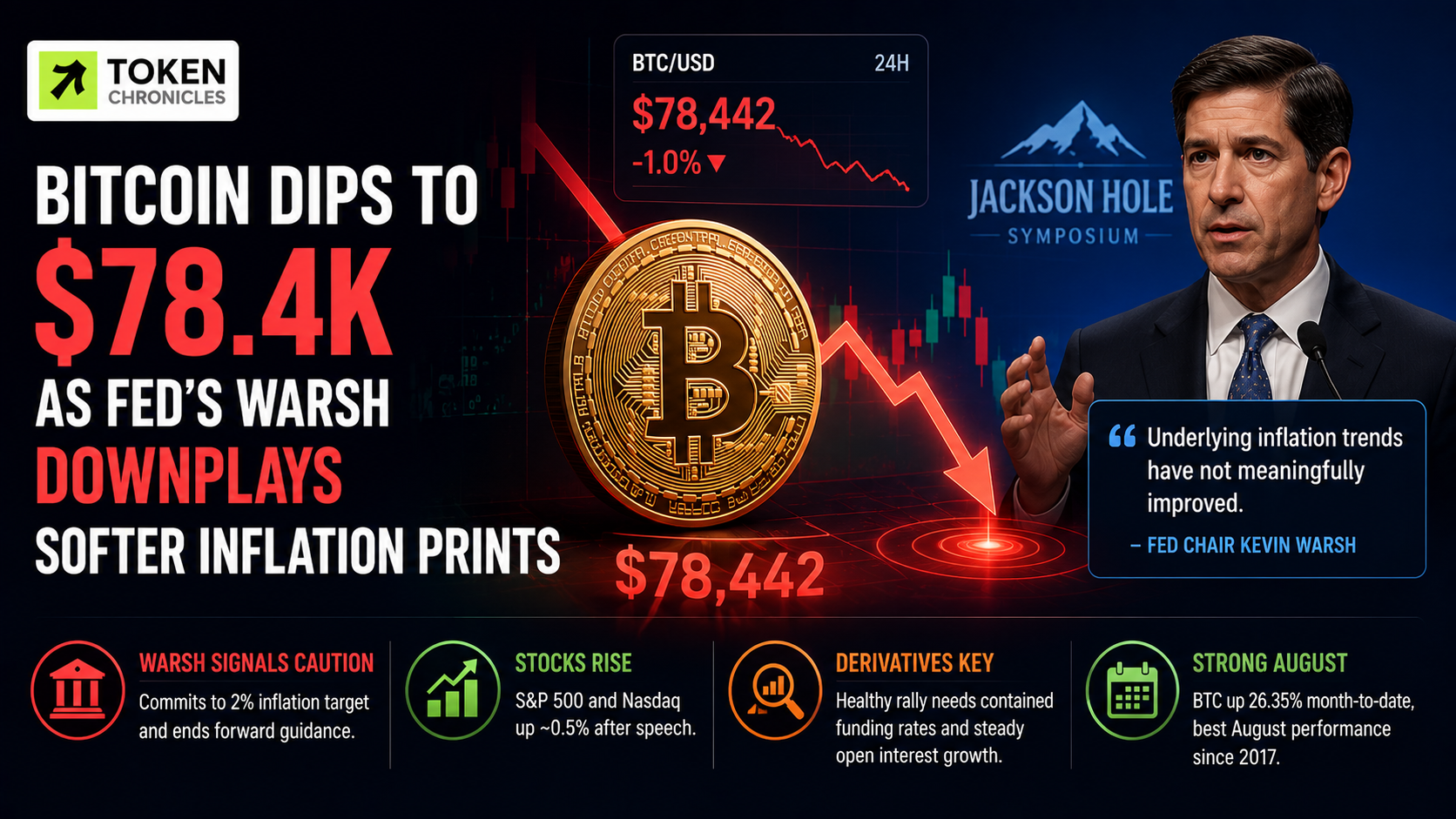
Bitcoin came under renewed pressure after US Federal Reserve Chair Kevin Warsh delivered a cautious message on inflation during his Jackson Hole keynote, limiting expectations for an easier monetary-policy path.
BTC briefly fell to around $78,442 before recovering toward the $79,500 area, while traders continued to struggle to push the cryptocurrency decisively above the $80,000 level.
Warsh Pushes Back on Expectations of Faster Inflation Relief
Bitcoin’s decline came as markets digested Warsh’s first keynote address at the annual Jackson Hole Symposium.
Although recent CPI and PCE inflation readings have been softer than expected, Warsh argued that the improvement does not yet demonstrate a meaningful change in underlying inflation trends.
He reiterated the Federal Reserve’s commitment to its 2% inflation objective and adopted a more cautious approach toward communicating future policy decisions.
Warsh also indicated that the Fed should move away from routinely providing forward guidance, arguing that the practice was introduced during the global financial crisis and has outlived much of its original purpose.
His remarks contrasted with the more optimistic interpretation some traders had placed on recent inflation data.
Bitcoin Remains Trapped Around $80,000
BTC continued to fluctuate near the $80,000 threshold following the speech, with the market entering the final stretch of August without a decisive breakout.
Technical analysts have highlighted the importance of maintaining support around the 50-week exponential moving average near $77,250 while Bitcoin attempts to regain higher levels.
On the upside, significant resistance has emerged between the current price and approximately $86,000, potentially making a sustained rally more difficult.
A clean move beyond $80,000 alone may therefore not be enough to establish a stronger bullish trend.
Derivatives Could Determine Bitcoin’s Next Move
Market analysts are increasingly focusing on Bitcoin’s derivatives market to determine whether a potential breakout would be supported by genuine demand or excessive leverage.
QCP Capital said a healthier advance would involve Bitcoin rising while funding rates remain controlled and open interest increases gradually.
Such a pattern would suggest that spot-market demand is supporting the move rather than traders aggressively piling into leveraged positions.
Conversely, a sharp increase in leverage alongside price gains could make the rally more vulnerable to liquidations and sudden reversals.
The distinction becomes particularly important around the $83,000 area, which analysts view as a key level for determining the character of Bitcoin’s next move.
US Stocks Remain Resilient
Despite the Fed chair’s cautious inflation assessment, US equities remained positive during the session.
The S&P 500 and Nasdaq Composite were each trading roughly 0.5% higher at the time of reporting, supported in part by favorable comments surrounding corporate performance and continued growth in artificial intelligence.
Bitcoin, however, remained more sensitive to monetary-policy expectations and positioning in crypto derivatives.
August Still Looks Strong for Bitcoin
Despite the latest pullback, Bitcoin remained up approximately 26.35% for August at the time of reporting.
If the gain holds through the monthly close, it would represent Bitcoin’s strongest August performance since 2017.
The immediate challenge is now whether BTC can defend the upper-$70,000 region while attracting enough spot demand to overcome resistance above $80,000.
For traders, the next major signal may not simply be whether Bitcoin breaks $83,000, but whether such a move is supported by sustainable spot buying rather than rapidly expanding leverage.