

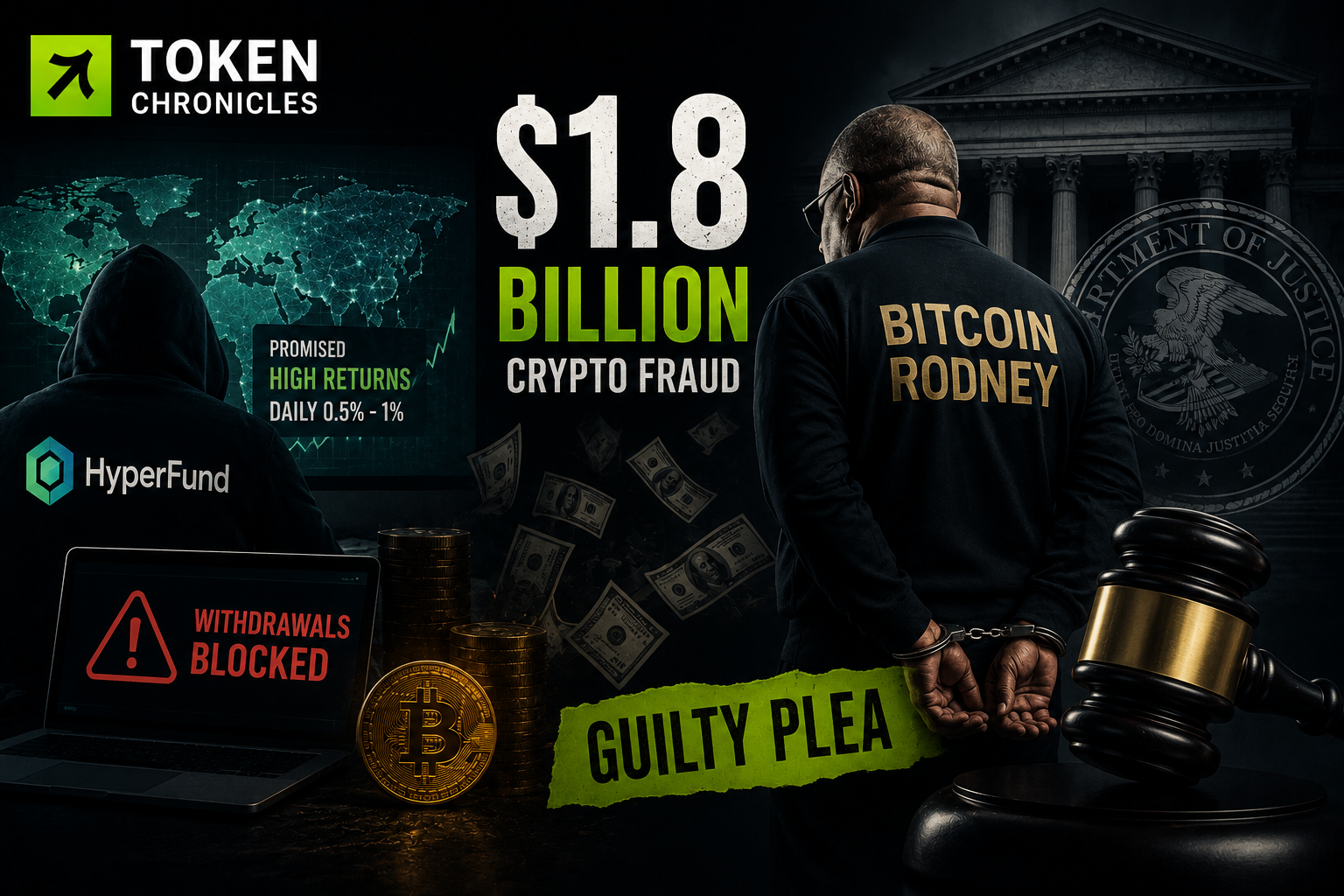
One of the most prominent promoters of the controversial HyperFund investment platform has pleaded guilty in the United States, marking another major development in one of the largest alleged crypto fraud cases in recent years.
Rodney Burton, widely known online as “Bitcoin Rodney,” admitted his role in operating an unlicensed money transmitting business connected to HyperFund, a cryptocurrency investment scheme that U.S. authorities say defrauded investors of approximately $1.8 billion worldwide.
The guilty plea was announced by the U.S. Attorney’s Office for the District of Maryland on June 17.
HyperFund’s Global Reach
According to federal prosecutors, HyperFund operated between 2020 and 2022 as an investment platform that promised extraordinarily high returns to participants.
The company marketed itself as a crypto wealth-building platform, claiming investors could earn:
- Daily returns of 0.5% to 1%
- Double or triple their initial investment
- Passive income through cryptocurrency mining operations
However, investigators allege these promises were misleading and unsupported by real business activity.
Prosecutors described HyperFund as:
“A global wire-fraud scheme disguised as a legitimate cryptocurrency investment platform that obtained approximately $1.8 billion from investors worldwide.”
Authorities claim the company lacked the extensive crypto mining infrastructure it promoted and instead relied heavily on continuous inflows from new investors.
The Role of ‘Bitcoin Rodney’
Court documents state that Burton actively promoted HyperFund from June 2020 through January 2022, encouraging investors to join the platform while helping facilitate the movement of funds through unlicensed money transmission services.
Federal investigators allege that Burton controlled multiple businesses that appeared to offer consulting services but were, in reality, used to process and move investor funds.
According to prosecutors:
“Burton controlled several companies that purported to offer consulting services but were in fact unlicensed money transmitting businesses.”
Nearly $8 Million in Personal Gains
Authorities say Burton personally earned at least $7.85 million through his involvement in the scheme.
The funds reportedly included proceeds linked directly to HyperFund investors, including victims located in the state of Maryland.
The case highlights the scale of financial incentives behind some crypto investment scams, where promoters can earn substantial commissions while investors face mounting losses.
Withdrawal Problems Raised Early Warning Signs
Investigators allege that HyperFund began experiencing serious operational issues in 2021.
As investor withdrawal requests increased, the platform reportedly:
- Restricted withdrawals.
- Delayed payouts.
- Limited access to investor accounts.
- Eventually blocked many users from accessing their funds.
These developments raised concerns among investors long before regulators formally intervened.
Growing Crackdown on Crypto Fraud
The guilty plea is part of a broader crackdown by U.S. authorities on cryptocurrency-related fraud schemes.
Regulators have increasingly targeted projects that promise:
- Guaranteed returns
- Unrealistically high yields
- Passive income with little transparency
- Complex referral and multi-level marketing structures
Law enforcement agencies have repeatedly warned investors to be cautious of platforms that rely heavily on recruitment incentives and provide limited information about how profits are generated.
Sentencing Scheduled for July
Burton now faces a maximum prison sentence of five years for conspiracy to operate an unlicensed money transmitting business.
His sentencing is scheduled for July 23, 2026.
Meanwhile, authorities continue investigating other individuals and entities linked to HyperFund as part of ongoing efforts to recover assets and pursue accountability for one of the largest alleged crypto fraud schemes ever uncovered.
Key Numbers
- Total Investor Losses: $1.8 Billion
- Funds Received by Burton: $7.85 Million
- Period of Activity: 2020–2022
- Maximum Prison Sentence: 5 Years
- Sentencing Date: July 23, 2026
The case serves as another reminder that while the crypto industry continues to mature, regulators remain focused on rooting out fraudulent schemes that exploit investor enthusiasm and trust.