


Bitcoin could be approaching the later stages of its current correction, with VanEck suggesting that an accumulation phase may emerge between September and November if historical cycle patterns continue to hold.
In an Aug. 18 research report, the asset manager said eight of its 12 Bitcoin capitulation indicators were signaling stress as of Aug. 12. All 12 indicators had entered capitulation territory at some point during the preceding three months, pointing to significant late-cycle pressure.
VanEck emphasized, however, that its historical analysis is not a price forecast and that the dataset contains relatively few independent market episodes.
Eight Capitulation Signals Remain Active
VanEck classifies an indicator as being in capitulation when its latest reading reaches an extreme percentile of its historical range. Most indicators must fall within the bottom 15% of their historical observations, or the top 10% when elevated readings represent stress.
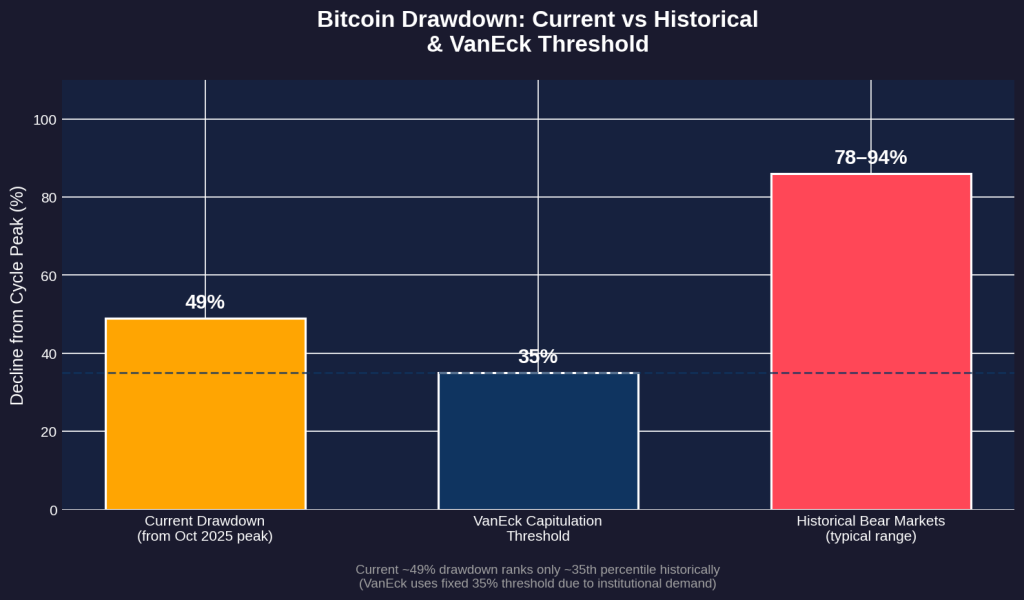
Bitcoin’s drawdown is assessed separately. The firm uses a 35% decline from the cycle peak as its capitulation threshold.
Bitcoin was approximately 49% below its October 2025 peak at the time of VanEck’s analysis. The decline, however, ranked only around the 35th percentile historically.
Using the same percentile methodology as the other indicators would reduce the number of active signals from eight to seven. VanEck maintains the separate 35% threshold because it believes increased institutional participation and demand through spot Bitcoin exchange-traded products could result in a less severe downturn than previous cycles.
The firm said it expects a shallower trough this cycle, while acknowledging that assumption has not yet been confirmed by market behavior. Previous Bitcoin bear markets experienced declines of roughly 78% to 94%.
Historical Data Does Not Guarantee a Six-Month Rebound
VanEck’s historical backtest offers a more cautious picture for investors expecting capitulation to produce an immediate bottom.
Periods in which eight to 12 capitulation indicators were active generated an average Bitcoin return of 12.8% over the following 90 days, compared with a 15.2% average return across comparable periods.
Over six months, the average return was approximately 32%, again below the 36.3% baseline.
The capitulation group only outperformed the baseline over a one-year period. Even that result comes with significant limitations.
VanEck noted that the one-year analysis included 115 observation days with substantial overlap, meaning the data represents relatively few distinct market episodes. The firm therefore cautioned against placing significant weight on the apparent one-year outperformance.
The takeaway is that capitulation indicators may help identify periods of late-cycle stress, but they do not necessarily identify the precise market bottom.
Bitcoin could still spend months moving sideways before a sustained recovery develops.
Bitcoin ETP Demand Has Absorbed Some Selling
Another factor supporting the potential accumulation thesis is institutional demand.
According to VanEck, U.S. spot Bitcoin exchange-traded products recorded approximately $663 million in net inflows during the 30-day period covered by its analysis. That represented roughly 10,400 BTC at prevailing prices and reversed a significant portion of the approximately $2.4 billion in outflows recorded during the previous month.
However, fund flows have remained volatile.
U.S. spot Bitcoin funds experienced roughly $385 million in combined outflows during the week ending Aug. 14 before demand returned.
According to subsequent flow data, the funds recorded approximately $297.5 million in net inflows on Aug. 17 and another $189.3 million on Aug. 18.
The combined $486.8 million inflow helped offset much of the previous week’s withdrawals, suggesting that institutional demand has not disappeared despite the broader market correction.
Long-Term Holder Selling Remains a Warning Sign
Bitcoin’s long-term holder data presents a more complicated picture.
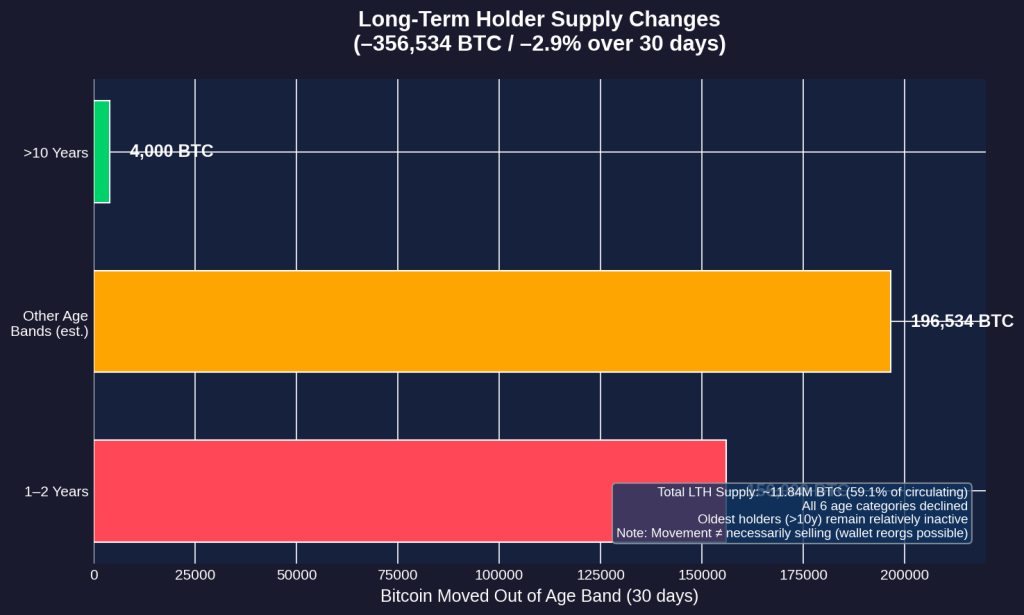
VanEck’s analysis found that the supply of Bitcoin held for more than one year declined by approximately 356,534 BTC over 30 days.
Long-term holdings fell 2.9% to approximately 11.84 million BTC, representing around 59.1% of Bitcoin’s circulating supply.
All six of the long-term holder age categories recorded declines.
The largest reduction came from coins that had been held for between one and two years, with approximately 156,000 BTC leaving that age bracket. By comparison, wallets holding Bitcoin for more than 10 years reduced their holdings by only about 4,000 BTC.
That suggests the oldest Bitcoin holders remain relatively inactive while newer long-term holders are showing greater movement.
However, VanEck cautioned that movement between age bands does not necessarily mean that the coins were sold.
Some transfers could represent wallet reorganizations, security measures or movement between private addresses.
The firm specifically pointed to concerns following the Coldcard security incident, although it acknowledged that security-related transfers are difficult to distinguish from actual selling based solely on the available data.
September to November Becomes a Key Test
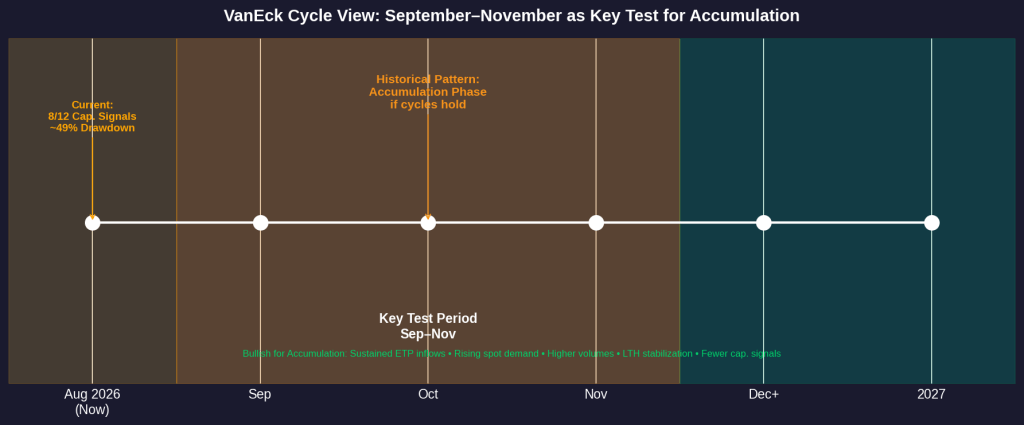
VanEck’s historical cycle analysis places the next several months at the center of the accumulation debate.
If Bitcoin follows patterns observed during previous cycles, the period between September and November could represent an important transition point.
Several factors could strengthen the accumulation thesis:
- Sustained inflows into U.S. spot Bitcoin ETPs
- Increasing spot market demand
- Improving trading volumes
- Stabilization in long-term holder balances
- A reduction in capitulation signals
Conversely, continued long-term holder distribution, renewed ETP outflows or another sharp decline in liquidity could undermine the thesis.
The broader message from VanEck is therefore less about predicting an exact Bitcoin bottom and more about identifying whether the market is moving from forced selling toward accumulation.
With Bitcoin’s correction already several months old, the coming months could provide a clearer indication of whether the current weakness represents the final stage of the cycle’s downturn or the beginning of another prolonged period of consolidation.