

Losses linked to a recently disclosed vulnerability in Coldcard hardware wallets have climbed to approximately $70 million, according to new findings from Galaxy Research. The firm estimates that nearly 1,200 Bitcoin addresses were emptied, with attackers draining more than 1,082 BTC in a coordinated series of transactions.
The issue first came to light after hardware wallet manufacturer Coinkite warned users about a firmware-related vulnerability affecting seed phrases generated on Coldcard Mk3 devices running firmware version 4.0.1 (released in March 2021) and later versions. The company later expanded the advisory to include certain Mk4, Mk5, and Coldcard Q firmware releases, while issuing emergency firmware updates for all impacted models.
Coinkite CEO Rodolfo Novak (NVK) publicly accepted responsibility for the incident, acknowledging that the company’s review process failed to identify the firmware bug before release. He also suggested that the vulnerability may have been discovered using artificial intelligence, noting that AI-assisted code analysis can uncover hidden security flaws more quickly than traditional manual reviews, creating new challenges for software security.
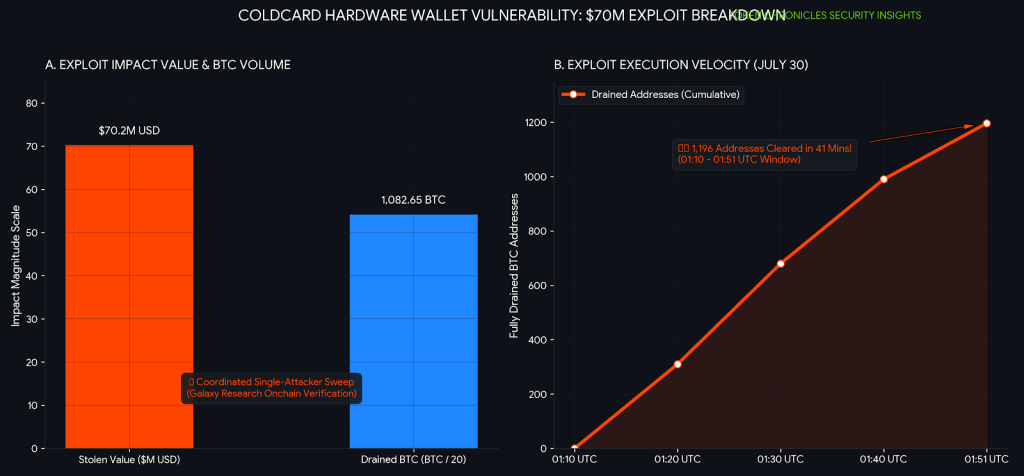
Galaxy Research analyzed blockchain data and reported that 1,196 Bitcoin addresses were fully drained between 01:10 UTC and 01:51 UTC on July 30, resulting in the theft of 1,082.65 BTC, valued at roughly $70.2 million at the time. Researchers believe the transaction pattern indicates a single attacker, although the movement of funds resembles normal wallet transfers on-chain, making the exploit difficult to detect.
The research team also warned that the vulnerability could enable additional attacks against any Bitcoin address generated using affected Coldcard firmware, meaning the identified transactions may represent only a portion of the overall risk.
In response, Coinkite is urging all affected users to immediately update their device firmware, generate a new seed phrase, and move their funds to a newly created wallet. The company also recommends testing the new wallet with a small transaction before transferring larger balances and retaining the original backup until the migration has been successfully completed.