
For years, crypto exchanges competed primarily on trading fees, liquidity, and execution speed. Today, that competitive landscape is rapidly evolving. The world’s largest exchanges are no longer just trading venues they are becoming comprehensive financial ecosystems where users can trade, invest, earn yield, make payments, and access traditional financial assets from a single account.
Binance sits at the center of this transformation.
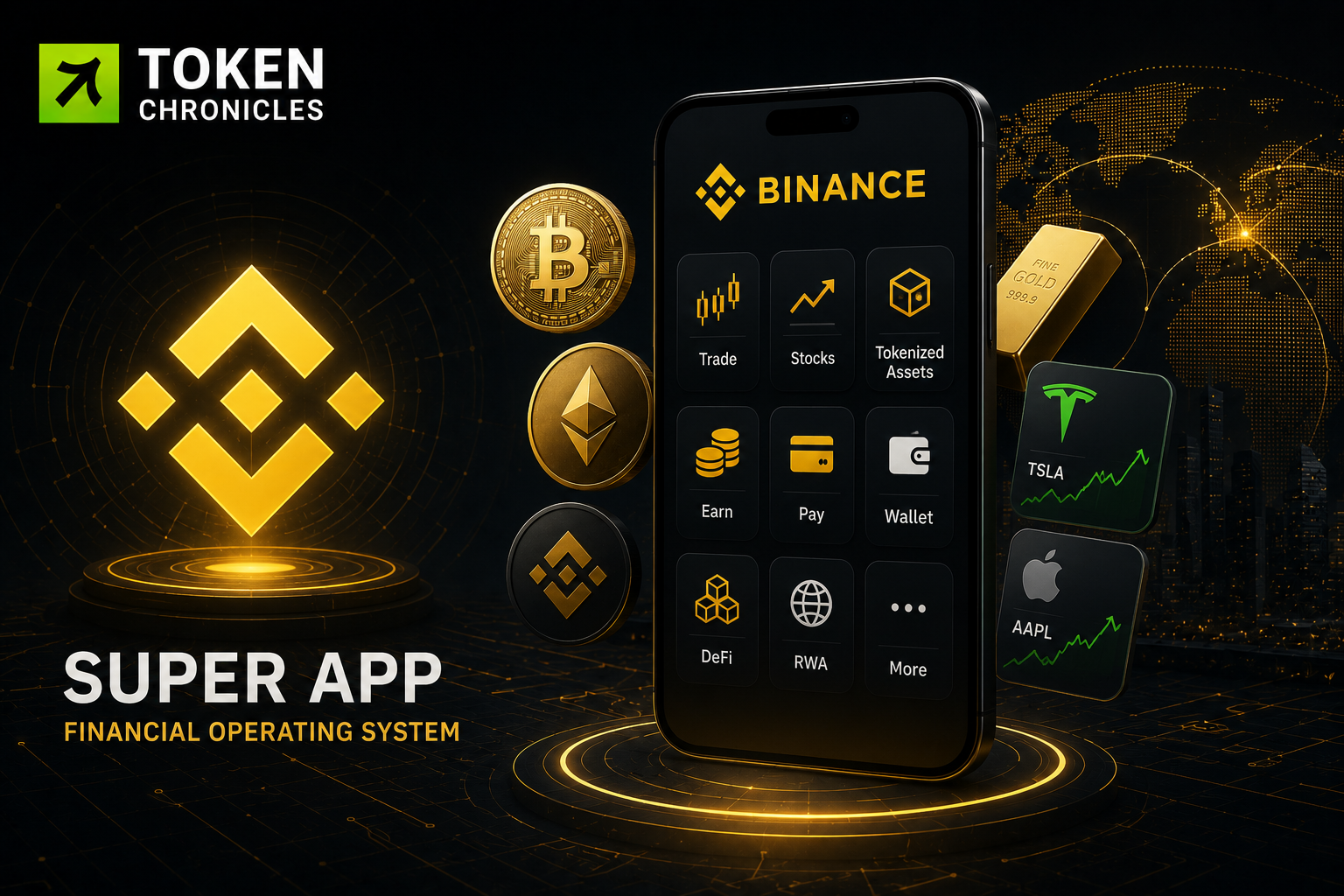
With more than 320 million registered users, approximately one-third of global spot trading volume, 42.5% of global futures volume, and $153 billion in customer assets, Binance is increasingly positioning itself as a financial operating system rather than simply a cryptocurrency exchange.
Beyond crypto trading
In less than seven months, Binance has significantly expanded beyond its crypto-native roots.
The platform now enables eligible users to access:
- Bitcoin and digital assets
- Tokenized U.S. stocks
- More than 7,000 U.S. equities and ETFs
- Precious metals through perpetual contracts
- Real-world asset (RWA) products
- Stablecoin-based trading
- DeFi services through Binance Wallet
Rather than maintaining separate accounts with multiple brokers, users can gain exposure to Bitcoin, gold, Tesla shares, and tokenized assets all within a single ecosystem.
This marks a major shift in how financial services are being delivered.
The rise of the financial super app
Binance’s strategy follows the “super app” model that has reshaped consumer technology across Asia.
Platforms such as WeChat, Alipay, and Revolut succeeded by continuously adding financial services into one seamless experience instead of competing on a single product.
Crypto exchanges now have a similar opportunity.
Instead of relying solely on trading commissions, exchanges can offer:
- Trading
- Payments
- Yield products
- Lending
- Tokenized securities
- Wallet infrastructure
- Educational content
- On-chain applications
Each additional service strengthens user engagement while reducing the need to leave the platform.
Tokenized stocks gain rapid adoption
One of Binance’s fastest-growing initiatives has been bStocks, its tokenized equity platform.
The early adoption has been remarkable.
Within just 15 days:
- Assets under management increased from $5.6 million to more than $100 million
- Cumulative trading volume surpassed $458 million
- Nearly 47% of trading occurred outside traditional U.S. market hours
- Approximately 58% of activity originated from emerging markets
These figures suggest demand extends far beyond speculative interest, highlighting growing global appetite for 24/7 access to traditional financial assets.
Real-World Assets become a growth engine
Binance has also expanded aggressively into real-world assets.
Following the launch of precious metals perpetual contracts and tokenized equities, the exchange now commands more than 55% of global real-world asset derivatives trading volume, according to industry estimates.
The broader RWA sector has grown rapidly throughout 2026 as institutions increasingly explore blockchain-based representations of traditional financial products.
Why the model works
Large crypto exchanges possess several structural advantages that traditional financial institutions struggle to replicate.
Existing user base
With hundreds of millions of verified users already holding assets on the platform, Binance can launch new products directly to an established customer base without significant acquisition costs.
Shared infrastructure
Trading, payments, custody, and settlements all operate on the same underlying infrastructure, allowing new financial products to be introduced quickly and efficiently.
Capital already on platform
Unlike traditional brokers, exchange users already maintain funded balances.
This enables seamless movement between:
- Spot trading
- Yield products
- Payments
- Tokenized securities
- DeFi applications
without requiring additional bank transfers or account setups.
Global accessibility
A single Binance account provides access across multiple jurisdictions, making expansion into emerging markets significantly easier than traditional financial institutions.
Diversifying revenue beyond trading
As exchanges mature, trading fees alone are becoming less reliable.
Binance has expanded into several recurring revenue streams, including:
- Binance Earn
- Binance Pay
- Asset management
- Stablecoin services
- Wallet infrastructure
- Tokenized asset trading
Binance Pay alone has processed over one billion transactions, illustrating how payment services are becoming an increasingly meaningful part of the company’s broader ecosystem.
This diversification reduces dependence on volatile trading activity while creating more stable long-term revenue.
A stronger competitive moat
The true advantage of Binance’s model is not any individual product.
It is the interconnected ecosystem.
The more services users adopt, the more difficult it becomes to switch platforms.
A single verified identity provides access to:
- Trading
- Investing
- Payments
- DeFi
- NFTs
- Educational resources
- Token launches
- Self-custody wallets
This increases customer lifetime value while lowering acquisition costs for every new product introduced.
Regulation is finally catching Up
For much of crypto’s history, regulatory uncertainty limited the development of integrated financial platforms.
That landscape is changing.
The introduction of clearer stablecoin legislation, evolving digital asset regulations, and increasing acceptance of tokenized securities is creating an environment where financial super apps can operate with greater confidence.
As regulatory frameworks mature across major jurisdictions, competition is likely to shift away from simple trading functionality toward the breadth, efficiency, and user experience of complete financial ecosystems.
The bigger picture
Crypto exchanges are no longer competing solely with one another.
Increasingly, they are competing with banks, brokerages, payment companies, asset managers, and fintech platforms simultaneously.
Binance’s rapid expansion illustrates a broader industry trend: the evolution of exchanges into comprehensive financial operating systems where users can manage nearly every aspect of their financial lives from a single platform.
If this model continues to gain traction, the next generation of financial infrastructure may not be built around traditional banks but around crypto-native platforms that seamlessly combine digital assets, tokenized securities, payments, and decentralized finance into one unified ecosystem.