
The world’s leading artificial intelligence companies have increasingly urged governments to impose guardrails around advanced AI. But critics argue that the regulatory push could become a form of industry capture and lawmakers are now considering proposals far more aggressive than the major labs may have expected.
The debate over artificial intelligence regulation is entering an unusual phase. Instead of resisting government intervention outright, some of the industry’s most powerful companies and executives have publicly supported stronger oversight, safety evaluations and restrictions on frontier AI development.
Supporters say advanced AI could create risks that markets alone cannot adequately manage. Critics, however, argue that extensive regulation could also protect established companies by making it prohibitively expensive for smaller competitors to develop comparable systems.
That tension has produced an unexpected political response. Proposals now circulating in Washington include government involvement in the ownership of major AI companies, temporary restrictions on advanced AI development and severe penalties for organizations that violate proposed rules.
At the center of the debate is a fundamental question: Is the push for AI safety creating sensible safeguards, or is it laying the groundwork for regulatory capture of one of the world’s most strategically important industries?
Key Takeaways
- Sen. Bernie Sanders has proposed giving the public a 50% equity stake in major AI companies as part of a proposed $7 trillion AI sovereign wealth fund.
- Anthropic CEO Dario Amodei has argued that frontier AI development should be subject to stronger coordination and external evaluation.
- Critics such as former White House adviser David Sacks have accused major AI laboratories of using safety concerns to encourage regulations that could disadvantage smaller competitors.
- A proposed bill from Sanders and Rep. Greg Casar would impose a temporary halt on certain advanced AI development and introduce severe penalties for violations.
- President Donald Trump has taken a substantially different position, portraying AI development primarily as a geopolitical competition with China.
The Regulatory Strategy Behind the AI Safety Debate
The artificial intelligence market has developed around a small group of extremely well-funded companies capable of spending billions of dollars on computing infrastructure, research and talent.
Alongside those large laboratories, however, there is a much broader ecosystem of startups, open-source developers and independent researchers.
That divide has fueled a debate over what regulation should actually accomplish.
Supporters of strict AI oversight argue that frontier models could eventually create risks involving cybersecurity, biological threats, autonomous systems, misinformation and other areas. From that perspective, governments need the ability to establish safety standards before increasingly capable systems become difficult to control.
Critics see another possibility.
If compliance requires enormous computing resources, expensive audits, specialized safety teams, licensing and extensive reporting, the largest companies may be the only organizations capable of meeting the requirements.
In that scenario, regulation could unintentionally become a barrier to entry.
This is the basic argument behind accusations of regulatory capture the idea that an industry can influence the rules governing it in ways that ultimately reinforce the position of established players.
David Sacks, a former White House adviser on technology and crypto policy, has previously accused Anthropic of pursuing such a strategy, arguing that fear surrounding advanced AI could be used to encourage regulations that disproportionately burden startups.
The allegation remains contested, but it highlights an important contradiction: the same rules designed to make AI safer could also make the industry less competitive.
When Safety Regulation Becomes a Competitive Barrier
Large AI laboratories have structural advantages that smaller developers generally lack.
Training and operating frontier models can require enormous quantities of specialized computing hardware, electricity, data and engineering talent. Adding mandatory government evaluations, licensing requirements or independent testing could further increase the cost of entering the market.
For established companies, those expenses may be manageable.
For a startup, they could be prohibitive.
That creates a potential regulatory moat.
Under this interpretation, a large AI company does not necessarily need to oppose regulation. It could support carefully designed requirements knowing that its financial and technical resources make compliance easier than it would be for competitors.
This does not prove that companies advocating AI safety are deliberately attempting to eliminate competition. Safety concerns can be genuine while simultaneously producing competitive consequences.
That distinction is becoming increasingly important as policymakers debate how far government oversight should go.
Sanders Proposal Takes the Debate Much Further
The political response has gone beyond conventional AI safety rules.
Sen. Bernie Sanders and Rep. Greg Casar introduced legislation on Sept. 3 that would seek to prohibit the development of certain forms of artificial superintelligence and temporarily pause advanced AI development while a new federal agency establishes regulatory requirements.
The proposal represents one of the most aggressive approaches to AI regulation currently being discussed in Washington.
Among its most controversial elements are severe penalties for violations, including the possibility of corporate dissolution and lengthy prison sentences for individuals involved in prohibited development.
The legislation illustrates how quickly the political conversation can move once governments accept the premise that advanced AI represents a potentially transformative national-security risk.
The regulatory argument therefore risks moving beyond questions such as “How should AI companies be supervised?” toward a much larger question:
“Who should ultimately control advanced artificial intelligence?”
A $7 Trillion Public Ownership Proposal
Sanders has also proposed a dramatically different approach to the ownership question.
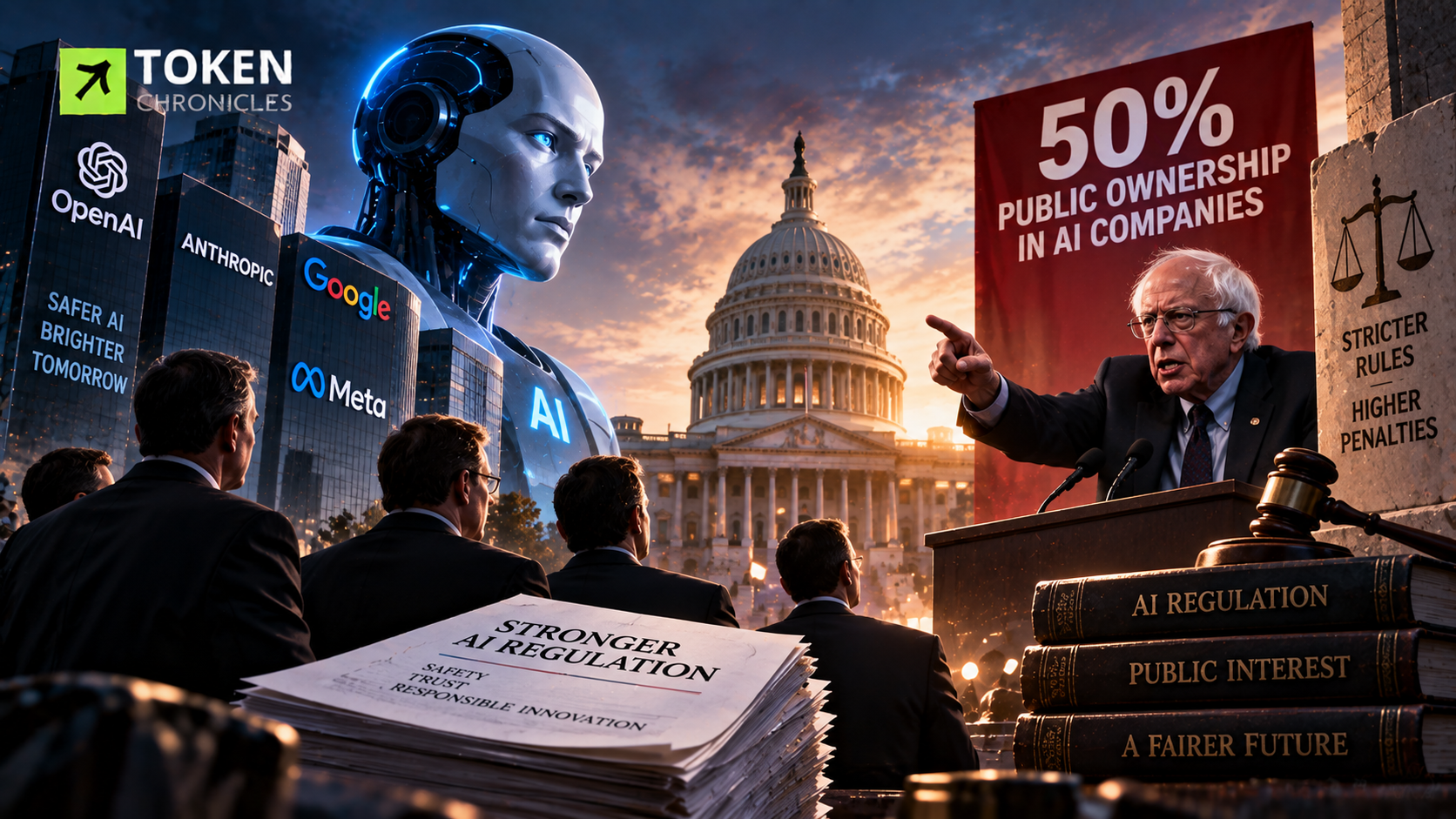
His AI sovereign wealth fund proposal would seek a 50% public equity stake in major AI companies, with the resulting holdings forming part of a public investment pool estimated at approximately $7 trillion.
The proposal reflects a broader concern that the economic benefits generated by AI could become concentrated among a relatively small number of private companies and their investors.
Under such a model, the public would receive a direct financial interest in the companies benefiting from the AI boom.
For the technology industry, however, the proposal represents an extraordinary departure from conventional private ownership.
It also demonstrates the unpredictable political consequences of framing AI as infrastructure with national importance. Once advanced AI is treated as strategically comparable to critical infrastructure, arguments for greater public ownership become easier to make.
That is a considerably different outcome from the limited regulatory oversight that some technology executives initially advocated.
Anthropic’s Dario Amodei Takes a Cautious Position
Anthropic CEO Dario Amodei has been one of the most prominent technology executives calling for greater coordination around frontier AI.
In a recent essay, Amodei argued for mechanisms that would allow advanced AI development to be paced more carefully, including greater use of third-party evaluations and coordination between companies and governments.
His position is based largely on the premise that AI capabilities are advancing quickly enough that relying exclusively on voluntary industry standards may not be sufficient.
Amodei has also acknowledged the unusual nature of having technologies with potentially enormous social and economic consequences developed primarily by private corporations.
That admission adds another dimension to the debate.
If advanced AI eventually becomes essential to national security, economic productivity and scientific research, policymakers may increasingly question whether a handful of private laboratories should retain complete control over its development.
Amodei has not necessarily endorsed government ownership of AI companies, but his argument that frontier AI requires greater public oversight overlaps with the broader premise behind some of the more interventionist proposals now appearing in Washington.
The Industry’s Biggest Fear May Be an Overcorrection
For AI companies, the most immediate concern may not be regulation itself but how far regulation eventually extends.
There is a major difference between requiring companies to conduct safety evaluations and giving government direct control over their ownership, development timelines or model capabilities.
Similarly, there is a significant distinction between regulating commercial deployment and criminalizing certain forms of AI development.
Once those boundaries begin to shift, policymakers could find themselves regulating not simply a product but an entire technological research ecosystem.
Critics warn that excessive restrictions could push development toward jurisdictions with weaker rules, reduce competition and slow beneficial applications of AI.
Supporters counter that allowing frontier systems to develop without meaningful oversight could create risks that become impossible to address after the technology becomes deeply embedded in society.
Both arguments are difficult to dismiss.
The China Factor Changes the Calculation
The debate is also taking place against the backdrop of intensifying technological competition between the United States and China.
That geopolitical dimension makes a sweeping domestic slowdown more complicated.
If the United States imposes strict restrictions on frontier AI while Chinese companies continue advancing, policymakers would have to consider whether safety gains at home could come at the expense of technological leadership.
President Donald Trump has emphasized this competitive dimension.
On Sept. 13, Trump dismissed some of the more extreme warnings about AI risks and rejected calls for a broad slowdown. Instead, he framed the technology race in geopolitical terms, arguing that the country that wins the AI competition could gain a decisive strategic advantage.
That philosophy is fundamentally different from the precautionary approach advocated by some AI safety researchers and executives.
It creates a three-way policy conflict:
- Industry-led safety regulation
- Aggressive government intervention
- Unrestricted competition aimed at maintaining technological leadership
The eventual U.S. framework could contain elements of all three.
Could Regulation Strengthen Big AI Instead?
The central irony is that AI companies may have helped create the political environment now threatening to constrain them.
Warnings about catastrophic risks can strengthen the argument for government intervention. Government intervention can then produce rules that favor companies with the largest resources.
But once policymakers accept the idea that AI is too important to leave entirely to private companies, the conversation does not necessarily stop at regulation.
It can progress toward public ownership, direct government control or restrictions on private development.
That is where accusations of regulatory capture become particularly interesting.
A company might support regulation because it expects the rules to protect its market position. Yet the political system could ultimately interpret the same arguments as evidence that the industry is too important—or too dangerous—to remain under concentrated private control.
In other words, the regulatory moat could become a nationalization argument.
Three Possible Futures for Frontier AI
The coming years could produce very different outcomes.
1. A regulated private-sector model
Governments could establish licensing, safety testing, transparency requirements and independent evaluations while allowing private companies to remain the primary developers.
2. Greater public involvement
AI could increasingly be treated as strategic infrastructure, leading to public investment, government-backed research and potentially greater public ownership.
3. A geopolitical arms race
The United States and China could prioritize technological leadership over broad development restrictions, with safety regulation taking a secondary role to national competitiveness.
None of these scenarios is inevitable.
The eventual outcome will depend on legislation, elections, technological breakthroughs, international competition and the ability of policymakers to distinguish legitimate safety requirements from rules that unnecessarily restrict competition.
The AI Regulation Paradox
The debate surrounding frontier AI has entered an unusual phase.
The companies with the greatest resources are warning governments about the dangers of rapidly advancing artificial intelligence. Policymakers are listening—but some are responding with proposals far more sweeping than the industry may have anticipated.
That creates a powerful paradox.
The companies seeking regulation to make AI safer could end up facing regulation that fundamentally changes who is allowed to build, own and control advanced AI.
For the technology industry, the lesson may be similar to what has happened in other heavily regulated sectors: once government becomes deeply involved in defining the rules of a strategically important market, companies do not necessarily control where the regulatory process ultimately leads.
The question is no longer simply whether AI should be regulated.
It is becoming a much bigger debate over who should control the technology, who should benefit from it, and how much power private companies should retain as artificial intelligence becomes increasingly central to the global economy and geopolitical competition.