

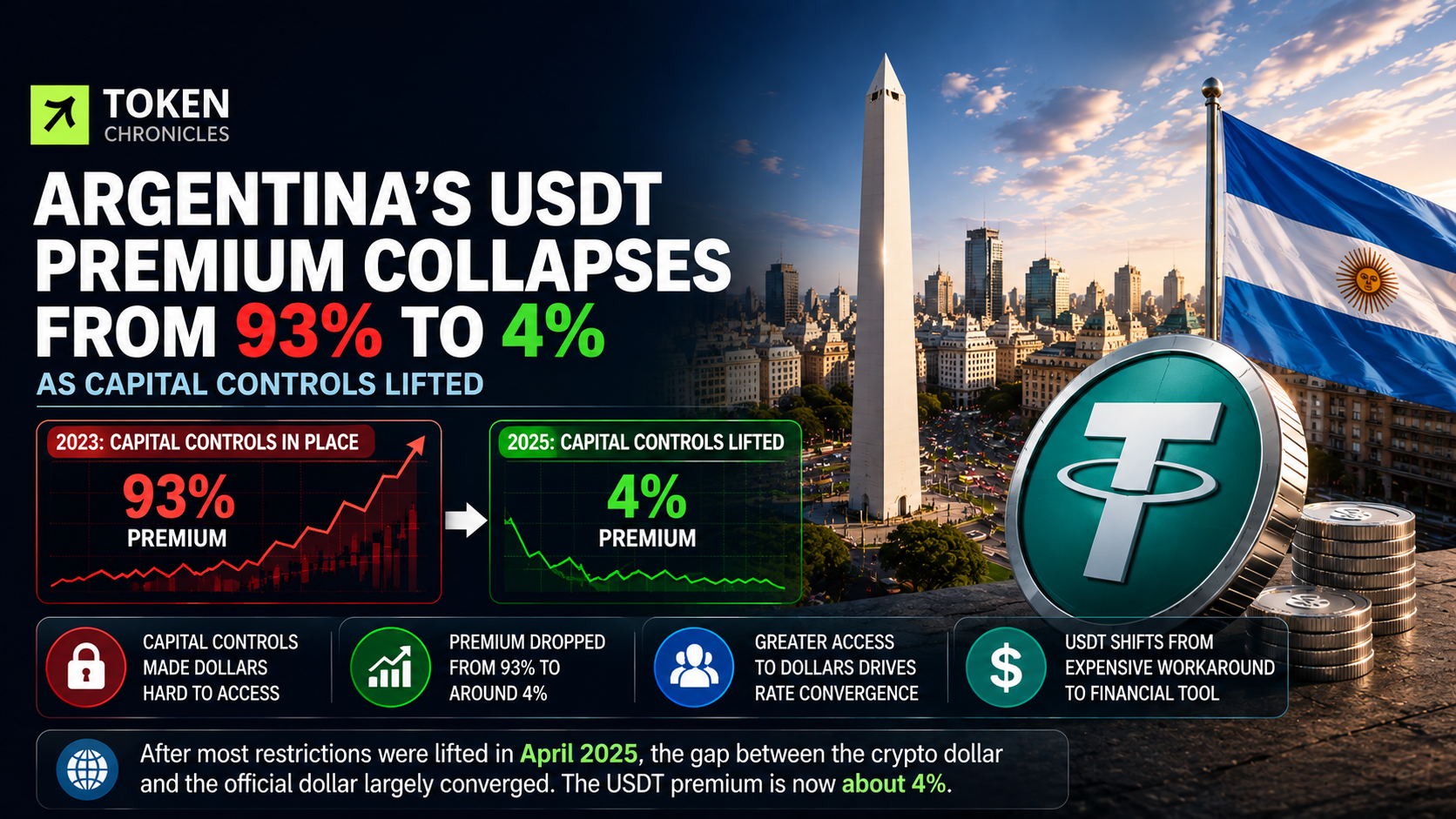
Argentina’s once-massive premium for buying dollar-pegged stablecoins has nearly disappeared as the government dismantled key foreign-exchange restrictions. The shift has sharply reduced the gap between the crypto dollar and official exchange rates, transforming USDT from a costly workaround for accessing dollar exposure into a much more closely priced alternative.
Argentina’s Crypto Dollar Gap Nearly Disappears
For years, Argentines faced strict limits on access to U.S. dollars. Those restrictions created a significant gap between official exchange rates and the prices available through alternative markets.
Dollar-pegged stablecoins such as USDT became an important tool for people seeking digital exposure to the U.S. dollar without relying exclusively on Argentina’s restricted official currency market.
During the most severe period of capital controls in 2023, the premium on stablecoins reportedly climbed to around 93% and at times exceeded 100%. In practical terms, buyers were paying dramatically more in pesos for digital dollar exposure than the official exchange rate implied.
The premium has fallen to approximately 4%, according to recent market reporting, bringing the crypto dollar much closer to conventional dollar pricing.
Capital Controls Were the Main Driver
The enormous USDT premium was closely connected to Argentina’s foreign-exchange restrictions.
When access to official dollars was limited, Argentines willing to pay a higher price for dollar exposure turned to alternative channels. Stablecoins provided a digital route that could be accessed through crypto platforms, allowing users to hold and transfer dollar-pegged assets without relying entirely on the traditional banking system.
The situation began changing dramatically in April 2025, when the government removed major components of the country’s currency controls.
The Central Bank of Argentina said the new measures eliminated restrictions on individuals’ access to the official foreign-exchange market and allowed people to purchase foreign currency without the previous limitations.
The U.S. Commercial Service similarly reported that most currency controls were lifted from April 14, 2025, allowing individuals and businesses to purchase U.S. dollars without the previous restrictions.
Why the USDT Premium Fell So Quickly
The relationship is relatively straightforward.
When official dollars are difficult to obtain, alternative forms of dollar exposure can command a substantial premium.
Once access to conventional dollars becomes easier, the incentive to pay a large additional amount for stablecoins decreases.
That appears to be what happened in Argentina.
The result is a dramatic narrowing of the difference between the official dollar rate and the crypto dollar rate. From a premium approaching 100% during the height of capital controls, the gap has now compressed to roughly 4%.
The change also undermines one of the most lucrative features of Argentina’s crypto-dollar market: arbitrage between restricted official channels and higher-priced stablecoin markets.
At a premium of only a few percentage points, transaction fees, transfer costs, and price slippage can consume much of the potential arbitrage opportunity.
USDT’s Role Is Changing
The narrowing premium does not necessarily mean Argentines have stopped using stablecoins.
Instead, the reason for using them can change.
During periods of strict capital controls, USDT offered a way to obtain dollar exposure when traditional channels were difficult or expensive.
With restrictions substantially reduced, users may increasingly value stablecoins for other characteristics, including:
- Fast digital transfers
- Cross-border payments
- Access to crypto markets
- Dollar-denominated savings
- Around-the-clock settlement
This distinction is important because stablecoin demand does not depend entirely on currency restrictions.
Argentina’s Broader Currency Reforms
The collapse in the USDT premium is part of a much broader transformation of Argentina’s foreign-exchange system.
The Central Bank moved toward a floating exchange-rate regime within a currency band in April 2025 while simultaneously relaxing restrictions on individuals and businesses.
The reforms were designed to improve access to foreign currency, increase exchange-rate flexibility, and support investment and economic activity.
The IMF has also noted that Argentina has gradually eased trade and capital-account restrictions, although some restrictions have remained or been reintroduced in specific areas.
More recently, Argentina’s government has continued moving toward greater liberalization. A decree published in August 2026 said the government was advancing the normalization of the economy and further easing restrictions on foreign exchange and capital movements.
From Emergency Dollar Alternative to Digital Financial Tool
Argentina’s USDT market provides a striking example of how regulation can influence cryptocurrency pricing.
At the height of capital controls, stablecoins effectively became a premium-priced gateway to dollar exposure. As those restrictions were removed, the extraordinary premium largely disappeared.
The move from 93% to approximately 4% illustrates how quickly crypto-market pricing can change when the underlying economic conditions change.
Argentina’s experience shows that stablecoin demand is not simply a function of crypto speculation. When access to traditional dollars is restricted, USDT can become a financial workaround; when those restrictions disappear, its value proposition shifts toward speed, portability, liquidity, and digital dollar access.