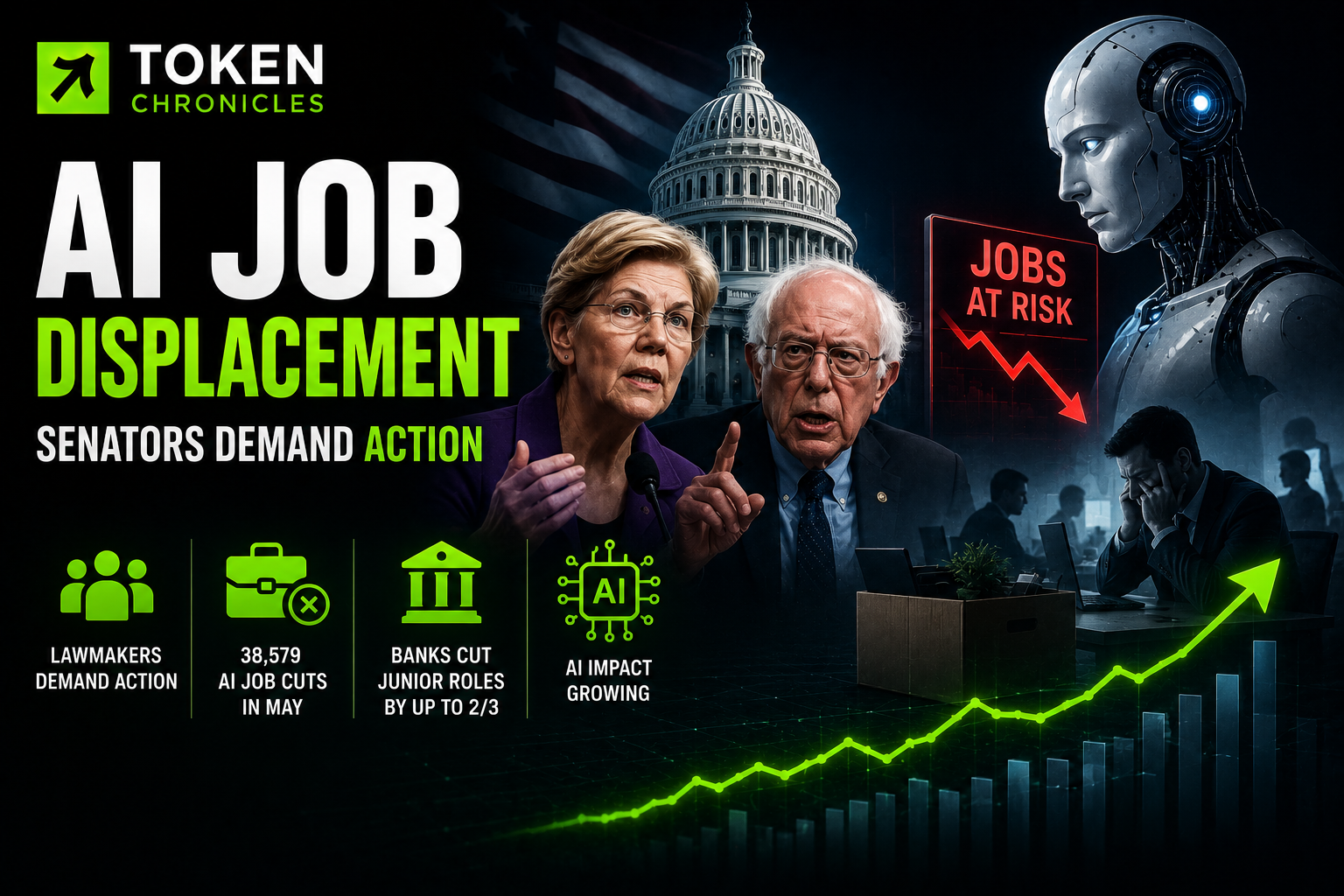
Concerns over artificial intelligence replacing human workers are rapidly moving from boardrooms and research papers into the center of political debate in Washington. A growing number of US lawmakers are urging Congress to address the employment risks associated with AI adoption, as new data reveals accelerating job losses linked to automation and major corporations openly discuss workforce reductions driven by AI technologies.
The debate reflects a broader challenge facing policymakers worldwide: how to balance the economic benefits of artificial intelligence with the potential disruption it could cause to millions of workers across industries.
Senators Warren and Sanders Call for Immediate Action
Leading the latest push are Senators Elizabeth Warren and Bernie Sanders, who argue that lawmakers cannot afford to wait until large-scale job displacement becomes a full-blown economic crisis.
Warren warned that Congress should not spend years studying the impact of AI while workers face growing uncertainty about their livelihoods. According to her, protections and policy safeguards need to be discussed now, before automation reshapes large segments of the labor market.
Sanders delivered an even stronger criticism, arguing that political influence from major technology companies is preventing meaningful action.
He claimed that concerns about worker displacement are being overshadowed by the growing financial power of the AI industry, calling for stricter oversight of political fundraising and lobbying activities tied to major technology firms.
Their comments reflect increasing pressure on policymakers to establish rules and support systems capable of helping workers adapt to rapid technological change.
Concern Extends Beyond Party Lines
The issue is no longer confined to Democratic lawmakers.
Republican Senator Josh Hawley has also emerged as one of the more vocal critics of unchecked AI expansion, emphasizing the need to take worker concerns seriously.
Citing recent research, Hawley noted that nearly one in five American workers believe artificial intelligence or automation could eventually replace their jobs.
While supporters of AI often argue that new technologies historically create more opportunities than they eliminate, Hawley warned that workers facing uncertainty today deserve more than promises of future benefits.
His position highlights a growing bipartisan recognition that AI’s impact on employment may become one of the defining economic issues of the coming decade.
AI-Related Job Cuts Reach Record Levels
The political debate is being fueled by increasingly concerning employment data.
According to recent workforce reports, employers attributed 38,579 job cuts to artificial intelligence during May alone, marking the highest monthly total since such tracking began.
Even more striking is the year-to-date trend.
Companies have linked approximately 87,714 layoffs to AI adoption so far this year, already exceeding the total number of AI-related job losses recorded throughout all of 2025.
These figures suggest that AI-driven workforce reductions are no longer theoretical concerns. They are becoming a measurable component of corporate restructuring strategies across multiple sectors.
Banking Sector Emerges as a Major Battleground
One of the industries experiencing the most visible transformation is financial services.
Major banking executives have increasingly acknowledged that artificial intelligence will significantly reshape staffing needs over the coming years.
JPMorgan
CEO Jamie Dimon has openly stated that AI will eliminate certain roles as automation becomes more capable of handling routine financial tasks.
Citigroup
CEO Jane Fraser has similarly acknowledged that some positions may eventually become unnecessary as AI systems improve operational efficiency.
Investment Banking
According to industry executives, banks are already reducing the size of junior analyst programs, with some firms reportedly cutting entry-level hiring by as much as two-thirds.
Tasks traditionally performed by young analysts—including financial modeling, research compilation, document review, and presentation preparation—are increasingly being automated through advanced AI systems.
For many observers, these developments provide a preview of how AI could transform white-collar professions that were previously considered relatively insulated from automation.
Corporate Restructuring Expands Beyond Banking
The impact is not limited to Wall Street.
Companies across multiple industries are beginning to integrate AI into operations ranging from customer service and administrative support to logistics and data analysis.
Recent reports indicate that:
- Customer support functions are increasingly being automated through AI-powered chat systems.
- Administrative and back-office operations are being streamlined using machine-learning tools.
- Corporate support teams are being restructured around AI-assisted workflows.
- Large enterprises are reevaluating long-term hiring needs as automation capabilities improve.
One notable example involves Standard Chartered, which recently outlined plans to reduce a significant portion of its corporate function workforce over the coming years as AI adoption expands.
These moves suggest that AI-driven efficiency gains are becoming a strategic priority across global business sectors.
Not Everyone Believes an AI Job Crisis Is Coming
Despite growing concerns, many economists and technology investors argue that fears of mass unemployment may be overstated.
Prominent venture capitalist David George of Andreessen Horowitz has rejected predictions of an AI-driven employment collapse, describing them as exaggerated.
Similarly, economist Tyler Cowen argues that artificial intelligence can dramatically increase productivity, enabling smaller teams to accomplish more than ever before.
According to this perspective, AI does not simply eliminate jobs—it lowers the cost of innovation and allows entrepreneurs to launch new businesses, products, and services that may ultimately create entirely new categories of employment.
Supporters of this view point to previous technological revolutions, including personal computers, the internet, and smartphones, all of which initially generated fears of job losses before ultimately creating new industries and opportunities.
The Central Question Facing Policymakers
The growing debate is no longer about whether AI will change the workforce.
That reality is already unfolding.
The more important question is whether governments, educational institutions, and businesses can adapt quickly enough to help workers transition into new roles as traditional jobs evolve or disappear.
Potential policy responses being discussed include:
- Workforce retraining programs
- Expanded technical education initiatives
- AI transition assistance for displaced workers
- Updated labor protections
- Tax incentives for employee reskilling
- New frameworks for human-AI collaboration
While opinions differ on the scale of the threat, there is increasing agreement that artificial intelligence will fundamentally reshape employment patterns over the next decade.
A Defining Economic Challenge
Artificial intelligence is rapidly moving from experimental technology to a core component of modern business operations. As adoption accelerates, the conversation is shifting from innovation and productivity toward workforce implications and economic resilience.
The latest warnings from lawmakers, combined with rising layoff figures and corporate restructuring plans, suggest that AI-driven job displacement is becoming one of the most important policy debates of the digital era.
Whether AI ultimately creates more opportunities than it removes remains an open question. What is becoming increasingly clear, however, is that governments, businesses, and workers will need to prepare for a labor market that may look very different from the one that exists today.