

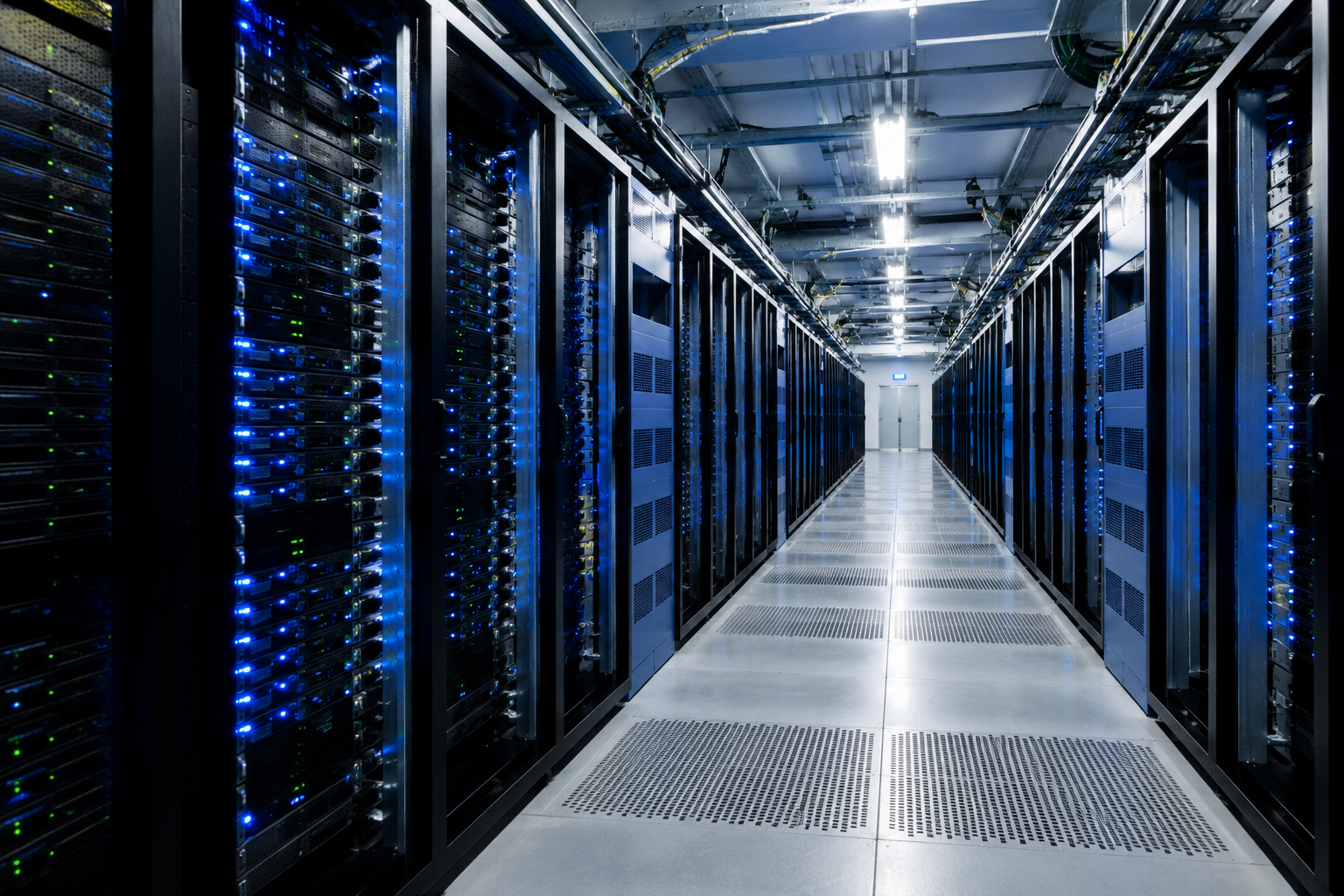
AI Growth Is Redefining Modern Data Infrastructure
Data centers around the world are undergoing major transformation as artificial intelligence increases the demand for faster computing, higher energy capacity, and more intelligent infrastructure. AI-powered applications require massive processing capabilities, forcing operators to rethink how facilities are designed, powered, and managed.
Key Developments Driving the Shift
- AI applications require significantly higher computing performance, encouraging wider adoption of GPUs and advanced processing hardware.
- Rising energy consumption is pushing operators to improve cooling efficiency and reduce operational costs.
- Data center architecture is evolving toward larger, more scalable, and AI-optimized facilities.
While much of the conversation around artificial intelligence focuses on software innovation, the infrastructure supporting these technologies is changing just as rapidly. Data centers now sit at the center of digital operations, and AI workloads are accelerating the need for a new generation of infrastructure.
AI Workloads Are Changing Demand Patterns
Traditional cloud computing workloads usually expanded at a predictable pace. AI workloads behave differently. They require greater processing power, continuous high performance, and sudden spikes in demand. Industry forecasts already suggest major increases in computing requirements and infrastructure expansion over the coming years.
This trend represents more than simple growth. It signals a structural shift in how data centers must operate to support next-generation applications.
Power Availability Has Become a Critical Challenge
In the past, efficiency improvements helped balance increasing computing demands. AI is disrupting that balance. Large AI models rely on dense computing clusters that consume enormous amounts of electricity.
For many operators, the primary challenge is no longer physical space or server availability. Access to reliable electrical power is becoming the biggest limitation. As a result, future data center expansion is increasingly tied to energy infrastructure and grid capacity.
This shift is influencing where facilities are built and how they are scaled.
High-Density Computing Is Replacing Traditional Distribution
Older data center models focused on distributing workloads across multiple systems. AI environments prioritize concentrated performance instead. Modern facilities are being designed around dense clusters capable of handling demanding computational tasks.
This transition leads to:
- Greater power usage per rack
- Increased heat generation
- Higher stress on internal infrastructure systems
The result is a move toward compact, high-performance environments designed specifically for AI-driven operations.
Cooling Systems Have Become Essential Infrastructure
One of the biggest challenges in AI-focused facilities is thermal management. AI hardware often operates continuously at high intensity, generating significantly more heat than traditional workloads.
Conventional air-cooling systems are struggling to maintain efficiency under these conditions. To address this issue, operators are adopting advanced cooling technologies such as liquid cooling and immersion systems.
These approaches provide better temperature control, improve efficiency, and help maintain stable performance under extreme workloads. Without more advanced cooling methods, large-scale AI expansion would become increasingly difficult.
Specialized Hardware Is Becoming the Standard
The hardware ecosystem inside modern data centers is evolving rapidly. Standard server infrastructure is no longer enough to support AI-intensive operations.
Operators are increasingly deploying:
- GPUs and AI accelerators
- High-speed networking systems
- Specialized processing architectures
Although these technologies improve computing efficiency and performance, they also introduce greater complexity. Integration between systems becomes more demanding, while infrastructure costs continue to rise.
Data Center Design Priorities Are Evolving
AI requirements are reshaping how facilities are planned and constructed. Operators are now designing data centers with scalability, energy efficiency, and higher density in mind from the beginning.
Key priorities include:
- Developing larger campuses for future expansion
- Using modular infrastructure for faster scaling
- Enhancing internal power distribution systems
Some companies are also exploring on-site energy generation to reduce dependence on external power grids.
Energy Strategy Is Becoming a Core Focus
As AI adoption accelerates, energy consumption continues to rise sharply. This growth is increasing concerns around sustainability and long-term operational efficiency.
To address these challenges, organizations are investing in cleaner energy solutions and optimizing energy management systems. Power strategy is no longer viewed as a secondary operational concern. It has become central to both business growth and cost management.
Investment Is Shifting Toward Infrastructure
Attention is increasingly moving beyond software applications and toward the infrastructure powering AI systems. Investors are focusing more heavily on sectors that support large-scale computing operations.
Areas attracting strong interest include:
- Data center construction
- Semiconductor production
- Energy infrastructure
- Cooling and thermal technologies
Infrastructure is evolving from a background necessity into a strategic competitive advantage.
The Future of Data Centers in the AI Era
Artificial intelligence is not simply increasing computing demand. It is fundamentally changing how data centers are built, powered, and operated.
Future success will depend on three major factors:
- Stable and scalable power access
- Efficient infrastructure design
- Rapid scalability capabilities
Modern data centers are becoming highly engineered environments optimized for continuous, high-performance AI workloads.
Conclusion
The impact of AI on global data centers is far greater than many initially expected. This transformation is not temporary. It represents a long-term shift in digital infrastructure strategy.
Data centers are no longer treated as passive operational facilities. They are becoming mission-critical assets that directly influence business performance, scalability, and technological competitiveness.
The transition is already underway, and the next generation of AI infrastructure is actively being built today.