

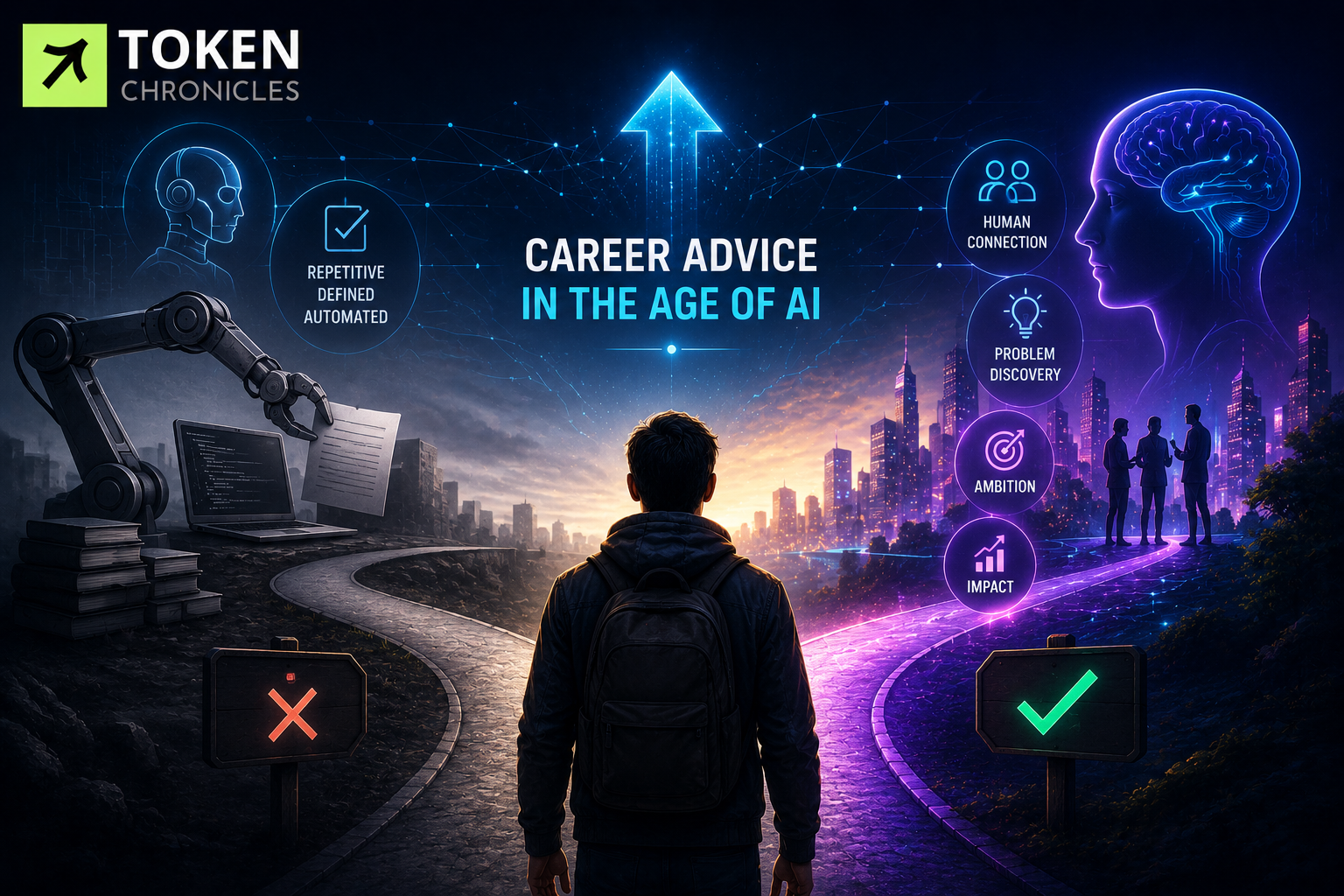
Artificial intelligence is rapidly reshaping the job market, forcing professionals to rethink which skills will remain valuable in an era where AI agents can increasingly perform coding, writing, research, and analytical tasks. As AI continues to automate well-defined work, experts argue that future career success will depend less on technical execution and more on identifying meaningful problems, exercising judgment, and building capabilities that machines cannot easily replicate.
Rather than replacing knowledge workers entirely, AI is expected to redefine how value is created, making creativity, strategic thinking, relationships, and decision-making the most important competitive advantages.
AI Excels at Solving Defined Problems
Modern AI systems continue to improve at tasks that can be clearly measured and optimized. Coding, mathematics, data analysis, document drafting, and standardized testing all fall into this category because they have objective answers and well-defined success metrics.
This has significant implications for education and employment.
Many traditional academic exercises are essentially optimization problems that AI can now solve with remarkable accuracy. As a result, future professionals will create value by working on problems that cannot simply be graded by an algorithm or solved through pattern recognition.
The ability to frame the right questions is becoming more valuable than simply producing the right answers.
Time, Relationships and Reputation Become Scarcer
While AI makes software development and content creation increasingly accessible, some resources remain impossible to automate.
Time.
Trust.
Reputation.
Strong professional relationships.
Experts argue these assets will become even more valuable as AI lowers the barriers to building products and businesses.
Choosing environments that provide exposure to exceptional people, ambitious projects, and high-quality mentorship may generate significantly greater long-term returns than simply maximizing salary.
Professional networks increasingly determine access to future opportunities, investment, partnerships, and breakthrough ideas.
Problem Discovery Will Outweigh Problem Solving
One of the biggest shifts brought by AI is changing what companies look for when hiring.
If AI agents can already solve many technical problems, employers will increasingly prioritize candidates who can identify the right problems before asking AI to solve them.
This changes hiring itself.
Traditional coding interviews focused on algorithms and memorization may gradually lose relevance.
Instead, organizations are beginning to value individuals who can quickly understand unfamiliar environments, recognize bottlenecks, prioritize high-impact work, and coordinate AI systems effectively.
In an AI-native workplace, success depends less on writing every line of code and more on directing intelligent systems toward meaningful outcomes.
Ambition Becomes a Competitive Advantage
AI is dramatically lowering the cost of building software.
This means simple applications and incremental improvements are becoming easier than ever to create.
Consequently, experts believe the greatest opportunities will increasingly belong to founders and professionals tackling difficult, ambitious problems rather than incremental ones.
When evaluating employers or startups, candidates should consider two questions:
- Is the company solving an important long-term problem?
- Does it have a realistic chance of becoming a market leader?
Working on frontier technologies or industries undergoing major transformation may provide significantly greater career leverage than optimizing mature markets.
The Final 10% Creates Most of the Value
AI can often produce functional work within minutes.
What it struggles with is refinement.
The final stage of product development polishing user experience, improving architecture, ensuring scalability, and delivering exceptional quality—continues to require human judgment and iteration.
This “last mile” increasingly separates average work from exceptional work.
As AI generates increasingly similar outputs, craftsmanship, creativity, and attention to detail become stronger differentiators.
Professionals who consistently improve beyond AI’s first draft will remain highly valuable.
Career Success Is About Opportunity and Execution
The report introduces an interesting framework borrowed from football: Expected Goals (xG).
In career terms, xG represents placing yourself where valuable opportunities naturally emerge.
Joining high-growth companies, working alongside exceptional colleagues, contributing to frontier technologies, and developing recognized expertise all increase the probability of future success.
However, opportunity alone is not enough.
Professionals must also execute effectively when those opportunities appear.
Career growth depends on maximizing both exposure to high-value environments and the ability to capitalize on them.
AI Is Making Research More Accessible
One of the most encouraging developments is that AI is lowering barriers to scientific research.
Researchers no longer require access to billion-dollar laboratories to begin contributing meaningful work.
Open-source models, public benchmarks, cloud computing credits, and accessible evaluation frameworks allow independent researchers to experiment with advanced AI systems from anywhere in the world.
Curiosity, experimentation, and persistence are becoming more important than institutional affiliation.
Many breakthroughs begin with individuals testing unconventional ideas before they attract large-scale resources.
Human Judgment Remains the Ultimate Advantage
Despite rapid advances in AI, experts argue that humans retain a fundamental advantage in selecting meaningful problems.
AI can optimize solutions.
Humans determine which problems deserve solving.
This distinction becomes increasingly important as intelligent systems grow more capable.
Organizations will rely on people to allocate resources, interpret uncertainty, understand human needs, and make decisions involving ethics, strategy, and long-term vision.
Rather than replacing human intelligence, AI is shifting its role toward higher-level reasoning and judgment.
Looking Ahead
The next decade is unlikely to reward those who simply become faster coders or more efficient content creators.
Instead, success will belong to individuals who build strong reputations, cultivate valuable relationships, embrace ambitious challenges, and learn to work alongside AI rather than compete against it.
As AI continues to automate routine knowledge work, careers will increasingly be defined by creativity, curiosity, strategic thinking, and the ability to identify opportunities that machines alone cannot see.
In the age of AI, the most valuable professionals may not be those who produce the most work but those who consistently choose the right problems to solve.