

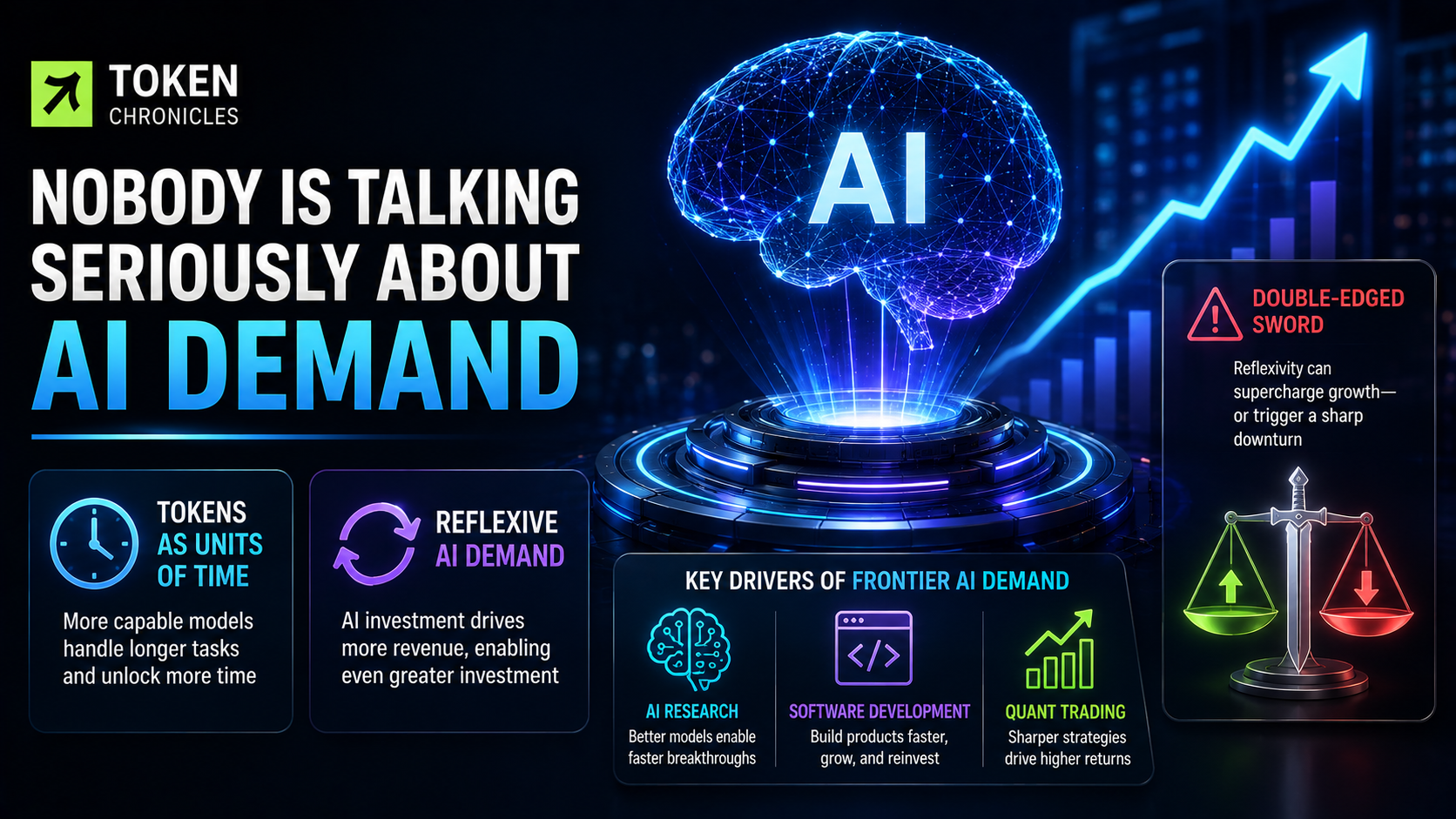
Artificial intelligence investment is accelerating at extraordinary speed, but the demand supporting that spending is receiving far less scrutiny. A new framework suggests that frontier AI demand is concentrated in a few high-value, long-horizon activities—and that the same feedback loops driving the boom could amplify a downturn if conditions reverse.
- AI infrastructure spending could reach extraordinary levels as frontier models improve.
- AI research, software development, and quantitative trading may account for a large share of frontier-model demand.
- Long-horizon, open-ended tasks have a fundamentally different economics from routine automation.
- AI demand can become reflexive, with higher spending creating more revenue and enabling still greater spending.
- The same mechanism can work in reverse, making frontier-AI demand vulnerable to a sharp cyclical slowdown.
- Capital could increasingly flow toward companies pursuing difficult, long-term problems rather than routine automation.
Why AI Demand Deserves More Attention
The AI industry has spent enormous amounts of capital expanding computing capacity, but much of the market’s analysis has focused on the supply side.
The more difficult question is whether demand will continue expanding fast enough to absorb that capacity.
Current expectations often assume that virtually every additional unit of AI computing will find a buyer. But demand ultimately determines how much frontier laboratories can afford to spend, which models customers choose, and where the economic value created by AI ultimately accumulates.
The argument presented in the source material is strongly optimistic about long-term AI adoption while warning that some of today’s demand may be self-reinforcing.
That distinction matters because a self-reinforcing market can grow extremely quickly—but can also contract rapidly when the underlying cycle turns.
Tokens Can Be Viewed as Units of Working Time
One useful way to understand AI economics is to treat model tokens as a proxy for how much work an AI system can complete over a particular time horizon.
Shorter-horizon models can handle relatively brief tasks, while increasingly capable frontier systems can take on longer and more complicated assignments.
This creates two useful classifications.
Short-Horizon vs. Long-Horizon Tasks
Short-horizon tasks are problems current AI systems can already complete reliably.
Long-horizon tasks remain difficult because they require sustained reasoning, planning, execution, or adaptation over extended periods.
As models become more capable, the boundary between the two continually moves outward.
Bounded vs. Unbounded Tasks
A second distinction concerns how much additional work is actually useful.
Bounded tasks have a natural ceiling. Tax preparation, for example, can become more efficient, but there is only a limited amount of additional tax work that needs to be performed.
Unbounded tasks have no obvious endpoint. Scientific research, software development, space exploration, chip design, and improving AI itself can continue indefinitely.
These two dimensions create a useful framework for understanding where AI spending is likely to concentrate.
Why Bounded Work Favors Cheaper AI
For bounded tasks, businesses generally want the work completed as cheaply and efficiently as possible.
Once a model becomes sufficiently capable to perform the task reliably, paying a premium for the most advanced frontier system may provide little additional benefit.
For example, a straightforward website can already be generated by many AI systems. As smaller models improve, they can capture more of this market without needing the capabilities—or pricing—of the newest frontier models.
The economics are therefore primarily about cost reduction.
Open-source models and specialized systems could become particularly competitive in this category because companies do not necessarily need the absolute best model. They need a model that is good enough to automate the job.
Unbounded Work Creates a Different Economy
The economics change dramatically when the task has no natural ceiling.
Consider AI research. There is effectively no point at which scientists can say the problem has been completely solved.
The same applies to software: companies can always build additional products, improve existing systems, or release new features.
Quantitative trading also has an open-ended character because firms can continuously search for new strategies and sources of market advantage.
For these activities, speed and capability can directly translate into additional economic value.
That makes frontier models much more attractive.
A company developing a breakthrough technology may be willing to pay substantially more for the best available model if doing so helps it move ahead of competitors.
Three Major Sources of Frontier AI Demand
The framework identifies three areas that could be responsible for a significant portion of current frontier-model revenue.
1. AI Research
AI laboratories themselves are obvious consumers of advanced computing.
Training increasingly capable models requires enormous amounts of computation, while inference can also be used for research, synthetic-data generation, experimentation, and post-training.
This creates a powerful feedback mechanism: better AI enables more effective research, which can produce better AI, which generates additional revenue and investment capacity.
2. Software Engineering
Software development is another major source of AI demand.
Startups are particularly important because they can often deploy AI-generated code quickly without the organizational constraints of large enterprises.
More efficient development can allow a startup to launch products faster, acquire customers, generate revenue, and attract additional investment.
That additional capital can then be directed toward even more AI usage.
Large technology companies can experience a similar dynamic as they compete over products, customers, talent, and market share.
3. Quantitative Trading
Financial firms may also be significant consumers of frontier AI systems.
Trading organizations can rapidly evaluate whether additional AI spending produces useful results. If a new model helps improve strategies and generates additional profits, those profits can be reinvested into further AI experimentation.
The result is another potential feedback loop between AI expenditure and financial returns.
Taken together, these categories could represent a substantial share of frontier-model inference revenue, according to the framework presented.
The AI Boom Could Be Reflexive
The most important concept in the analysis is reflexivity.
In a reflexive system, spending can create the conditions for even more spending.
For example:
AI investment → better capabilities → higher revenue → greater funding → more AI investment.
The same pattern can occur in software startups and quantitative trading.
A startup spends more on AI, builds products faster, grows revenue, raises more capital, and then purchases additional AI capacity.
A trading firm spends on advanced models, improves its strategies, earns higher returns, and reinvests those gains into more computing resources.
This creates a potentially powerful growth engine.
Why Reflexivity Can Become Dangerous
The same feedback mechanism that accelerates growth can also magnify a downturn.
If one major source of frontier-AI demand weakens, the impact may spread to the others.
A slowdown in AI-company revenue could reduce investment. Lower venture funding could hurt AI-heavy startups. Weaker financial markets could reduce trading profits and therefore quantitative firms’ technology budgets.
The result could be a chain reaction in which several major AI customers reduce spending simultaneously.
This makes frontier-AI demand potentially highly correlated and procyclical.
In a strong market, spending accelerates. In a weak market, spending could contract faster than conventional demand models suggest.
What Could Trigger a Downturn?
Several factors could potentially disrupt the cycle.
Possible catalysts include:
- Tighter regulation that slows AI development or deployment.
- Higher interest rates that make large infrastructure investments more expensive.
- An external economic or financial shock that reduces available capital.
None of these scenarios necessarily implies a permanent decline in AI demand.
The concern is that even a temporary slowdown could have an outsized effect if the major sources of frontier-token consumption are tightly connected.
Why AI Demand Needs Its Own Model
AI investment decisions have traditionally emphasized the supply side: chips, data centers, electricity, networking equipment, and model capacity.
A complementary demand model could help investors determine whether planned infrastructure spending is supported by sustainable economic activity.
This becomes increasingly important as annual AI capital expenditure and laboratory revenues reach unprecedented levels.
The goal would not simply be to estimate how many tokens the world can consume, but to understand who is consuming them, why they need frontier models, and whether that demand generates enough economic value to sustain the spending.
Where Could the Long-Term Value Accumulate?
The framework also suggests that the economic impact of AI may extend beyond data centers and semiconductor companies.
Routine, bounded work is likely to become increasingly automated. Over time, some economic value currently associated with human labor could shift toward the computing infrastructure required to perform those tasks.
However, the largest opportunities may emerge from unbounded problems.
Companies capable of using AI to tackle scientific discovery, advanced engineering, software creation, financial optimization, and other open-ended challenges could potentially capture much greater economic value.
In this scenario, investors may increasingly reward teams based on their ability to allocate enormous amounts of capital toward long-term objectives rather than simply generating predictable near-term cash flow.
The Market Could Begin Valuing Long-Term Ambition Differently
Traditional financial analysis generally places a premium on predictable recurring revenue and discounts businesses that require large amounts of uncertain research spending.
An AI-driven economy could eventually reverse some of those assumptions.
If investors become convinced that a company can deploy enormous amounts of computing resources effectively toward difficult, long-term objectives, they may place substantially greater value on that capability.
The source material points to companies such as Tesla and SpaceX as early examples of markets assigning significant value to ambitious long-term capital allocation.
As AI capabilities expand, more companies could potentially pursue projects that would previously have required several human lifetimes to complete.
The Bigger Question: Who Can Sustain Frontier Demand?
The AI boom is increasingly becoming a question of demand quality rather than simply demand quantity.
Routine automation could generate enormous volumes of AI usage, but those workloads are likely to migrate toward cheaper and increasingly capable models.
The most valuable frontier demand may instead come from problems where more intelligence, more speed, and more computation directly create additional economic value.
That makes AI research, advanced software development, and quantitative trading particularly important to the current frontier-model economy.
The central risk is that these same industries are tightly connected to capital markets and economic cycles. If that reflexive loop remains positive, frontier AI could experience extraordinary growth. If it reverses, however, the contraction could be just as powerful. Understanding that demand cycle may therefore become one of the most important questions for AI investors and infrastructure builders over the next several years.