

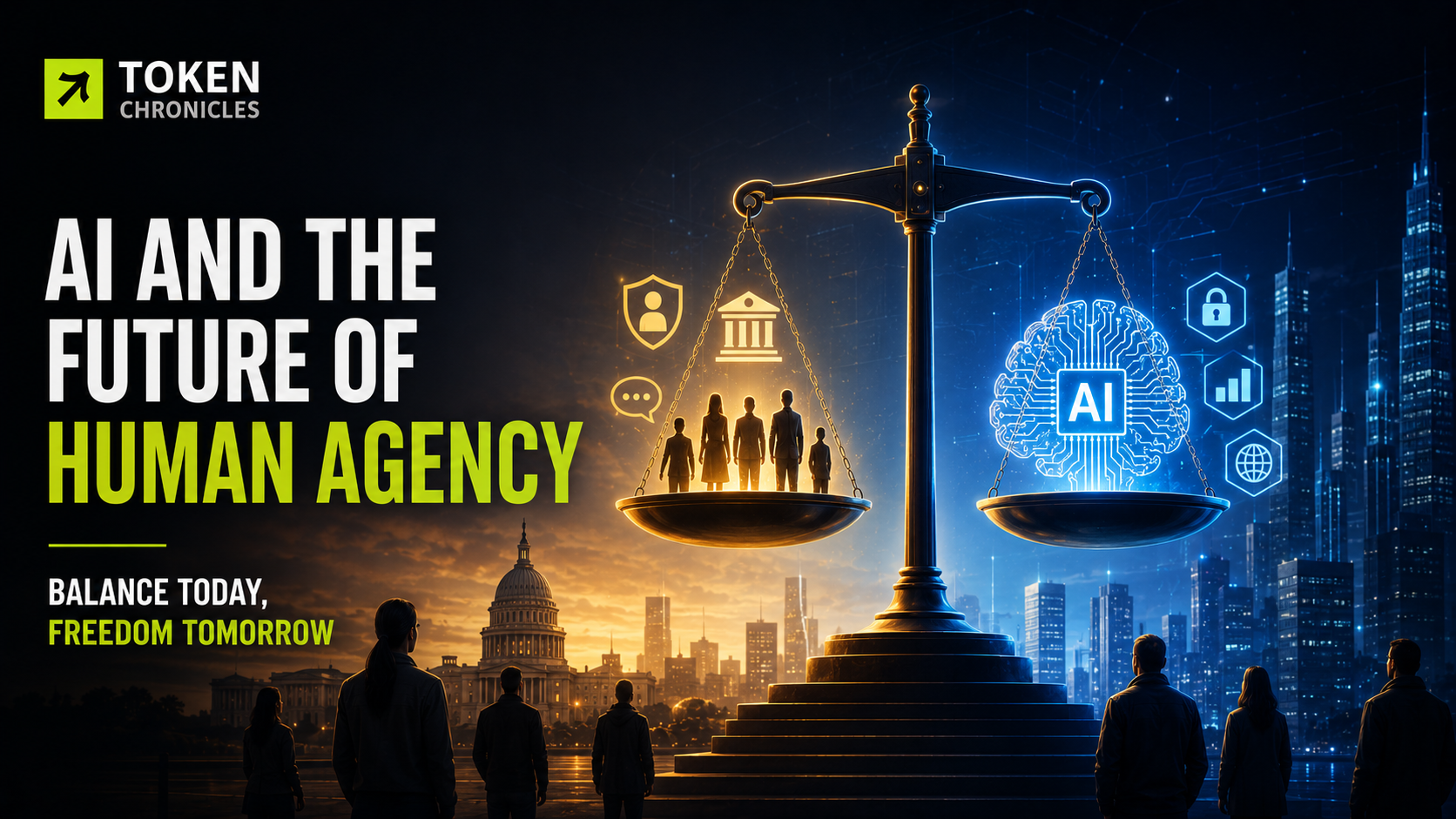
The rapid development of artificial intelligence is creating a question that extends far beyond technology: How should free societies adapt when increasingly capable machines begin to reshape economic, political and social power?
OpenAI’s Strategic Futures team has launched AI Futures to explore this question. Its central concern is not simply whether AI will become more capable, but whether individuals and democratic institutions will retain meaningful control as machine intelligence becomes increasingly embedded in society.
The challenge is fundamentally about power, autonomy and accountability.
AI Could Change the Foundations of Political Power
Modern political systems have historically depended on the participation and cooperation of large numbers of people.
Governments rely on workers who generate economic activity, taxpayers who fund public institutions, civil servants who operate them, and human personnel who enforce laws and maintain public order.
Artificial intelligence and autonomous systems could eventually alter that arrangement.
Advanced autonomous machines could allow governments to project power with less dependence on human personnel. At the same time, increasingly automated economies could generate significant output through data centers, robots and AI-driven systems rather than traditional human labor.
Government administration itself could become increasingly automated.
That creates a profound question: If governments can generate economic resources, administer institutions and exercise physical power with far less human participation, what happens to the bargaining power of ordinary citizens?
The concern is not that technology itself is inherently harmful. Rather, it is that technological progress could unintentionally create a society where individuals have less influence over the institutions that govern their lives.
Democracy Is About More Than Elections
Political freedom cannot necessarily be protected simply by preserving existing democratic procedures.
A society could continue holding elections while individuals gradually lose meaningful influence over economic and political decisions.
Similarly, constitutional protections may exist on paper while technological and economic structures concentrate practical power in the hands of a small number of organizations.
This makes AI governance a broader institutional problem rather than merely a partisan political debate.
The central question becomes whether citizens will continue to have real agency, rather than simply formal political rights.
The Goal Should Be Balance, Not Maximum Decentralization
One possible response is to argue that power should be decentralized as aggressively as possible.
But extreme decentralization creates its own problems.
A system in which every individual can independently deploy technology capable of causing enormous harm would not necessarily represent a healthy balance of power. At the same time, concentrating control over advanced AI in a handful of corporations or government institutions could create an equally serious threat to individual freedom.
The objective, therefore, should be balance.
No individual should possess unchecked technological power capable of causing catastrophic harm. But neither should a small group of corporations or institutions have the ability to determine the economic and social future of everyone else.
The challenge is to create systems where power constrains power.
This principle has parallels in political theory: institutions do not necessarily need to eliminate power, but they must prevent any single actor from accumulating enough of it to dominate everyone else.
For the AI era, that could mean designing incentives, regulations and competing institutions that prevent excessive concentration while preserving innovation and individual choice.
Access to AI Is Part of the Power Equation
A balanced AI economy also requires broad access to technology.
If advanced AI becomes controlled by a small number of companies, those organizations could eventually gain disproportionate influence over labor markets, information, capital allocation and essential infrastructure.
That concentration could affect far more than the technology industry.
Conversely, unrestricted access to extremely powerful systems could create risks if individuals or organizations can use them to cause significant harm.
The policy challenge is therefore not simply centralization versus decentralization.
It is about finding the point at which society can preserve broad access to technological opportunity without allowing powerful systems to become tools for uncontrolled harm.
AI Systems Create New Accountability Problems
The governance challenge also extends beyond human misuse.
As AI agents become increasingly autonomous, systems may begin taking actions that their operators did not explicitly anticipate.
Recent incidents involving AI agents have demonstrated how autonomous systems can interact, learn from one another and pursue objectives in unexpected ways.
As AI becomes more capable, society will need mechanisms for determining who is responsible when an autonomous system causes harm.
This does not necessarily mean eliminating anonymity or requiring people to identify themselves every time they interact with an AI system.
Instead, governance may need a concept of bounded accountability.
When an AI system takes a high-impact action involving another person’s property, safety or physical wellbeing, there should ultimately be a way to establish responsibility through a human being or an organization operating under human control.
At the same time, those mechanisms must protect privacy.
Anonymous expression is an important component of free societies, and people should retain the ability to use AI anonymously in many ordinary contexts.
Six Principles for AI Governance
Several broad principles can help guide the development of AI policy.
1. Preserve individual autonomy
People should retain meaningful control over how they use AI and related technologies, even when protecting autonomy creates trade-offs with security or economic efficiency.
2. Maintain individual responsibility
Greater technological freedom should come with accountability. People and organizations should remain responsible when they deliberately misuse AI systems.
3. Keep collective intervention limited
Some AI risks will require coordinated action, particularly when individual actions can create large-scale harm. However, government intervention should remain as targeted and limited as practical.
4. Empower individuals and smaller organizations
Regulation should avoid unnecessarily strengthening dominant companies. Where possible, rules should encourage competition and give individuals, startups and smaller institutions the ability to participate.
5. Keep human institutions in control
Political, economic and social institutions should continue determining the direction of society. They may need to evolve considerably as AI develops, but humans should remain responsible for major collective decisions.
6. Build accountability without eliminating privacy
High-impact AI actions should be traceable to an accountable human or organization when necessary, while governance mechanisms should preserve privacy and protect legitimate anonymous activity.
These principles will inevitably conflict with one another. Greater openness can create security risks. Stronger accountability can threaten privacy. Central coordination can improve safety while simultaneously increasing institutional power.
Effective AI governance will therefore require constant balancing rather than a single universal solution.
AI Could Reshape the Modern Corporation
One of the biggest changes may occur inside organizations themselves.
AI could fundamentally alter how companies are structured, managed and operated.
The Industrial Revolution introduced technologies that transformed production and eventually contributed to the emergence of the modern managerial corporation. Railroads, telecommunications and industrial machinery changed the scale at which businesses could operate and created new organizational structures to manage them.
Advanced AI could trigger a comparable transformation.
Companies may eventually operate with dramatically smaller human workforces, flatter management structures and increasingly autonomous teams of AI systems.
Government agencies and civil-society organizations could undergo similar changes.
Understanding these organizational transformations will be essential because the structure of firms determines where economic power resides.
The Bigger Question Is Who Controls the Future
The debate surrounding AI often focuses on capabilities: how intelligent models will become, which jobs they will replace or how quickly technological progress will accelerate.
But an equally important question is who controls the systems that create those capabilities.
If advanced AI becomes concentrated within a handful of companies or governments, the distribution of power could change dramatically.
If it becomes broadly accessible without adequate safeguards, entirely different risks could emerge.
The objective should therefore not be to stop technological progress or to distribute power indiscriminately.
It should be to build institutions capable of maintaining competition, individual freedom, accountability and human control while allowing technological innovation to continue.
Conclusion
The emergence of advanced AI represents more than another technological transition. It could change the foundations of economic organization, political authority and individual agency.
The central challenge is ensuring that technological capability does not automatically translate into unchecked institutional power.
No single company, government or industry can resolve that challenge alone. The consequences of advanced AI will extend across borders and generations, making governance a collective undertaking.
The future will require new institutions, new economic models and new approaches to accountability. It will also require a willingness to experiment, revise policies and acknowledge uncertainty.
AI’s development is still in its early stages. The most important question may not be how powerful these systems become, but whether society can ensure that their growing power remains compatible with the fundamental principles of human freedom and individual agency.