

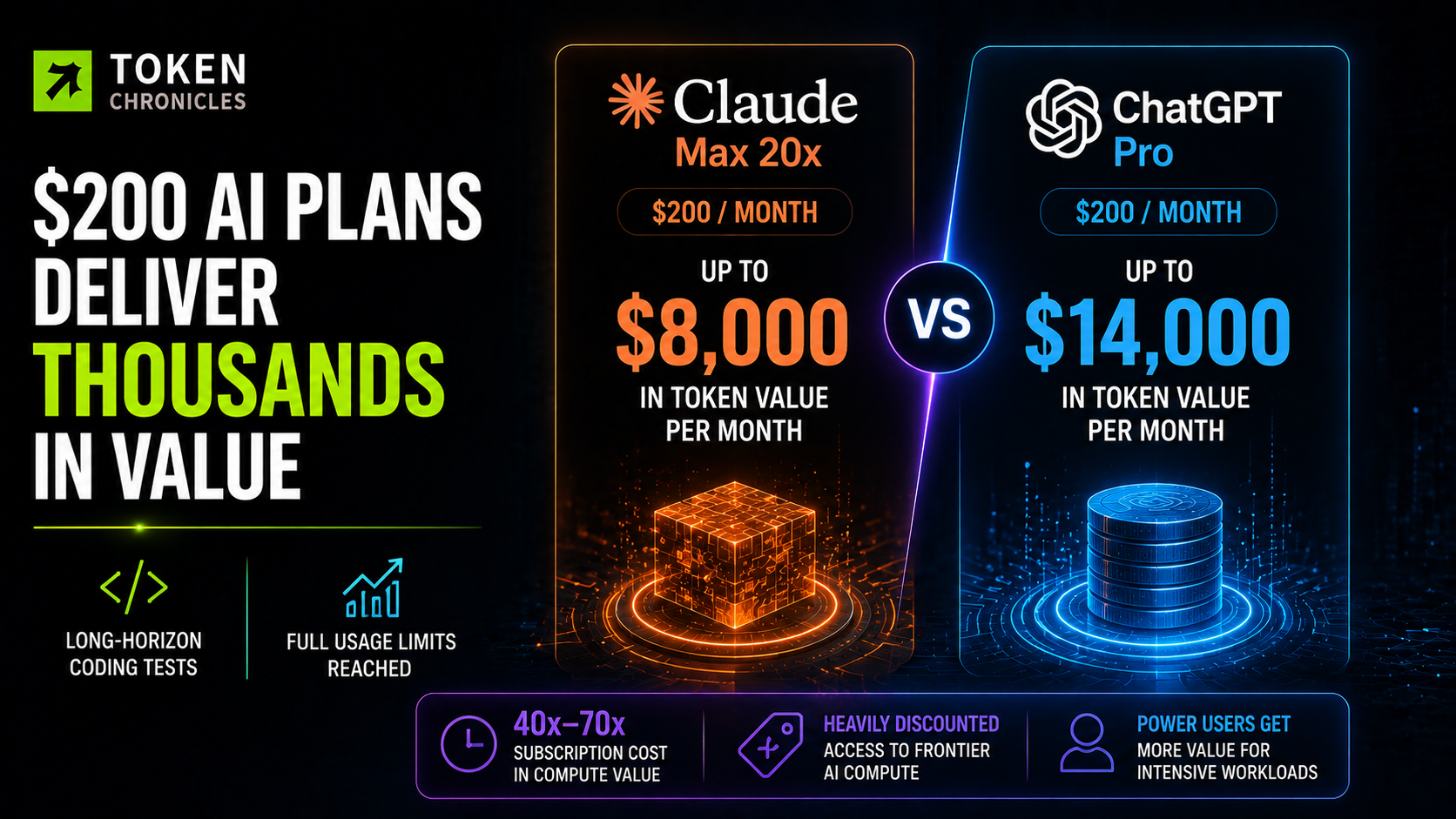
A SemiAnalysis analysis of Anthropic and OpenAI’s highest-tier $200 monthly plans suggests that heavy users can extract significantly more value than the subscription price implies.
The researchers stress-tested Claude Max 20x and ChatGPT Pro by running extended coding and agentic workloads until their weekly usage limits were reached. Based on tests conducted in June 2026, the estimated API-equivalent value of the consumed tokens was substantially higher than the monthly subscription fees.
Key findings
- Anthropic’s Claude Max 20x: up to roughly $8,000 in monthly API-equivalent token value.
- OpenAI’s ChatGPT Pro: up to approximately $14,000 under the tested conditions.
- Both plans cost $200 per month, meaning heavy users could receive compute value many times greater than the subscription price.
- The estimates challenge the common assumption that a $200 AI subscription provides only around $2,000 worth of API-equivalent usage.
Subscription plans are effectively subsidizing compute
The results point to a growing gap between the price consumers pay for premium AI subscriptions and the underlying computational value they can potentially consume.
For developers and other power users running long coding sessions or autonomous AI agents, these plans can provide access to large quantities of frontier-model inference at a fixed monthly cost.
That makes the economics very different from conventional software subscriptions, where the marginal cost of intensive usage is generally limited.
Instead, premium AI plans increasingly resemble discounted access to high-end compute, with providers absorbing part of the inference cost in exchange for subscription revenue and user retention.
OpenAI showed the larger potential value
Under SemiAnalysis’ testing methodology, ChatGPT Pro generated the highest estimated token-equivalent value, reaching approximately $14,000 at maximum utilization.
Claude Max 20x reached roughly $8,000, still representing about 40 times the $200 subscription price.
The figures are estimates based on API pricing rather than cash that users could directly recover. Actual value also depends on the type of workload, model used, token mix and whether a user can realistically reach the platform’s usage limits.
The bigger AI economics story
The findings highlight a broader shift in the AI industry: consumer subscriptions are becoming a mechanism for distributing large amounts of compute at prices far below their potential API-equivalent cost.
For occasional users, the difference may be largely irrelevant. But for developers running intensive agentic workflows, the gap between subscription pricing and underlying compute value can be substantial.
As AI companies continue competing on models, usage limits and subscription tiers, the economics of who subsidizes compute, how much power users consume and whether these plans remain sustainable could become an increasingly important part of the AI business model.